

Audio By Carbonatix
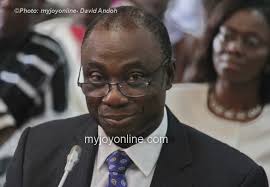
Former Power Minister, Dr. Kwabena Donkor has maintained that Power Purchasing Agreements (PPAs) signed under the erstwhile John Mahama-led government is the cheapest compared to recent agreements.
According to Dr. Donkor, the Ameri deal for instance, which was brought in under an emergency plan, remains the cheapest among existing thermal plants across the country.
The Country Director of the World Bank in Ghana, Mr. Pierre Frank Laporte in a recent interview with Joy Business, among other concerns, criticised the Power Purchasing Agreements signed by the government, stating that they were expensive and burdened the country with paying for unused energy due to "take or pay contracts."
Speaking to the media at a press conference to address the issue, the former power minister described Mr. Larporte's claim as "unfortunate."
"We brought in the Ameri power plant as an emergency power plant. The plant had a capital recovery cost of USD 0.055 per kilowatt hour for year one to five. It has a capital recovery price of USD 0.00 from the 6th to 20th year. Therefore, for its 20-year minimum lifespan, the levelled capital recovery was USD 0.2377. So we have a capital recovery of USD 0.0233, and that makes it the cheapest thermal plant in Ghana in terms of capital recovery," he said.
He continued that "for comparison, when we take the Sunon Asogli Power Plant (SAPP) phase 1, the capital recovery was initially 0.0523 negotiated in 2007, which was later renegotiated down to 0.0395 when the phase 2 and 3 were being added during the period of emergency under John Mahama. If you take the Takoradi International Company (TICo), the capital recovery was 0.0365 in 2007. Another IPP, Jacobson, which was brought in in 2014, had a capital recovery of 0.03788, again lower than SAPP phase 1. The Tema Thermal Plant 2 Power Plant (TTP2PP) owned by VRA has a capital recovery of 0.0309, which are all higher than Ameri."
The Minister said it is important to address these issues because "the World Bank Country Director created the impression that all the power purchase agreements signed under the John Mahama regime were higher, expensive, and in his view, contributed towards the challenges of the power sector today.
“I would have wished that the Country Director had gotten back to his researchers to get a holistic picture of the issue.”
JUSTIFICATION FOR TAKE-OR-PAY
According to Dr Donkor, the 'take-or-pay contracts' have become inevitable in Ghana's PPAs because it is needed to guarantee returns for the investors; the reason why "every single fuel and power purchase agreement after 2016 has had a pay or take component in it."
"Take-or-pay is a reality in our situation because of confidence. If you take a 330MW combined cycle plant, it will cost about $500m in our sub-region.
“Is the World Bank Country Director saying that the International Finance Corporation (IFC), which is an arm of the World Bank, will finance a project worth $500m and will not demand a guarantee or an off-taker agreement?" he quizzed.
Dr. Donkor believes that the World Bank Country Director's comment was to find fault with the previous government, to please the government in power.
He has also advised the government to convert all single cycle plants to combine cycle plants to improve production at lower cost.
Latest Stories
-
UK pledges additional £50 million to help contain Ebola outbreak in Congo
1 minute -
Oil prices extend gains as US and Iran trade fresh strikes
10 minutes -
Dropbox says about 5,000 accounts compromised in August hack
18 minutes -
Could Tupac verdict inspire new efforts to find killer of his rival the Notorious B.I.G.?
25 minutes -
District Assembly elections set to become major flashpoint in constitution review
34 minutes -
NPP warns government against taking control of constitutional referendum campaign
52 minutes -
NPP set to challenge government’s position on constitutional reforms
1 hour -
Algeria president seeks death penalty for arsonists after deadly forest fires
1 hour -
‘I have fired 40 of my agents for being corrupt’, says Nigeria’s anti-corruption chief
2 hours -
Urine test can spot more than nine in 10 bladder cancers
2 hours -
Iran retaliates after US strikes kill four at wedding party, state media reports
2 hours -
Germany says Russia behind Leipzig airport drone attack
2 hours -
Constitution Review: Committee won’t rubber-stamp govt’s proposals, says Barker-Vormawor
2 hours -
We’ll translate political decisions into law, not make them, says Barker-Vormawor
3 hours -
‘I’ll get better’ – how did Alcaraz look on winning singles return?
3 hours