

Audio By Carbonatix
Sierra Leoneans are awaiting general election results following a tense campaign marred by violence.
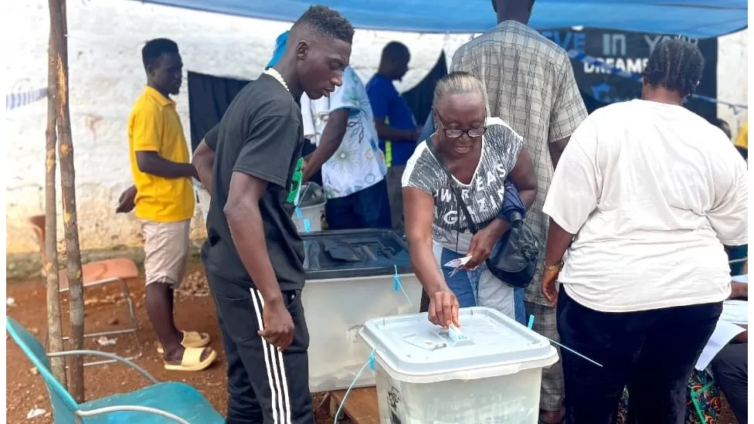
There was a high turnout, with voters telling the BBC the process was smooth despite ballots opening hours late in many areas.
There had been concern about potential clashes in the run-up to the vote.
On Wednesday, the main opposition party alleged that one of its supporters was shot dead by police, which the police have denied.
Supporters of both main parties have been accused of attacking opponents.
Accusations of election irregularities were also being thrown on Saturday after the leader of the opposition alleged ballot stuffing and voter suppression in some parts of the country.
However, the electoral body had insisted, in a press conference earlier this week, that they had mechanisms in place to ensure a fair vote. Local media reports that arrests were made.
The election is taking place against the background of a troubled economy, the rising cost of living, and concerns about national unity.
The voters are choosing a president, MPs and councillors in the West African country's fifth election since the civil war ended in 2002.
The 11-year conflict cost an estimated 50,000 lives, but since then the country has a tradition of largely peaceful, free and credible elections, according to Marcella Samba Sesay, chairperson of the NGO National Elections Watch.
With strong party loyalty among the 3.3 million registered voters, the campaigns have focused on shoring up their parties' bases rather than articulating and debating policy issues.
However, voters have told the BBC, they want to see concrete change in the country.
"I want a responsible government that will provide jobs, education, improve healthcare and also ensure food security. I expect the new President to work for the nation," Solomon Beckley from Freetown said.
Who are the candidates?
President Julius Maada Bio, 59, of the Sierra Leone People's Party (SLPP) is running for a second five-year term. His main rival among the 12 challengers is Dr Samura Kamara, 72, of the All People's Congress (APC).
This is a repeat of the race in 2018, which saw Mr Bio narrowly win following a second round run-off.
How much violence has there been?
There has been an uptick in violence compared to five years ago, according to the West Africa Network for Peace-building Sierra Leone. It has counted 109 violent incidents since April.
This week, the APC said one person was killed by security forces as its supporters gathered for a protest at its headquarters in Freetown on Wednesday.
The police alleged the shots were fired from the direction of the APC building.
Dr Kamara has also said that his motorcade came under attack and there were reports that the APC office was set ablaze in the city of Bo last weekend.
The SLPP has said that it too has faced attacks in opposition strongholds.
President Bio has called for "peaceful elections" and "no violence". The African Union has also expressed concerns over reported incidents of violence and intimidation in parts of the country.
Sierra Leoneans have been alarmed by campaigners' rhetoric, the Reuters news agency reports.
"All I want is peace. I am scared by the high level of hatred I see being exhibited on social media by political extremists on both sides," a student from Freetown who wanted to remain anonymous told Reuters.
What about women?
This election comes months after a landmark law which says women must make up 30% of all positions in both the public and private sector - including in parliament.
But analysis from Sierra Leone's Institute for Government Reform (IGR) suggest the next parliament will fall short of this.
Parties have put forward lists of candidates running in each of the country's districts to be elected on a proportional representation basis. But according to the IGR, not enough women are placed high enough on those lists to make sure the 30% threshold is crossed.
Out of the 13 candidates running for president only one is a woman - the little-known Iye Kakay.
How does the election work?
The APC has also expressed concerns about the transparency of the counting process and has cast doubt on the electoral commission's ability to hold fair elections.
The commission has defended itself, saying measures have been put in place to ensure the credibility of the voting and counting process.
Results should be known within the next few days.
To be declared the winner of the presidential race, the leading candidate must secure 55% of the votes cast, otherwise a run-off will be held between the two candidates with the highest number of votes.
Latest Stories
-
NSMQ 2026: Yaa Asantewaa Girls’ going ‘beck’ to Tanoso after Bishop Herman deals them early exit
3 minutes -
Data Protection Commission acquires two vehicles to strengthen data protection enforcement
13 minutes -
NSMQ 2026: Holy Child School storms back from two-year NSMQ absence to book One-Eighth ticket
2 hours -
GNFS dismisses reports of unpaid 2025 rent allowance
3 hours -
Gordon Asare-Bediako steps down from NPP Communications Director race, backs Dennis Aboagye
3 hours -
GES dismisses requirement for newly promoted teachers to submit documents for salary adjustments
3 hours -
Meko Bono 2026: Vice President pledges agricultural revival as Atebubu hosts grand homecoming
4 hours -
Russian skydiver Sergey Boytcov sets world record with 11,551-metre stratosphere jump
4 hours -
Ablakwa-led committee submits five reports to Mahama ahead of 2027 AU chairmanship
4 hours -
Africa not seeking Western cash in reparations campaign – Ablakwa
5 hours -
Production decline, reserve depletion threaten Ghana’s upstream sector – Jinapor
5 hours -
Surveyors caution against treating compensation disputes as professional misconduct
5 hours -
Mahama calls for AU dialogue on migration after South Africa xenophobic tensions
5 hours -
I haven’t experienced any envy in the gospel music industry — Ohemaa Mercy
6 hours -
Prayer does not solve everything — Ohemaa Mercy
6 hours