

Audio By Carbonatix
Macroeconomic modeling in Ghana appears to be on the right track, according to the African Development Bank's latest report on Benchmark Macroeconomic Models for Effective Policy Management in Africa.
The report aims to take an inventory of models currently used by countries, gaining a better understanding of their features and predictive capacities to diagnose existing capacity needs in African institutions.
Although the financial agency pointed out some limitations in Ghana’s macroeconomic modeling, it predicts that improved global macroeconomic conditions, strong domestic demand, and growth in capital expenditure are expected to lead to the reboot of economic activity in Ghana.
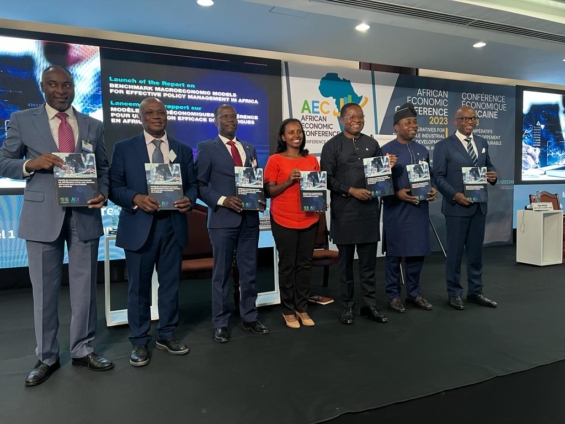
Details of the African Development Bank’s report on Benchmark Macroeconomic Models for Effective Policy Management in Africa were revealed at the launch of the document on the sidelines of the 2023 Africa Economic Conference in Addis Ababa, Ethiopia, where stakeholders reflected on the “Imperatives for sustainable industrial development in Africa."
In his address to the Gathering Chief Economist and Vice President of the Bank, Professor Kevin Chika Urama noted that “Macroeconomic models provide the tools for countries to effectively understand and predict the behaviour of their economies, analyse policy response options, evaluate possible outcomes, and guide their implementation, monitoring and evaluation. But models are only attempts to simplify realities in a logical manner to inform decision-making under specific assumptions, contexts and realities”.
He added that “While some argue that economic development is often a gamble, it has become evident that having sound models that are embedded in national realities improves the probability of winning the gamble”.
“Strengthening capacity in macroeconomic modelling is therefore critical to inform a better understanding of the dynamics of economies, formulation of good policy responses and prioritization, and shape effective policy implementation, monitoring and evaluation,” the chief economist noted.
Country report on Ghana
Survey Findings
2.1 Status of Macroeconomic Models/Frameworks at the Central Bank of Ghana
Survey data from the Central Bank of Ghana reveal a suite of macroeconomic tools used for macroecoenomic management. This includes the Quarterly Projection Model (QPM), which was developed locally with external support and is used for medium-term macroeconomic forecasting, simulation, and poli cy analysis. There is also a suite of models such as VAR, ARIMA, and Dynamic Factor Models as well as Machine Learning for nowcasting inflation and GDP.
The Bank also uses a Macroeconomic framework that was developed by local and foreign experts. This framework is used to generate medium-term forecasts for key macroeconomic variables. In addition, there is also a Debt Sustainability Analysis Framework (DSA) to analyze the debt dynamic and profile in Ghana. The DSA was also developed by both local and external experts. Lastly, the Central Bank highlighted that, generally, all their models are flexible enough to accommodate emerging issues.
Challenges in Macroeconomic Models/Frameworks
Despite the extensive support with continuous technical support from the IMF and training on various macroeconomic modelling courses organized by the IMF and other regional Central Banks, the staff has indicated that the most significant challenge in macroeconomic modelling are the occasional significant revi sions of GDP figures. The staff also indicated that the changing macroeconomic structure in Ghana requires additional satellite models as inputs into the QPM.
Conclusion
Macroeconomic modelling in Ghana appears to be on the right track. One area of improvement should be enhancing the capacity of the staff on suitable expansions of the QPM to allow for responsiveness to the changing economic structure.
Another is to enhance the capacity of staff on methods to control for the constant revisions of GDP data.
More on the report at https://www.afdb.org/en/documents/benchmark-macroeconomic-models-effective-policy-management-africa
Latest Stories
-
Scrap 15% priority placement quota for SHS admissions – GNAPS
4 minutes -
IFC Managing Director Makhtar Diop to visit Ghana for investment talks
11 minutes -
GPRTU opposes auctioning broken-down vehicles after 21 days
38 minutes -
Nigerian Goodnews Aina crowned J30 Accra champion as Ghana’s Gwendolyn Duvor Klu retires in final
3 hours -
WACCE urges gov’t to declare state of emergency in galamsey-prone areas
3 hours -
NACOC boss calls for practical cross-border action against drug trafficking
3 hours -
Ghana calls for stronger regional cooperation to combat drug trafficking
4 hours -
Ablakwa presents bicycles to 100 North Tongu day students
4 hours -
Ablakwa supports 2,269 North Tongu SHS students with essential items
4 hours -
Dr Bawumia expresses sympathy with farmers over their inability to sell their produce even at reduced prices
4 hours -
Constitutional review: Govt must keep discussions open – Dr Tandoh
4 hours -
GPL 2026/27: David Gyamfi hat-trick fires Ashantigold to historic first victory
4 hours -
Ericsson celebrates 150 years of global innovation, 30 years of partnership and digital transformation in Ghana
5 hours -
Ghana’s Ambassador to Serbia hosts African ambassadors’ September meeting in Belgrade
5 hours -
Ghana closer to terrorism threat than ever before – WACCE
5 hours