


Audio By Carbonatix
A medical sociologist and migration health researcher at the Kwame Nkrumah University of Science and Technology, Dr. Dr. Seth Christopher Yaw Appiah is advocating a review of Ghana’s migration policies to include climate-induced migration.
He believes the move will address migration issues caused by climate change.
“In Ghana, we have the national migration policy and the national labour migration policy but they don’t focus on how climate change induces migration. There is some silence on that,” he noted.
Speaking at the Historical Ties and Multiple and Recurring Climate-Induced Displacements Study (Histo-MultiClimDis Study) symposium, Dr. Appiah indicated the creation of the Migration Commission will be crucial in overseeing climate-related issues.
“There was supposed to have been the establishment of the Migration Commission similar like CHRAJ they will look at all migration-related issues,” he explained.
The symposium which was under the aegis of the Department of Sociology and Social Work of KNUST was themed: “Post COP28, an integrated and interdisciplinary response to climate migration or immobility and social determinants of health in Ghana.”
The event brought together historians and sociologists to discuss the issue of climate migration.
Dr. Dr. Seth Christopher Yaw Appiah who is the Principal Investigator of the Histo-MultiClimDis Study and senior lecturer at Department of Sociology and Social Work was also worried about the continuous displacement of residents around the Bagre dam.
He says climate mitigation and adaptability responses will lead to the reduction of problems caused by the situation.
“A lot of health effects come out of this Bagre Dam spillages, and it’s become cyclical. But when can we have a minimal effect?
“If we’ve done climate mitigation and climate adaptability responses then the people who would have to move and people who are will be trapped, there will be some social protection interventions for them,” he said.
Other speakers included Professors Samuel Adu Gyamfi from the Department of History and Jonathan Mensah Dapaah from the Department of Sociology and Social Work who explored the phenomenon.
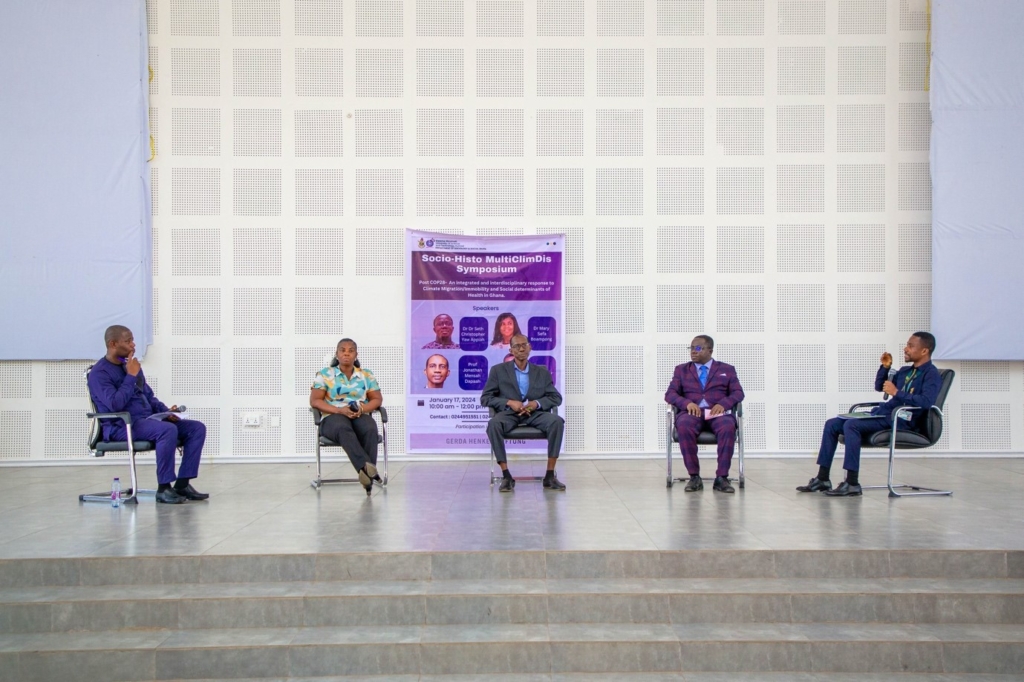
Prof. Jonathan Mensah Dapaah added: “Government and city authorities need to put in place social policies. That will go a long way to help those demographics. Some of them don’t have anywhere to go.”
Prof. Samuel Adu Gyamfi encouraged researchers to delve into the situation to properly tackle the problems associated with the spillage.
“We need our researchers to have longitudinal evidence-based study to know why people are refusing to migrate and if they’re migrating, what’s the nature of response, so we can give the assurances that indeed when they move to this place, they’re assured of their safety,” he said.
The Histo-MultiClimDis study is supported by Gerda Henkel Stiftung Germany.
Latest Stories
-
Today’s front pages: Friday, August 21, 2026
6 minutes -
Power outages could drive up cost of digital services — NITA
8 minutes -
Only 16% of Ghana health facilities meet basic sanitation standard — WHO / UNICEF
15 minutes -
Competence has no age; let’s stop punishing new businesses
31 minutes -
JoyNews Republic Bank Habitat Fair 2026 opens today at Achimota Mall
34 minutes -
What Is Wrong With Us: The roads that keep counting our dead
38 minutes -
MTN condemns recent xenophobic attacks on Ghanaians in South Africa
42 minutes -
Philip Nai: What happens at your front desk can make or break your brand
54 minutes -
Ghana’s mining deaths fall sharply, but Chamber insists ‘three deaths are too many’
2 hours -
Tatale Sanguli officials destroy expired food products, warn traders
2 hours -
Police arrest two watchmen over alleged defilement of 14-year-old student
2 hours -
The woman behind General Mosquito: Could Ghana be meeting its next First Lady?
2 hours -
Court remands man over alleged Labone bank robbery attempt
3 hours -
Supreme Court to rule on injunction application on legal vacation today
3 hours -
Tamale Metropolitan Assembly distributes 10,000 bags of fertiliser to farmers
3 hours