

Audio By Carbonatix
Designing Artificial intelligence to help people with disabilities has become crucial for ensuring inclusivity in the AI space.
It is therefore one of the focus of The Artificial Intelligence for Development in Africa (AI4D Africa) program phase 2.
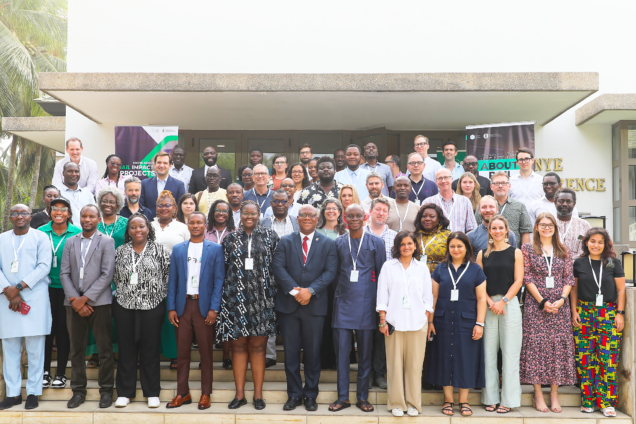
In a workshop hosted in Accra by the Responsible AI Lab(RAIL) at the Kwame Nkrumah University of Science and Technology participants including AI stakeholders, funding agencies like GIZ, FCDO, USAID, IDRC, Bill and Melinda Gates Foundation, Lacuna Fund, Mozilla Foundation, Google, documentary makers, and evaluators (Genesis Analytics) discussed plans for the future and the project’s next phase.
The discussions centered on readiness to scale and responsible AI framework for Africa. They again delved into ways to strengthen research for policy change, language models as well as means to ensure effective collaboration.
“Much effort has been put into planning the AI4D Phase 2 workshop because RAIL cherishes its relationship with its funders and stakeholders. Like a mustard seed, the AI4D project has started small but has significant potential to influence and impact Africa and the world,” said Prof. Jerry John Kponyo, Principal Investigator and Scientific Director, RAIL.
Laurent David Elder of International Development Research Centre (IDRC), emphasized the importance of policy and innovation in driving AI4D Africa vision.
“Policy is creating responsible AI governance in the continent, and innovation on responsible AI should be scaled to address developmental challenges,” he said.
About AI4D Africa
The Artificial Intelligence for Development in Africa (AI4D Africa) program is dedicated to a future where Africans across all regions create and use artificial intelligence (AI) to lead healthier, happier and greener lives.
As with any widely adopted technology — especially one as powerful and potentially pervasive as AI — the benefits come with risks that must be managed and mitigated. It can reinforce structural inequalities and bias, perpetuate gender imbalances, threaten jobs, and facilitate oppressive government surveillance. The time to write the future of AI in Africa is now, as policies and practices put in place today will shape the benefits and harms of AI in the decades to come.
To contribute to these efforts, Canada’s International Development Research Centre (IDRC) and Sweden’s government agency for development cooperation (SIDA) launched the Artificial Intelligence for Development in Africa (AI4D Africa) program in 2020.
IDRC and SIDA sponsored phase 1. The phase 2 is sponsored by IDRC and Foreign Commonwealth Development Office of the UK government(FCDO).
This four-year, close to CAD 70 million partnership seeks to address the above challenges through supporting African-led development of responsible and inclusive AI. The program promotes excellence in applied research and applying AI technologies in the service of solving development challenges and improving livelihoods for those living in poverty.
Latest Stories
-
Baffour Awuah granted GH¢50m bail after EOCO detention
31 minutes -
“Every genre we create doesn’t have to be ‘Afro’ something” – M.anifest
43 minutes -
GMTF marks first anniversary with lifesaving equipment for 9 more hospitals
1 hour -
NAIMOS seizes 10 excavators in raid on illegal mining sites blocking River Pra’s flow
1 hour -
Pump prices may stay unchanged as government holds TOR, Sentuo prices
1 hour -
Akra Reads! 2026: Ladé Wosornu poetry contest expands to JHS
1 hour -
K9 dog sniffs out 72lbs of prohibited Ghanaian food items at JFK
1 hour -
If family planning is our choice, why isn’t it in our budget?
2 hours -
Mahama, Lordina to attend World Assemblies of God Congress opening in Accra
2 hours -
‘The power play is disgusting’ – Atta Akyea questions Baffour Awuah’s detention by EOCO
2 hours -
Ghana to review all public-sector AI acquisitions under new directive
2 hours -
NPP ready for national elections; 7,121 delegates to vote
2 hours -
‘I didn’t expect this under Mahama’ – Annoh-Dompreh on Baffour Awuah’s detention at EOCO
2 hours -
GRA welcomes Tribunal decision upholding US$393 million tax assessment
2 hours -
COMAC says Uniform Fuel Pricing Fund should not be confused with fuel subsidy
2 hours