


Audio By Carbonatix
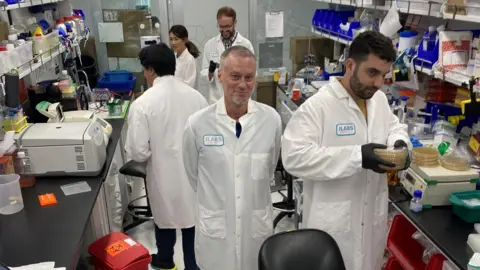
The blood of a US man who deliberately injected himself with snake venom for nearly two decades has led to an "unparalleled" antivenom, say scientists.
Antibodies found in Tim Friede's blood have been shown to protect against fatal doses from a wide range of species in animal tests.
Current therapies have to match the specific species of venomous snake anyone has been bitten by.
But Mr Friede's 18-year mission could be a significant step in finding a universal antivenom against all snakebites - which kill up to 140,000 people a year and leave three times as many needing amputations or facing permanent disability.
In total, Mr Friede has endured more than 200 bites and more than 700 injections of venom he prepared from some of the world's deadliest snakes, including multiple species of mambas, cobras, taipans and kraits.
He initially wanted to build up his immunity to protect himself when handling snakes, documenting his exploits on YouTube.
But the former truck mechanic said that he had "completely screwed up" early on when two cobra bites in quick succession left him in a coma.
"I didn't want to die. I didn't want to lose a finger. I didn't want to miss work," he told the BBC.
Mr Friede's motivation was to develop better therapies for the rest of the world, explaining: "It just became a lifestyle and I just kept pushing and pushing and pushing as hard as I could push - for the people who are 8,000 miles away from me who die from snakebite".
'I'd love to get my hands on some of your blood'
Antivenom is currently made by injecting small doses of snake venom into animals, such as horses. Their immune system fights the venom by producing antibodies and these are harvested to be used as a therapy.
But venom and antivenom have to be closely matched because the toxins in a venomous bite vary from one species to another.
There is even wide variety within the same species – antivenom made from snakes in India is less effective against the same species in Sri Lanka.
A team of researchers began searching for a type of immune defence called broadly neutralising antibodies. Instead of targeting the part of a toxin that makes it unique, they target the parts that are common to entire classes of toxin.
That's when Dr Jacob Glanville, chief executive of biotech company Centivax, came across Tim Friede.
"Immediately I was like 'if anybody in the world has developed these broadly neutralising antibodies, it's going to be him' and so I reached out," he said.
"The first call, I was like 'this might be awkward, but I'd love to get my hands on some of your blood'."
Mr Friede agreed and the work was given ethical approval because the study would only take blood, rather than giving him more venom.
The team is trying to refine the antibodies further and see if adding a fourth component could lead to total protection against elapid snake venom.
The other class of snake – the vipers – rely more on haemotoxins, which attack the blood, rather than neurotoxins. In total there are around a dozen broad classes of toxin in snake venom, which also includes cytotoxins that directly kill cells.
"I think in the next 10 or 15 years we'll have something effective against each one of those toxin classes," said Prof Peter Kwong, one of the researchers at Columbia University.
And the hunt continues inside Mr Friede's blood samples.
"Tim's antibodies are really quite extraordinary - he taught his immune system to get this very, very broad recognition," said Prof Kwong.
The ultimate hope is to have either a single antivenom that can do everything, or one injection for elapids and one for vipers.
Prof Nick Casewell, who is the head of the centre for snakebite research and interventions at the Liverpool School of Tropical Medicine, said the breadth of protection reported was "certainly novel" and provided "a strong piece of evidence" that this was a feasible approach.
"There is no doubt that this work moves the field forwards in an exciting direction."
But he cautioned there was "much work to do" and that the antivenom still needed extensive testing before it could be used in people.
But for Mr Friede, reaching this stage "makes me feel good".
"I'm doing something good for humanity and that was very important to me. I'm proud of it. It's pretty cool."
Latest Stories
-
Minority calls for the immediate suspension of Ghana-Colombia maritime agreement
5 minutes -
Ghanaian professional Sydney Hushie appointed UNFPA Chief of Digital Centre of Excellence
10 minutes -
GHS urges health managers to use community scorecards to improve healthcare delivery
17 minutes -
Ekyeamamfrom-Pivot irrigation project 90% complete but stalled over unpaid certificates
20 minutes -
When the Gavel speaks, where is the choir that once sang for Wontumi?
21 minutes -
NPP does not need a new chairman: It needs a brand architect
24 minutes -
GNFS contains fire at Avenor North Industrial Area in Accra
27 minutes -
NITA appoints Anthony Owusu-Ansah as Acting Deputy Director-General
33 minutes -
RANA warns Salomey Bafoh case could have chilling effect on free expression
34 minutes -
Who is the ‘hero’ Indian pilot who was stabbed on Israel-bound flight?
51 minutes -
NPP External Branches demand 90-day roadmap for ROPAA implementation
52 minutes -
No sustainable digital economy without trust, cybersecurity – CSA
55 minutes -
SSNIT increases stake in Société Générale Ghana to 24.36%
58 minutes -
Ghana-Colombia port deal sparks fresh cocaine trafficking security concerns
58 minutes -
EOCO moves to search Baffour Awuah’s office, residence after interrogation
1 hour