

Audio By Carbonatix
When a political party loses power, the instinct is to find a new message. The wiser instinct, however, is to ask a harder question: have we lost ourselves?
In brand management, there is a concept known as brand erosion. It does not happen overnight. It happens gradually, through a series of small inconsistencies a promise made and broken here, a value stated and contradicted there, and a constituency served and then taken for granted.
By the time the damage is visible, it has usually been accumulating for years. What the public eventually reacts to is not the final inconsistency. It is the sum of all of them.
The NPP experienced its own version of brand erosion on December 7, 2024. The scale of the defeat, losing both the presidency and parliamentary majority in unprecedented margins was not simply the result of an unpopular administration or an effective opposition. It was the result of a party that had, over time, drifted from the brand it had originally built its identity around: disciplined, grassroots-connected, ideologically coherent, and trustworthy in its management of the public interest.
But to understand the full weight of the damage, one must go back further than election 2024. The erosion has a history, and that history begins with the abandonment of something the NPP once owned with quiet confidence: the identity of the party of ideas.
For much of its existence, the NPP carried a brand distinction that was genuinely rare in Ghanaian politics the perception of being the party of intellectuals.
This was not self-flattery. It was a widely held public assessment, earned through the character of its founding membership, the quality of its internal debates, and the calibre of the voices it consistently put forward. The evidence was measurable.
In elections conducted across Ghana’s tertiary institutions universities, polytechnics, and training colleges the NPP dominated with reliable consistency. Young, educated Ghanaians saw their values and their aspirations reflected in the party’s identity.
The NPP was where intellect-loving individuals went.
When a brand abandons what made it distinct, it does not become more competitive. It becomes irrelevant.
That brand began to erode after 2016. Having won power, the party made a choice—perhaps unconsciously, perhaps by institutional drift—to follow the NDC’s lead into the politics of anything goes. The intellectual register that had distinguished the NPP gave way to a communications culture that prioritised noise over substance, loyalty over competence, and short-term effect over long-term credibility.
The party became unrecognisable to many of its own most committed supporters. What had once been a clear and compelling difference between the NPP and its principal opponent collapsed. By the time voters went to the polls in 2024, there was, in the eyes of many, no meaningful brand distinction between the two major political parties.
The NDC saw and understood this gap and exploited it deliberately. Arriving at the 2024 election with a communications strategy built around younger, intellectually articulate voices, people who could engage in policy debate with credibility, who understood social media as a persuasion environment rather than a megaphone, and who projected the kind of thoughtful confidence that resonates with educated young Ghanaians.
The NDC reclaimed a positioning the NPP had vacated. The results were visible not just in the national outcome but in a detail that should concern every NPP strategist: the party lost in nearly every tertiary institution, constituencies it had once treated as safe ground.
Among young, politically active Ghanaians today, the perception gap is still widening. A cursory examination of political discourse on social media reveals a generation that finds the NDC’s brand more intellectually credible and more authentically connected to their concerns.
This is not a temporary sentiment driven by the novelty of a new administration. It is a brand perception problem, and it will not be solved by a new message alone.
The NPP is not a failing party. It is only an injured brand. And that distinction matters enormously, because the prescription for each is completely different.
A failing party needs a revolution. An injured brand needs a restoration.
A failing party needs new ideas, new faces, new direction. An injured brand needs something more disciplined and more difficult: a return to its own best self. It needs someone who understands what the brand was built on, what caused it to drift, and what it will take, structurally, organizationally, and culturally, to restore it to a position of credibility with the people whose trust it lost.
This is why the NPP’s choice of National Chairman is, arguably, the most consequential decision the party will make between now and the 2028 general election.
The flagbearer has been chosen. The presidential candidate is set. What determines whether that candidate walks into a competitive election or an unwinnable one is the organizational and reputational condition of the party behind him. And that condition is, in large measure, the chairman’s responsibility.
A political party is a brand in the most complete sense of the word. It has an identity, a promise, a constituency, and a reputation. Its chairman is not merely an administrator. The chairman is the custodian of the party’s brand, the person responsible for ensuring that what the party says it stands for is reflected in how it operates, how it treats its members, how it engages its grassroots, and how it presents itself to the Ghanaian public.
By that standard, the NPP does not need a chairman who is simply well-known, well-connected, or well-funded. It needs a chairman who understands the architecture of organisational identity, someone who can look at a fractured, demoralised, post-defeat party and see not just the damage but the foundation that was always there beneath it.
It needs someone who can rebuild the internal structures without which no amount of messaging will matter. Someone who can restore the grassroots to a position of genuine prominence rather than ceremonial acknowledgment. Someone who understands that reclaiming the party’s intellectual and moral distinctiveness is not a communications project; it is a governance project, and it begins from the inside.
And someone whose own character is calm but firm, fair, principled, and above factional calculation—exemplifies the values the brand is trying to recover.
The NPP does not need a performer for this moment. It needs a builder.
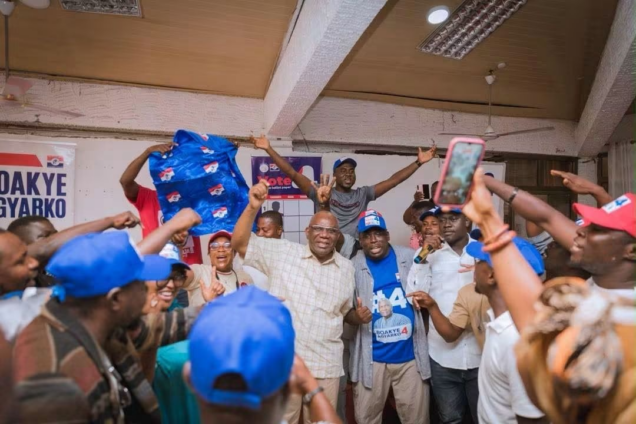
That person is Boakye Kyeremateng Agyarko. Agyarko’s case for the chairmanship is not built on novelty. It is built on fit. His decades of engagement with the NPP, as a founding member, as a campaign leader, as a minister, and as someone who has observed the party from both the inside and the outside, give him a rare understanding of what the NPP’s brand is at its best and what causes it to drift from that best. His personal temperament deliberate, measured, and genuinely party-first is not a campaign posture. It is who he is.
And in brand restoration, authenticity is not a feature. It is the prerequisite. There will be those who argue that the NPP needs energy and boldness at this moment. They are not wrong about the need. They are only wrong about the instrument.
Energy without structure produces noise. Boldness without organizational coherence produces spectacle. What the NPP needs first is a restoration of its foundation, its internal discipline, its grassroots relationships, its intellectual credibility, and its sense of itself as a party that stands for something specific and something serious.
Brand restoration is slow, unglamorous work. It rarely produces headlines. But it produces results. And in 2028, results are the only currency that matters.
The NPP has a choice to make. It can choose a chairman who reflects how the party wants to be seen. Or it can choose a chairman who will do the harder, quieter work of making the party worthy of how it wants to be seen.
The second choice is Boakye Agyarko. And in brand management, as in politics, the second choice is almost always the wiser one.
Latest Stories
-
BNI investigates Ampofo Ankrah over alleged $623,000 World Cup visa scheme
2 minutes -
NPP National Delegates Conference: Police announce road closures, diversions around Baba Yara Stadium
10 minutes -
Parliament demands financing plan for Pwalugu Irrigation Project before 2027 Budget
13 minutes -
Minority calls for the immediate suspension of Ghana-Colombia maritime agreement
23 minutes -
Ghanaian professional Sydney Hushie appointed UNFPA Chief of Digital Centre of Excellence
28 minutes -
GHS urges health managers to use community scorecards to improve healthcare delivery
35 minutes -
Ekyeamamfrom-Pivot irrigation project 90% complete but stalled over unpaid certificates
39 minutes -
When the Gavel speaks, where is the choir that once sang for Wontumi?
39 minutes -
NPP does not need a new chairman: It needs a brand architect
42 minutes -
GNFS contains fire at Avenor North Industrial Area in Accra
45 minutes -
NITA appoints Anthony Owusu-Ansah as Acting Deputy Director-General
52 minutes -
RANA warns Salomey Bafoh case could have chilling effect on free expression
53 minutes -
Who is the ‘hero’ Indian pilot who was stabbed on Israel-bound flight?
1 hour -
NPP External Branches demand 90-day roadmap for ROPAA implementation
1 hour -
No sustainable digital economy without trust, cybersecurity – CSA
1 hour