

Audio By Carbonatix
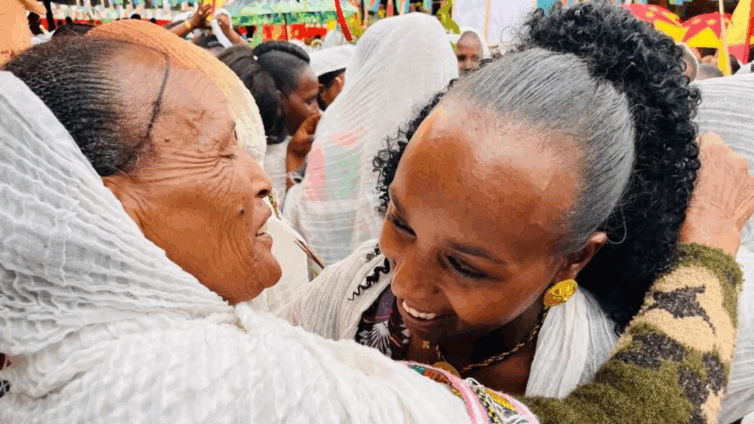
There have been celebrations at the border between Ethiopia and Eritrea as communities from the frontier villages came together for the first time in five years.
Separated by the closed border since the outbreak of the 2020 conflict in Ethiopia's northern Tigray region, and subsequent political tensions, Sunday's coming together was a symbolic moment of peace and reconciliation.
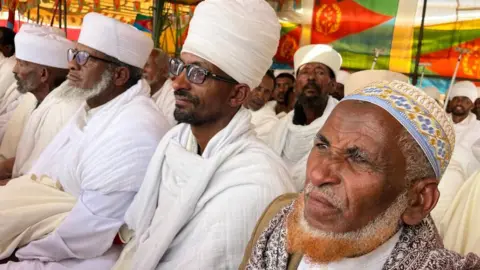
The reunion of families and friends took place in the Ethiopian town of Zalambessa in the presence of village elders and religious leaders.
The move to re-open a section of the border was organised by local activists and community figures without the official backing of the authorities on either side.
But those behind it indicated that they had the blessing from officials in Tigray and Eritrea.
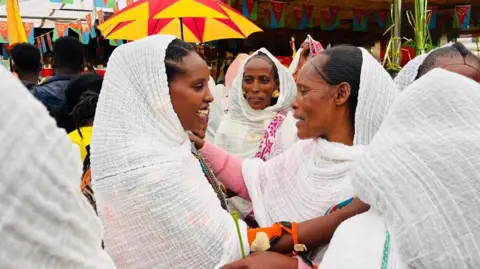
Many at the celebration described it as an emotional and long-overdue gathering.
For five years, relatives and friends whose communities straddled the international boundary had not been able to see each other across the militarised border.
Many in Zalambessa and the nearby villages had suffered economic hardship and social fragmentation during the two-year war in Tigray that ended in November 2022.
People had been forced to flee their homes, with more than 55,000 people now living in makeshift shelters in Adigrat, 30km (19 miles) south of Zalambessa, relying on relatives for survival.
The border has officially remained closed despite the end of the war amid tensions between the two governments.
"Enough of the past, let's sit at the table of peace and build a better future," people chanted on Sunday.
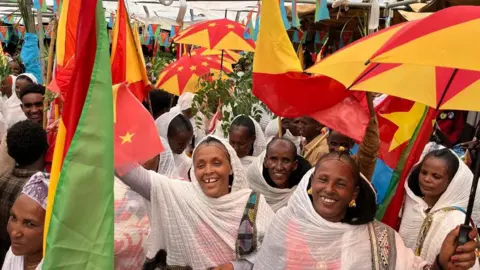
Cross-border trade near Zalambessa has also restarted with people using both the Ethiopian and Eritrean currencies.
"As people, we want to eat, trade and attend social events as before. Their siblings are here, their siblings are there. What we need is peace," one woman from Tigray told the BBC.
But a lot of work still needs to be done to repair the damage of the war.
Zalambessa's infrastructure remains broken, with electricity, telephone and banking services completely destroyed.
Much of the infrastructure is owned by Ethiopia's federal government, and residents say restoring it will require significant investment.
Water, health and education facilities, also affected, are slowly being rebuilt by local communities and donors.
Since Eritrea seceded from Ethiopia more than three decades ago, relations have been tense – the border has been closed for most of that time.
It was formally reopened in 2018, shortly after Ethiopian Prime Minister Abiy Ahmed came to power and signed a historic peace agreement with Eritrean President Isaias Afwerki.
The deal earned Abiy the Nobel Peace Prize.
While the move initially brought hopes of normalised relations, the eruption of the conflict in Tigray in November 2020 derailed progress.
 Girmay Gebru / BBC
 Girmay Gebru / BBC
Religious leaders were instrumental in making the meeting happenPeople want things to return to how they were before the civil war
"I am confident that the peace and reconciliation we started today will continue to grow," said Nebiat Woldegergis, who travelled from Senafe, Eritrea, to attend the ceremony.
Amleset, a mother who had lived for five years in a refugee camp in Adigrat after fleeing Zalambessa, said: "Today I came to see my locked house. From now on, I will return with my children and continue living on my land."
Local people recalled how families who once lived together had been torn apart by the conflict.
Representatives from both communities declared that "peace and reconciliation has begun", encouraging residents to return home and rebuild their lives.
However, challenges remain.
Looted property, destroyed homes, and a lack of services continue to make resettlement difficult for thousands of displaced families.
And it is not clear if this local arrangement will be translated into a wider reconciliation between the governments of Ethiopia and Eritrea.
Latest Stories
-
‘I don’t trust OSP’ to probe GH¢70k ‘bribe’ allegation – Kwasi Kwarteng
9 minutes -
Road inspections not to witch-hunt contractors – Kwame Agbodza
33 minutes -
Inter Milan mount stunning comeback to beat Napoli
41 minutes -
Modric plans to play for Croatia past 41st birthday
51 minutes -
Bayern fail to score for first time in 59 games
55 minutes -
Bawumia preparing new cocoa policy package for farmers – Annoh-Dompreh
59 minutes -
Wa-Tumu-Bolga road upgrade will unlock agriculture, trade – Agbodza
1 hour -
Ghana Maritime Authority readies oil-spill response vessel for deployment
1 hour -
Ayariga turns to drones, AI to tackle Agbogbloshie waste mountain
1 hour -
Agbogbloshie waste heap must go – Mahama Ayariga declares
1 hour -
Government to upgrade all rural telephony sites to 4G – Communications Minister
1 hour -
Rural calls, data to become cheaper by Q1 2027 – Sam George
1 hour -
National Chief Imam remains Ghana’s strongest symbol of interfaith harmony – Mahama Ayariga
2 hours -
Nhyiaesohene pledges support to ECG to curb encroachment
2 hours -
Somanya residents demand asphalt overlay to protect road investment
2 hours