

Audio By Carbonatix
A World in Search of Accountability For decades, governments, corporations, and institutions across the globe have wrestled with one persistent challenge: how to build systems that truly deliver on their promises. Plans are announced, strategies are drafted, yet outcomes often fall short.
Accountability is too often diluted, and consequences—whether positive or negative—rarely align with actions taken.
This disconnect has left many leaders and citizens frustrated. In Africa especially, where governance has direct consequences for social stability, economic growth, and global competitiveness, the stakes could not be higher.
It is in this climate that a bold idea emerges: the Consequential Management System (CMS).
What is CMS?
The Consequential Management System (CMS) is more than a theory.
It is a strategic governance framework designed to close the persistent gap between intention and outcome. CMS insists that every decision, policy, or leadership action must be directly tied to measurable consequences. It establishes a culture where accountability is not optional, but structural.
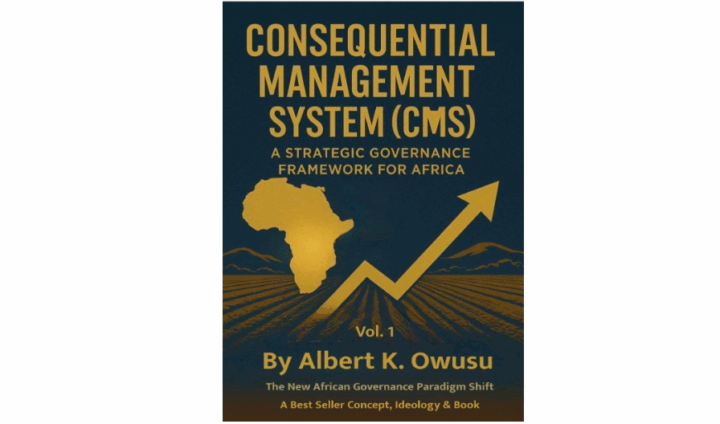
Developed by thought leader Albert K. Owusu, CMS is articulated in his forthcoming book, Consequential Management System (CMS): A Strategic Governance Framework for Africa. The book positions CMS not as a mere management tool, but as a foundational requirement for true transformation in governance, leadership, and institutional culture.
Why Now?
The rise of CMS is timely. Across Africa and beyond, young populations are demanding transparency, results, and leadership integrity. Global investors are asking for reliable governance frameworks before committing resources. And leaders themselves are seeking approaches that can transform accountability from a vague aspiration into a daily practice.
CMS arrives not as another management fad, but as a consequence-driven system designed for a new era. It challenges leaders to rethink decision-making, policy implementation, and institutional culture through the lens of cause and effect.
From Framework to Movement
While CMS begins as a framework, its implications stretch far beyond management theory. At its core, it signals a shift in leadership philosophy: actions must always be tied to consequences, and leaders must be willing to embrace those consequences—good or bad.
As Albert K. Owusu puts it, “The power of leadership is not in the promises leaders make, but in the consequences they create.”
Setting the Stage for Transformation
Part 1 of this three-article series introduces the foundation of CMS: a bold reimagining of how accountability can be woven into the fabric of governance and organizational management.
In the coming articles, we will explore how CMS transforms organizations in practice (Part 2), and how it is evolving into a global movement, The Consequence Generation (Part 3).
From the forthcoming book, Consequential Management System (CMS): A Strategic Governance Framework for Africa, by Albert K. Owusu.
Latest Stories
-
CSIR warns Ghana’s soil health is deteriorating, calls for urgent national action
10 minutes -
Two feared swept away after River Agyei overflows Kasoa–Domeabra road
13 minutes -
Tony Elumelu appointed chairman of Seplat Energy
26 minutes -
Education Minister raises alarm over indiscipline in SHSs, announces national reform conference
28 minutes -
Lom Ahlijah advocates tech-based monitoring in schools after assault case
32 minutes -
UTAG threatens nationwide strike over delay in book and research allowance rate
40 minutes -
Boundary Commission urges border residents to protect boundary pillars and support national security
43 minutes -
Ghana to grow at 5.0% GDP in 2026, but faces huge investment financing gap – AfDB
44 minutes -
Deputy AG, 14 CSOs appear at Supreme Court for hearing on challenge to OSP’s prosecutorial powers
49 minutes -
Minority MPs meet Ghana High Commissioner to Canada to discuss diaspora welfare and bilateral relations
58 minutes -
GNAT threatens WASSCE boycott over detained Nyinahin SHS teacher
1 hour -
Free SHS: Education Minister hails end of school food shortages
1 hour -
NLA Director-General calls for a concerted effort in fight against illegal gambling
1 hour -
74% of returned Ghanaians had overstayed visas – South Africa’s Int’l Relations Minister
1 hour -
Ghana’s National Vaccine Institute joins WHO-backed Global Clinical Trials Forum
1 hour