


Audio By Carbonatix
Director at the Institute of Health Research at the University of Health and Allied Sciences (UHAS), Prof. Alexander Manu, has revealed that three major factors - breathing difficulties, prematurity, and infections—are responsible for a majority of newborn deaths in Ghana and across the continent.
Speaking during the JoyNews National Dialogue on Investment in Newborn Health: Giving Preterm Babies a Strong Start, held on Thursday, Prof. Manu stated that between seven to nine out of every 10 newborn deaths are linked to these three causes.
“Difficulty in breathing, being born too early, and germs or infections are responsible for the majority of deaths that occur in newborns,” he explained. “We are talking about between seven to nine out of every ten newborns that are dying—they are from just these three causes: how they can breathe, because they’ve come too early, and because they have infections.”
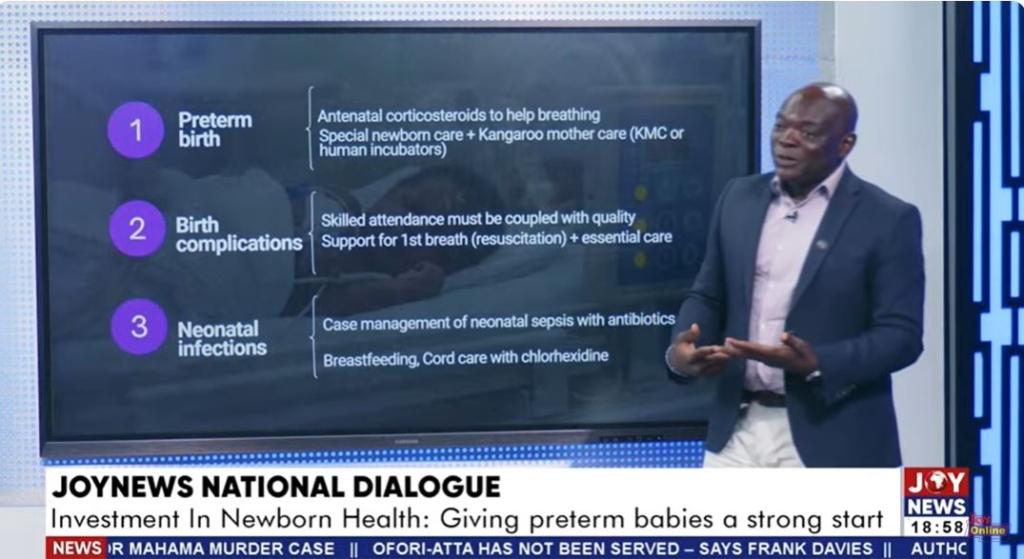
Despite the alarming statistics, Prof. Manu stressed that the situation is far from hopeless. He highlighted a global intervention framework known as the “three-by-two plan”, which outlines practical measures health systems can adopt to save preterm babies.
He explained that early identification and proper preparation are crucial, particularly when signs indicate that a mother may deliver before term.
“Our preparation as a health system to be able to receive this baby becomes paramount,” he said. “We can give steroids, and these steroids help the lungs to mature and open so air can go in, so the baby can breathe.”
Prof. Manu emphasised the importance of keeping preterm babies warm immediately after birth, describing it as a low-cost but highly effective intervention. He also underscored breastfeeding, especially early initiation—as essential for newborn survival.
Using a vivid analogy, he said: “If a preterm baby or any baby is born and they take in the first breast milk, and it’s from the mother’s warm body—imagine yourself early morning in the cold Harmattan season and someone brings you warm Hausa Koko. That is how the newborn feels when they get that first breast milk, and it keeps them warm.”
Prof. Manu added that for babies born with complications such as difficulty in breathing, skilled personnel must be available to provide immediate support to stabilise and protect the newborn.
He stressed that strengthening the health workforce, improving preparedness, and promoting proven interventions can significantly reduce newborn deaths in Ghana.
Latest Stories
-
Fire destroys belongings in Akweteyman apartment
7 minutes -
Baffour Awuah to turn himself in to EOCO today – JoyNews sources
12 minutes -
Government identifies payment discrepancy holding up teachers’ strike resolution
30 minutes -
BoG signals no FX intermediation for October as GoldBod plans $1bn support for banks
34 minutes -
When share ownership becomes personal: The African mindset of the Dangote IPO
44 minutes -
Why MFWA Legal Fund matters to Ghana’s democracy
44 minutes -
Fuel prices to rise from October 1; diesel could hit GH¢19.60 – COMAC
45 minutes -
Parliament must investigate how 3.9 tonnes of cocaine left Ghana undetected – Samuel Jinapor
45 minutes -
Government pledges to pay striking teachers as payment dispute is resolved
59 minutes -
Government cannot investigate drug exports under its own watch – Abu Jinapor
1 hour -
Government extends GH¢2 diesel subsidy for two more months
1 hour -
GTEC flags over 100 tertiary institutions as unrecognised
1 hour -
Agric Committee chair commends NAFCO for turnaround from GH¢20m debt to GH¢96m profit
1 hour -
NPP: Judicial office requires judges to surrender some personal freedoms
1 hour -
Senyo Hosi: Ghana missed its chance to end galamsey under Akufo-Addo
1 hour