

Audio By Carbonatix
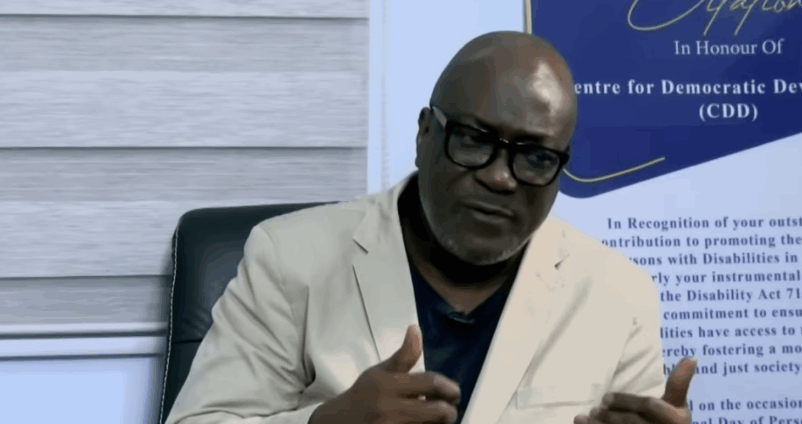
Chairman of the Constitution Review Committee, Prof Henry Kwasi Prempeh, says evidence gathered over the years shows Ghana’s current prosecutorial system is not working and must be fundamentally reformed.
Speaking on Joy News on December 25, Prof Prempeh said the country has reached a point where it must confront reality. “It’s obvious that if it was going to work, why hasn’t it worked?” he asked.
He said Ghana has experimented with the system for years, including periods with career attorneys general. “We’ve had career attorneys general before,” he said, but noted that the current structure is different.
“Our current attorney general setup is not a career attorney general setup. It is a politician, Attorney General, setup,” he said.
Prof Prempeh stressed that constitutions are designed for real people, not ideals. “Constitutions are made for human beings,” he said, adding that human incentives must be considered.
He pointed out that the Attorney General is not just a lawyer, but an active politician. “He is a politician,” he said. “In fact, in this case, he even contested, and he is an MP too.”
He described the Attorney General as “a real politician, an active politician,” who is “a member of a political party, a member of a government,” yet is expected to fight corruption.
According to him, this contradiction explains the outcomes Ghana keeps seeing. “Corruption doesn’t have a party label. Corruption is corruption,” he said.
He said it should not surprise anyone that prosecutions against incumbents are rare. “How is it any surprise that we have had so few corruption cases against incumbents?” he asked.
Addressing the argument that political alternation solves the problem, Prof Prempeh was unconvinced. He said the idea that one party will prosecute the other when it takes power is flawed.
“You have four years, you come during your term, you don’t prosecute any of your people, and you expect that by the time that the other side comes, then they will start prosecuting you,” he said.
He questioned the certainty of political turnover. “But what if they don’t come?” he asked. “Nothing is saying that the other side will actually come or also stay on for much longer.”
Beyond outcomes, Prof Prempeh said the deeper problem is public trust. “Even the perception, the people don’t even trust the credibility of the process,” he said.
He explained that even evidence-based prosecutions are viewed through partisan lenses. “If you came and said, look, I’m going after this target genuinely, because evidence is leading me this way, Ghanaians will doubt you,” he said.
According to him, people assume partisan motives. “Oh, you are going after this person because you are NDC and he’s NPP,” he said, adding that “no matter what you do, you cannot persuade people that that is what is happening.”
Prof Prempeh said this destroys legitimacy. “What you are doing has legitimacy and credibility,” he said, explaining that people must believe “you are being fair.”
He warned that selective prosecutions weaken institutions. “If you keep doing that, you are destroying trust in the institution,” he said.
He also pointed to the cycle of pardons. “The other side will come and pardon another person,” he said, describing it as retaliation for perceived political targeting.
“So I think it’s we’ve gotten to a point where, look, certain things are not working,” he said. “Let’s agree that they are not working.”
Prof Prempeh said Ghana is not alone in confronting this problem. He cited countries with independent anti-corruption agencies where the Attorney General does not prosecute.
“In Kenya, in the 2010 constitution, the Attorney General does no prosecution at all, zero,” he said.
He said Kenya comes from the same common law tradition as Ghana. “They have had a similar experience,” he said, and concluded that “this attorney general doing prosecution matters is not working.”
According to him, the evidence is clear. “Let us just accept the evidence we’ve gathered that in our system, when you give prosecutorial power to a politician Attorney General, this is how it works,” he said.
He acknowledged that other models exist. He cited the United States, where the Attorney General is also a political appointee. “The only other place I know where it has worked before is the US,” he said.
But he explained that the US relies on deep conventions. “They’ve built a long-standing convention around that power,” he said, noting that senior career prosecutors handle cases.
He cited examples of prosecutions cutting across party lines. “They’ve gone after Democratic senators,” he said, adding that “Joe Biden was president, his son was being executed.”
Even so, Prof Prempeh said Ghana must design systems that fit local realities. “Different countries, they’ve been able to build a certain culture,” he said.
“I’m not saying it’s entirely impossible,” he added, “but we were supposed to do things that fit the Ghanaian condition.”
Latest Stories
-
WAFU B WCLQ: Ampem Darkoa Ladies thrash Dynamique FC to reach final
18 minutes -
Chief Justice should avoid partisan political arena – Prof Kwaku Asare
23 minutes -
GMTF Administrator hails Mintah Akandoh’s support as Fund marks first year
31 minutes -
GPHA honours 410 staff for outstanding service
44 minutes -
BoG slashes September FX support to $500m as GoldBod boosts dollar supply
48 minutes -
GNFS rolls out automated fire compliance system
50 minutes -
SOE profit at GH¢19.8bn: I call it a miracle, but it’s not operational efficiency – Dr Atuahene
52 minutes -
SHS violence: Government must review discipline policy – IFEST
1 hour -
Nana Akomea leads NPP First Vice Chairman race in new poll
1 hour -
Ato Forson begins groundwork for Mahama’s $10bn New Economy agenda
1 hour -
SHS violence: Peter Anti demands intelligence-led security in schools
1 hour -
‘Presidents can’t have unfettered powers’ – Sophia Akuffo
1 hour -
Kwame Agbodza cuts Wenchi-Bole road contracts by 25km over slow work
1 hour -
Ghana’s borrowing costs plunge as inflation eases sharply – World Bank
1 hour -
Unnecessary appeals delaying justice – Sophia Akuffo calls for tighter Supreme Court limits
2 hours