

Audio By Carbonatix
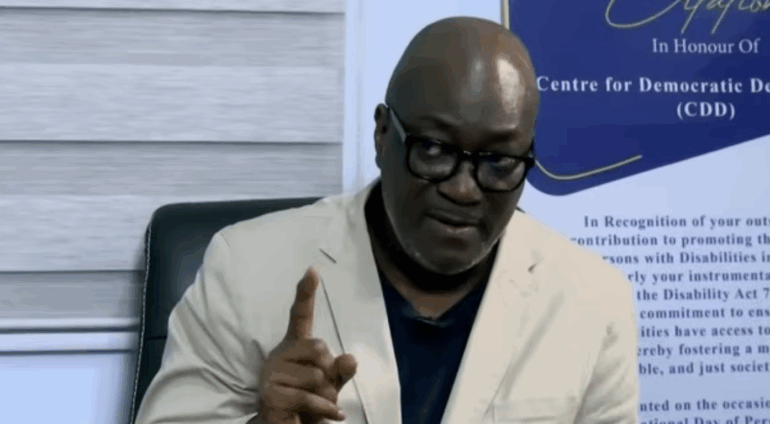
Constitution Review Committee Chairman, Prof. H. Kwasi Prempeh, has cautioned that the government’s decision to present its own position on constitutional reforms has complicated an already delicate review process.
Speaking on JoyNews’ PM Express on Monday, Prof. Prempeh said constitutions are meant to outlive governments and political parties, making it essential for political actors to approach the exercise with patriotism rather than partisan interests.
He argued that constitutional reforms should not be treated like everyday politics because they determine how the country is governed for generations.
“Constitutions are different; they are forward-looking. They last at least a generation,” he said, stressing that they establish the rules for governance, leadership recruitment, the transfer of power and the distribution of authority.
According to him, those leading the process should think beyond their time in office and consider the kind of country future generations will inherit.
He said if political leaders view the exercise only as “another way for one incumbent party to get their preferences vis-à-vis the rival party,” Ghana would lose a rare opportunity to deliver “real game-changing reforms.”
Prof. Prempeh acknowledged that politics will inevitably influence the process but insisted that public deliberation must remain at its centre.
“This is why I think it’s important for the deliberative content of this process to be very high,” he said, urging extensive debate and broad public participation before decisions are made.
He warned against rushing reforms simply to secure a vote, arguing that citizens should have the opportunity to hear competing arguments before changes are adopted.
On the timeline for completing the review, Prof. Prempeh said valuable time had already been lost.
“In hindsight,” he explained, he would have preferred the government to submit its views through the same consultative process available to all stakeholders instead of taking a separate route.
He said that approach would have avoided months of waiting since the end of January and allowed consultations to proceed without interruption.
Prof. Prempeh acknowledged that government may be trying to align any referendum with the upcoming local government elections to improve voter turnout, noting that standalone referendums often struggle to attract enough voters.
Even so, he maintained that the remaining period should prioritise meaningful public engagement instead of speed.
He admitted that greater consultation could extend the process but argued that this is the nature of constitutional democracy.
“That’s what makes constitutions and constitution-making and democracy slower than the alternative,” he said, adding that slowing the process can improve both the quality and legitimacy of the final outcome.
Prof. Prempeh said the government’s position had introduced fresh uncertainty into the review.
“It throws a little bit of a spanner in the works a bit,” he said, questioning how competing political positions would now be weighed and filtered into the constitutional review process if other parties also submit their own official positions.
Latest Stories
-
I have no issue with John Boadu; we’ll work together – Justin Kodua
21 minutes -
Adom FM Y2K Jam delivers a night of music, fashion and nostalgia
1 hour -
Lawrence Kobena Nsarko Otoo, Esq
2 hours -
Bel-Aqua intensifies mental well-being campaign ahead of 15th anniversary
2 hours -
From banking to party finances: Alfred Kwadwo Thompson elected NPP Treasurer
2 hours -
George Christian Papa Mends
2 hours -
Ali Suraj elected NPP NASARA Coordinator
2 hours -
Mustapha Hamid misses out on NPP Vice Chairmanship by 31 votes despite early poll lead
3 hours -
Kojo Bamba, Henry Nana Boakye and Nana Akomea elected NPP Vice Chairmen
3 hours -
From Delta Force to NPP First Vice Chairman – Kojo Bamba’s political journey
3 hours -
Police restore calm at Larteh following Odwira festival disturbance
4 hours -
‘All the camps will dissolve’ – Bawumia demands one NPP for 2028
4 hours -
There is no time to waste – Bawumia orders NPP to begin 2028 work
5 hours -
Sarkodie visits MobileMoney Fintech LTD
5 hours -
John Boadu unveils new NPP strategy to win back youth and modernise party
5 hours