

Audio By Carbonatix
The College of Engineering at the Kwame Nkrumah University of Science and Technology (KNUST), Kumasi is intensifying collaboration with industry partners to accelerate innovation, strengthen engineering education and deliver practical solutions to Ghana’s development challenges.
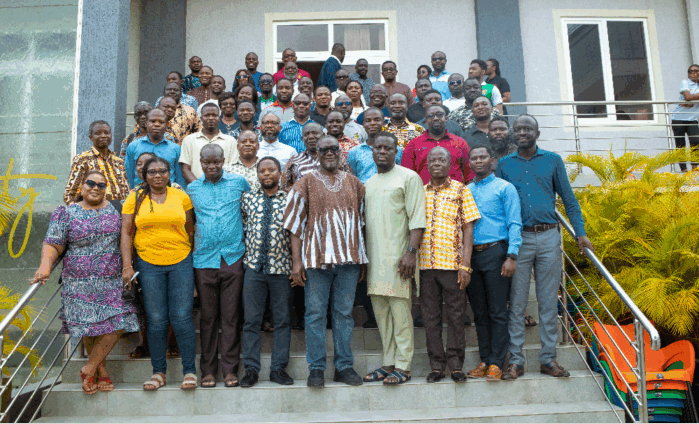
The renewed push was outlined at the College of Engineering and Industry Symposium held at Kwawu-Nkwatia in the Eastern Region of Ghana under the theme “Engineering Partnerships for Sustainable Innovation and Development,” which brought together academics, industry leaders and policymakers to explore long-term collaboration models.
Provost of the College of Engineering, Prof. Kwabena Biritwum Nyarko said closer engagement between academia and industry had become essential as Ghana confronts challenges in infrastructure, energy transition, climate resilience and industrial competitiveness.
“The complex issues of our time require solutions that are interdisciplinary, practical and context-appropriate. No single institution or sector can address these challenges alone,” he said, adding that collaboration between academia, industry and government “is not optional; it is essential.”
The College of Engineering, which currently has about 10,000 undergraduate students across 18 programmes and more than 1,000 postgraduate students across 69 programmes, sees industry partnership as critical to translating research and innovation into real-world impact.
It recently graduated more than 2,300 engineers, including 49 doctoral graduates.
The College of Engineering said its Innovation Centre had already produced promising start-ups, but stressed that industry support was needed to help these ventures scale into viable enterprises.
“We must co-design solutions, co-develop technologies and co-implement innovations that respond to society’s pressing needs,” Prof. Nyarko said.
Presentations at the symposium emphasized that innovation goes beyond generating ideas, focusing instead on converting inventions into products, services and systems that create value.
Prof. Samuel Patrick Owusu-Ofori, who led a session on creativity, invention and innovation, said industry-university collaboration provides the bridge needed to move research from laboratories into society.
“Innovation improves on or makes significant contributions to what has already been invented, with the purpose of creating wealth,” he said, noting that industry partnerships expose students and faculty to real-world problems, data and operational constraints.
Using global examples such as Boeing’s long-standing collaboration with universities, Prof. Owusu-Ofori said industry benefits from access to youthful talent and low-cost innovation, while universities gain funding, curriculum enhancement and placement opportunities for graduates.
“The big picture is knowledge and technology exchange, possible business growth and a labour force with the desired attributes,” he said.
Industry partners at the symposium included GRIDCo, the Volta River Authority, Bui Power Authority, Ghana Water Company Limited and the Community Water and Sanitation Agency, among others.
Industry speakers highlighted existing and emerging collaborations between the College of Engineering and key players in Ghana’s energy sector, including the Ghana Grid Company Ltd. (GRIDCo) and the Bui Power Authority (BPA).
GRIDCo officials said partnerships with KNUST were helping to address the technical demands of a rapidly evolving power transmission system, driven by rising electricity demand, renewable energy integration and grid digitalisation.
“Rapid technological change, climate pressures and economic transitions demand stronger, more deliberate partnerships. Innovation must be scalable and development-driven,” a GRIDCo presentation noted.
Current areas of collaboration include student internships, national service placements, substation study tours, software development for load-flow analysis and joint research on artificial intelligence-based predictive maintenance. GRIDCo has also initiated the renewal of its memorandum of understanding with KNUST to formalise data sharing, capacity building and access to grid infrastructure for research.
Similarly, the Bui Power Authority outlined plans to deepen cooperation with universities to support hydropower optimisation, renewable energy integration and advanced grid management.
“Our research output must be aligned with practical industry problems, while industry needs access to cutting-edge research and skilled talent,” a BPA presentation stated, proposing joint research consortia, shared laboratories and co-developed curricula as part of a multi-track partnership framework.
Participants agreed that sustainable collaboration requires more than ad-hoc projects, calling instead for structured, long-term frameworks that align teaching, research and industry needs.
Latest Stories
-
Government procures over 2,000 transformers as Ghana’s electricity access hits 89.13% – Energy Minister
25 minutes -
UTAG-UG threatens strike on October 19 over unpaid allowance
33 minutes -
Let The Constitution direct Chieftaincy to deliver “All Development Is Local”
2 hours -
John Jinapor outlines renewable energy, nuclear power priorities for 2027
2 hours -
Ghana explores centre of excellence for hearing, communication and cochlear implant care
3 hours -
Schizophrenia-related disorders lead mental health cases recorded in Ghana
3 hours -
Dutch authorities enlist Ghana in hunt for fugitive drug lord Bolle Jos
4 hours -
Ghana housing finance conference adopts communiqué to improve affordable housing access
8 hours -
Special Initiatives Minister urges Wa Technical Institute to enrol more girls as EU-backed solar training lab opens
9 hours -
In the matter of my first year at the Bar
9 hours -
ActionAid Ghana calls for an end to child marriage, greater investment in girls’ rights
9 hours -
Newsfile to tackle World Cup visa scandal, beach demolitions, education strikes, BRICS bid
9 hours -
UK-Ghana Trade & Investment Summit: Trade Resource Centre to help businesses maximise UK-Ghana trade opportunities
10 hours -
Embassy of Denmark celebrates World Maritime Day
10 hours -
Linking LEAP to productive inclusion could cut extreme poverty by 2030 – UNICEF
11 hours