

Audio By Carbonatix
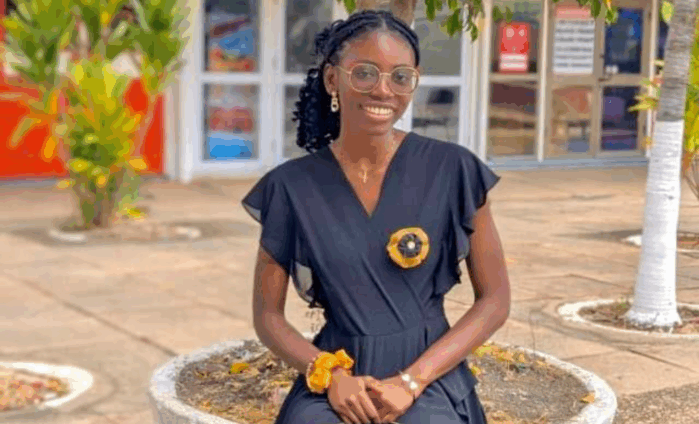
At a young age, Audrey Agbeve discovered that the world was not meant to be blurry. The moment she put on her first pair of glasses, clarity transformed not only her vision but her future. Today, that same transformative power of science drives her work in biomedical engineering and artificial intelligence, where she designs practical digital health tools aimed at expanding access to care for underserved communities.
At 13, Audrey Agbeve did not know her world was out of focus.
She thought the blur was normal. That everyone saw chalkboards that way. That everyone squinted at distant faces.
Then she got her first pair of glasses.
The moment she put them on, the world snapped into clarity. Edges sharpened. Colours deepened. Details she had never noticed before came alive. It was a quiet revelation, but a lasting one. Science had simply transformed her world.
That experience would go on to shape the course of her life, leading her to pursue biomedical engineering, a field at the intersection of health and technology.
During her undergraduate studies, that promise took on a new dimension: artificial intelligence. For her final year project, Audrey developed an AI-powered WhatsApp chatbot to deliver hypertension health education.
The logic was both strategic and grounded in reality. In many low-resource settings, sophisticated digital health platforms struggle to gain traction. WhatsApp, however, is already in people’s hands.
By building on a platform people trust and use daily, the project showed how digital health interventions can be woven into everyday life. It was a reminder that innovation can be simple. Sometimes it is about meeting people where they are.
The project led her to the Global Health and Infectious Diseases Research Group (GHID) at the Kumasi Centre for Collaborative Research in Tropical Medicine (KCCR) at the Kwame Nkrumah University of Science and Technology, Kumasi (KNUST), where she now works within the AI and Digital Health subunit.
There, in a multidisciplinary environment, Audrey’s thinking has matured. Mentoring undergraduate students and working alongside clinicians, researchers, and data scientists has reinforced a crucial lesson: technology does not succeed on elegance alone.
It must fit workflows. It must function within infrastructure constraints. Most importantly, it must make sense to the people who use it.
This understanding has shaped her advocacy for sociotechnical approaches to digital health, approaches that recognise that health systems are as much technical systems as they are social ones.
Her ambition remains steady: to design scalable, practical digital health solutions that expand access to care, particularly for underserved communities. Not flashy prototypes. Not pilot projects that fade. But tools that endure.
On this International Day of Women and Girls in Science, Audrey’s story feels fitting. It is about perspective. About what happens when a young girl sees clearly for the first time and decides to help others see new possibilities, too.
If you are inspired by Audrey, read her paper here: https://www.best-lmic.org/bl/article/view/9
Latest Stories
-
Western Regional Minister applauds Karpowership’s role in Ghana’s power sector
12 minutes -
Livestream: Road safety crises: Where are we getting it wrong?
15 minutes -
Enterprise Life celebrates 25 years of protecting families and building trust
22 minutes -
ICC London rules in favor of Ghana against Tullow over $400m tax charge
32 minutes -
We are disappointed in ICC’s ruling over our corporate income tax assessment in Ghana – Tullow Oil
43 minutes -
Cost of building inflation for August 2026 increases to 4.6% – GSS
44 minutes -
Today’s front pages: Wednesday, September 30, 2026
1 hour -
Bawumia highlights agricultural, compulsory insurance reforms in IBAG engagement
1 hour -
Ghana will secure Tullow tax revenues while protecting Jubilee, TEN investments – Ato Forson
1 hour -
Ghana wins $393m Tullow tax arbitration as tribunal upholds GRA assessment
1 hour -
Gender Minister assures women’s group of action on Affirmative Action, Development Bank
2 hours -
Over 2,000 teachers in Dormaa comply with strike – GNAT Secretary
2 hours -
Food Buffer Stock seeks stronger liquidity buffer despite record profit
2 hours -
LPG investments key to achieving 50% access target by 2030 – Energy Minister
2 hours -
Jinapor: New LPG terminal strengthens Ghana’s energy security
3 hours