

Audio By Carbonatix
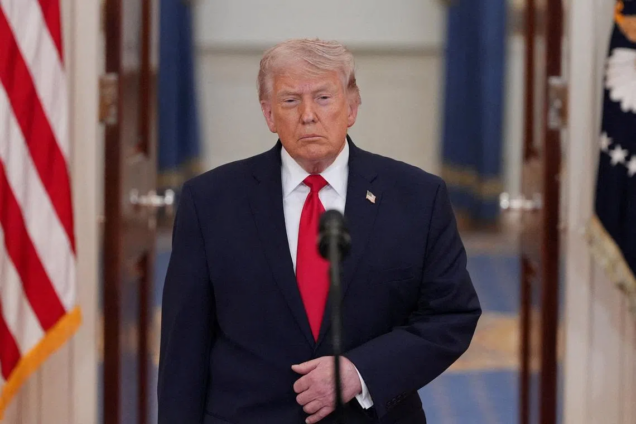
US President Donald Trump was swift to declare victory after the second crew member of an F-15 fighter jet downed over Iran was recovered, claiming that the dramatic and successful rescue in Iranian territory "proves, once again, that we have achieved overwhelming air dominance and superiority".
Observers, however, paint a more complicated picture of what this means for the US in Iran.
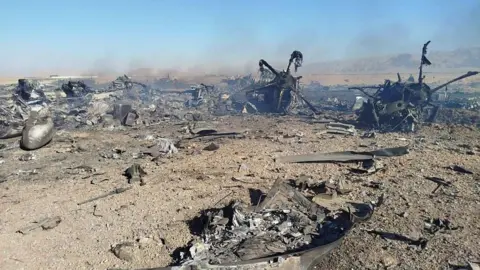
While the mission was a success, the events of the last few days - in which two aircraft were downed and at least one helicopter was hit by gunfire - highlight that threats to US aircraft and personnel remain even after weeks of heavy US and Israeli strikes against Iran's military infrastructure and boasts from the president that Tehran had "no anti-aircraft equipment" left.
Several Washington sources who spoke to the BBC speculated that the loss of aircraft and the complexity of the operation to recover the pilots could potentially dissuade Trump from any ground operation to take control of Iran's key oil export terminal at Kharg Island and other sites in the Gulf, or to seize highly enriched uranium buried deep underground in Iran.
These operations – scoped by military planners and presented to the president as options – are deeply complex and risk exposing US forces to lingering Iranian capabilities, including difficult-to-find man portable air defence systems, known as Manpads, which are shoulder-launched missiles most effective against low-flying aircraft.
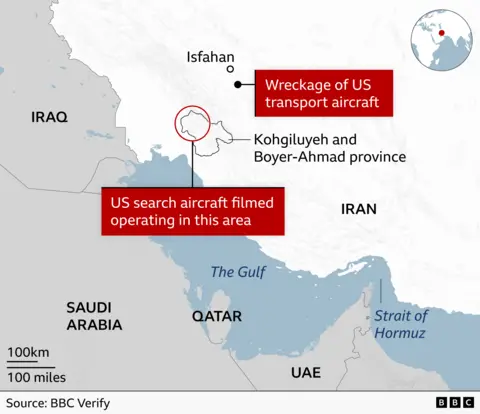
On the other hand, the fact that US troops were able to enter a contested environment, and set up a forward airfield and refuelling point under the nose of the Iranians, then hold it for hours while two stuck aircraft were destroyed and replacements sent, might embolden him.
It could convince the administration that an airborne or amphibious operation against targets in Iran stands a good chance of success.
That message is one that would be heard, loud and clear, by US service members flying over Iranian skies as the conflict goes on, and by those preparing for a potential deployment.
Trump has also has sent mixed messages about the path forward, telling reporters in a series of phone calls on Sunday that he believes a "deal" with Iran could be just around the corner.
If that fails, he has said repeatedly on Truth Social, the clock is ticking on a self-imposed deadline to begin striking Iranian power plants and bridges.
If the Strait of Hormuz was not opened, he posted in an expletive-laden message on Sunday to the Iranian regime, they would be "living in Hell". In a brief phone interview with Fox, Trump also suggested he might move to "take" Iran's oil, without providing further details.
An expanded campaign against Iranian infrastructure and energy targets would represent an escalation, with human rights groups warning of the impact on civilians and potential war crimes.
The president's critics are likely to take it as a sign of Trump's frustration that the US has been unable to secure freedom of navigation in the Strait of Hormuz, a vital global corridor for oil and other commodities.
So far, the president's supporters have rallied behind the administration and its effort to rescue the crew members.
For Trump, the rescue represents a "win" both in the eyes of the public and those inside the US military.
The rescue served to reinforce the administration's willingness to put other Americans in harm's way to abide by the ethos of the Soldier's Creed that no US service member would be abandoned.
But some - even fervent MAGA supporters - have already grown uncomfortable with the prospect of an expensive, messy war with an unclear endgame, which could lead to US casualties.
However, the recovery of the two pilots robbed Iran of what would have amounted to a massive propaganda victory.
The sight of US military personnel in Iranian captivity would have very likely become the primary war-related story in the US and hijacked Trump's narrative of a quick, clean victory.
Trump's comments over the weekend stand in contrast to several he made last week, including a televised address on 1 April, in which he suggested that the US had already created the conditions necessary for other countries to engage in the Strait. "Take it, protect it, use it for yourselves," he told allies.
Trump had also recently suggested that he was willing to "leave" Iran even if a deal eluded him.
But he now appears to have shifted course in the hopes that doubling down on the threat of devastating attacks on the country's core infrastructure can prompt Tehran's leadership to come to the table.
Latest Stories
-
Oil falls on increased Gulf supply and hopes for US-Iran talks
2 hours -
South Sudan’s Kiir dissolves government, clears hurdles to delayed election
2 hours -
Ntim Fordjour accuses government of failing to act on Ghana’s drug crisis
4 hours -
Autopsy shows Hayden Panettiere died from a drug overdose
4 hours -
Earl Spencer should pull Diana book from shelves, Piers Morgan says
4 hours -
IMF tells advanced economies to ‘bring debt down’ as borrowing costs rise
5 hours -
‘I have never felt heat like that’ – a survivor on watching 33 cellmates die in Nigeria
5 hours -
16 arrested, 4 printing hubs busted in major counterfeit currency crackdown
5 hours -
Sir Jim Ratcliffe suspends production at key UK plants blaming high gas prices
5 hours -
Major US outlets suspend shared Trump coverage in protest at media ban
5 hours -
Trump says he would back ban on diesel exports
6 hours -
Lekzy DeComic to feature four generations of comedians on upcoming show
6 hours -
Nigeria wins arbitration as Sunrise’s $400 million hydropower claim dismissed
6 hours -
Xhaka under investigation over Covid-19 certificate
6 hours -
FAW chief questions Infantino’s Fifa reform claims
6 hours