

Audio By Carbonatix
The Accra Metropolitan Assembly (AMA) has announced plans to revise its existing bylaws to incorporate heat-health provisions, in a move aimed at strengthening the city’s preparedness and response to increasing urban heat risks.
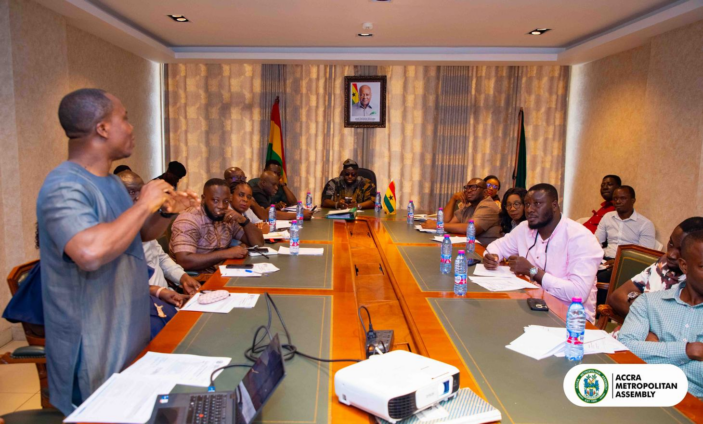
The Mayor of Accra, Michael Kpakpo Allotey, disclosed this on Monday following a management meeting.
He explained that the proposed amendments stem from a comprehensive review of the Assembly’s governance framework, including its Resilience Strategy, Medium-Term Development Plan (MTDP 2026–2029), and existing regulatory instruments.
The review, he noted, revealed significant gaps in addressing the escalating threat posed by extreme heat.
He further stated that the amendments would introduce provisions to formally recognise heat as a public health risk, while also granting the Assembly the legal authority to implement and enforce heat-related interventions during periods of extreme weather.
According to the Mayor, the revised bylaws will outline safety measures across critical sectors such as markets, transport terminals, and temporary structures—areas where exposure to extreme heat is particularly high.
He added that the reforms are part of a broader effort to align the Assembly’s regulatory systems with evolving climate conditions and to safeguard vulnerable groups, especially outdoor workers and residents in high-risk communities.
Presenting the findings of the review, Richard Amfo-Otu, Consultant for the Accra Urban Heat Management Project, explained that while the AMA has established structures to support urban resilience, the issue of urban heat remains inadequately recognised and insufficiently integrated into policy, planning, and regulatory frameworks.
He noted that existing bye-laws do not classify heat as a public health hazard, pointing out that buildings may comply with current standards yet still pose significant thermal risks to occupants. This regulatory shortfall, he said, has left many residents—particularly the elderly, children, and outdoor workers—vulnerable to heat-related health conditions such as heat stroke and dehydration.
Prof. Amfo-Otu further revealed that the review identified gaps across several key sectors, including building regulation, public markets, transport services, and informal economic activities, all of which currently lack enforceable measures to mitigate heat exposure.
He stated that the proposed amendments would introduce new legal definitions such as “excessive heat” and “heat-health risk,” while also requiring passive cooling designs, improved ventilation, and the provision of shading infrastructure in both buildings and public spaces.
He added that the reforms would incorporate occupational safety measures and enable flexible operational responses during heat emergencies.
In addition, Prof. Amfo-Otu emphasised that green infrastructure—such as trees and urban vegetation—would be formally recognised and protected as critical public health assets under the revised regulatory framework, due to their role in reducing urban temperatures.
He noted that the absence of a coordinated governance structure and effective early warning systems has constrained the city’s ability to respond proactively, underscoring the urgent need for institutional and legal reforms.
Latest Stories
-
Power restoration fault suspected in Kumasi Central Market fire
1 hour -
The 7-foot giant of Ngleshie Amanfro: Seven-foot Ghanaian Ephraim Saawa dreams of joining the national basketball team
2 hours -
Government promises support for Kumasi Central Market fire victims
2 hours -
Vibes The Movie: Big Ghun’s Ghanaian film earns five nominations at 2026 REFFA
2 hours -
MamaCare CEO warns unresolved conflicts among health workers could undermine maternal and neonatal care
3 hours -
Health professionals urged to translate medical knowledge into practice to save mothers
3 hours -
Conflicts among care providers linked to maternal, neonatal deaths – Expert
4 hours -
GIS marks 10th TIME conference, champions improved teaching practices
5 hours -
BRICS Or Balance? What Ghana’s bid really means
5 hours -
GPRTU wants full TRAFFITECH-GH implementation to start in 2027
5 hours -
Mahama announces plans to import electric wheelchairs for PWDs
5 hours -
KGL U17 Colts 2026: Western beat Prempeh Elite Academy to set up final final with Greater Accra Region
6 hours -
Late Solanke strike salvages 10-man Spurs draw at Man United
6 hours -
Gender Ministry to monitor welfare of Nana Akua Addo’s children amid domestic violence case
6 hours -
Benedict Okyere Yeboah: Ghana’s football problem goes beyond sacking a coach
6 hours