

Audio By Carbonatix
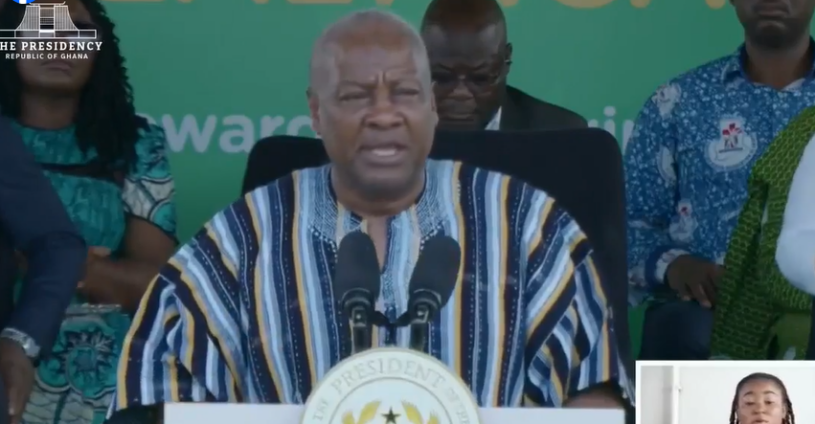
President John Mahama has cautioned Ghanaians against the habit of eating heavy meals late at night.
He warned that such lifestyle choices are contributing significantly to the growing burden of non-communicable diseases (NCDs) in the country.
Speaking at the launch of the Free Primary Healthcare Programme at the Shai Osudoku District Hospital on April 15, 2026, he urged the public to adopt healthier routines, including earlier meal times and increased physical activity.
He said: "...And so one of the aspects of the free primary healthcare too will be to educate people on what makes you susceptible to non-communicable diseases, how to change your lifestyle.
"I mean, if you are the kind of person who likes eating heavy foods, you are not physically active, you are sitting in one place, and yet, when they give you your fufu or Banku, you say it's too small, you want a big bowl of fufu, and you want to eat it every day.
"Sometimes you eat it at night before you go to sleep, all those dietary changes you will be educated on".
"Please, by seven o'clock, eat your dinner and don't eat again. If you are hungry, just take a cup of tea or something. Don't eat any heavy food (such as banku) in the evening.
"You come from work in the evening, and then your poor wife is tired, and you come and say, ' Do Banku for me, at 10 o'clock at night, why?"
The President linked poor dietary habits and sedentary lifestyles to the rising incidence of NCDs, which he described as the leading disease burden in Ghana.
He noted that conditions such as breast cancer, cervical cancer, hypertension, strokes, cardiovascular diseases and kidney failure were increasingly prevalent due to lifestyle changes.
“With the Free Primary Healthcare Programme, we are trying to prevent, especially, non-communicable diseases before they become something else. The NCDs have become the heaviest disease burden in Ghana,” he said.
President Mahama explained that a central pillar of the new healthcare policy would be preventive education, aimed at helping citizens understand risk factors and make informed lifestyle choices.
He observed that while previous generations consumed similar diets, they remained healthier due to higher levels of physical activity, particularly through manual labour.
In contrast, he said, modern lifestyles characterised by prolonged sitting, limited exercise and excessive food intake were worsening health outcomes.
The Free Primary Healthcare Programme, he added, is designed to shift the country’s health system from a treatment-focused approach to one centred on prevention, early detection and community-level care.
He further clarified that the initiative would complement, rather than replace, the National Health Insurance Scheme, with basic services such as screening and treatment for common illnesses to be provided free of charge at Community-based Health Planning and Services (CHPS) compounds.
“The Free Primary Healthcare complements the National Health Insurance, and so at that level it is free of charge. You go to the screening, everything is free of charge,” he said.
More complex cases, he explained, would be referred to higher-level facilities where patients could access care using their NHIS cards.
To support implementation, the President announced plans to deploy health professionals and volunteers, including national service personnel and trained but unposted nurses, to primary healthcare facilities across the country.
“We are going to have a category that we will call health volunteers. These will be national service personnel, nurses, and other paramedics who have finished school and are waiting for posting,” he said.
He assured that those who volunteer under the programme would be given priority during recruitment and postings.
The policy is expected to be rolled out across 150 districts nationwide, supported by the distribution of approximately 24,000 pieces of medical equipment to strengthen frontline healthcare delivery.
Latest Stories
-
Sam George cautions ministers against reading unverified AI-generated speeches
55 seconds -
Ghanaian entrepreneur Mary Nyamekye Asamoah wins Africa Travel 100 award
4 minutes -
Obuasi SHTS abuse: Sanction all officials who failed to act – Moving Masculinity
9 minutes -
Lucy Agyepong honoured for excellence in engineering education at maiden GAAS Women’s Awards
12 minutes -
Harriet Afia Konadu Asiedu
19 minutes -
AFCON 2027: Sports Minister ‘convinced’ Black Stars will qualify despite losing opening two games
20 minutes -
CUTS welcomes VAT collection on cross-border digital services, urges fair treatment of Distance Learning students on overseas programmes
24 minutes -
Leave the Chiefs and fix the Galamsey Problem: Dr Solomon Owusu Advises President Mahama
27 minutes -
Pay attention to teachers and give them what is due – Ho District GNAT tells government
30 minutes -
Authorities knew of abuse allegations against Obuasi headmaster months before suspension – JoyNews investigation
35 minutes -
US teenager appears in court over alleged Hindu temple shooting plot
38 minutes -
Academic City donates paediatric rehabilitation staircase to Ga East Hospital
41 minutes -
Services drive 7.4% expansion in Ghana’s economic activity
53 minutes -
‘I don’t make music for awards, I make it to connect people’ – Rocky Dawuni
1 hour -
Farmer jailed for three months over assault on wife in viral video
1 hour