

Audio By Carbonatix
A 10-day ceasefire between Israel and Hezbollah took effect early Friday, aiming to halt a devastating conflict that has become a central obstacle in the broader war involving the United States and Iran. The truce comes as President Donald Trump announced that the U.S. and Iran are "very close" to a separate deal to end their direct war, a development that could signal a major shift in regional stability.
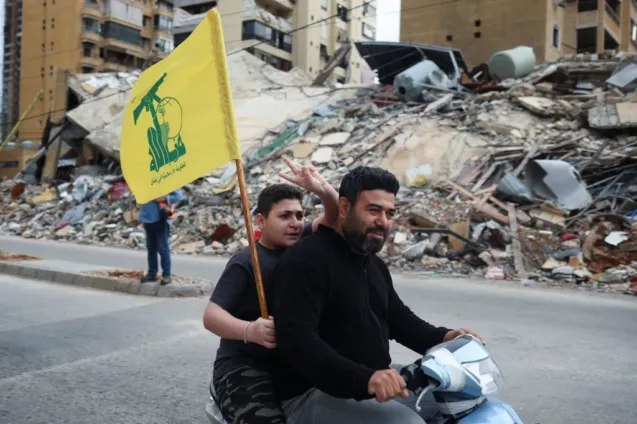
The ceasefire brought temporary relief to Beirut, where fireworks and red streaks of tracer fire lit the skyline at midnight. However, the truce remains precarious as the Lebanese army accused Israel of "a number of acts of aggression" and intermittent shelling in southern Lebanon just hours after the start. Displaced families began moving toward southern suburbs despite warnings from officials to wait until the stability of the truce is confirmed.
Strategic Objectives and Military Presence
Prime Minister Benjamin Netanyahu confirmed his agreement to the ceasefire to "advance" peace efforts, yet he maintained a firm stance on Israel’s military footprint. Israeli forces have established a security zone extending 10 kilometres (6.2 miles) into southern Lebanon. Regarding the ongoing presence of his troops, Netanyahu stated, “That is where we are, and we are not leaving.” The U.S. State Department clarified that while Israel will not carry out "any offensive military operations against Lebanese targets," it reserves the right to defend itself “at any time, against planned, imminent or ongoing attacks.” Conversely, a Hezbollah official warned that the group reserves the right to respond, noting that Lebanese people have “the right to resist” Israeli occupation.
Diplomatic Breakthroughs and White House Involvement
The truce resulted from intensive diplomacy led by the Trump administration, marking the first direct talks between Israeli and Lebanese ambassadors in Washington in decades. Vice President JD Vance reportedly played a pivotal role, with a senior official noting he “pushed the Israelis for days to be more careful in Lebanon,” in hopes that ending the loss of life would soothe regional tensions. President Donald Trump, who suggested a White House summit could occur within two weeks, hailed the agreement as a “historic day” and indicated the U.S. and Iran are "very close" to a separate deal. Speaking at a Las Vegas event for his "no tax on tips" policy, Trump expressed optimism regarding the broader conflict, stating, “I will say the war in Iran is going along swimmingly. It should be ending pretty soon,” before adding, “It was perfect. It’s perfect. It was the power we have.”
Regional Impact and the Global Energy Crisis
The conflict has exacted a heavy human toll, with at least 3,000 killed in Iran, 2,100 in Lebanon, and 13 U.S. service members. Beyond the human cost, the war has triggered an energy crisis due to Iran’s closure of the Strait of Hormuz. IEA Executive Director Fatih Birol warned that Europe has “maybe six weeks or so” of jet fuel left. While the United States maintains a naval blockade and warns that Iran retains “thousands of missiles” and drones, a senior Iranian official insisted there is “no concern about the supply of essential goods” in Iran. Meanwhile, the leaders of Britain and France will host a virtual meeting on Friday to discuss reopening the strait.
Prospects for an Extended Peace
Negotiations are currently focused on Iran’s nuclear program, the Strait of Hormuz, and wartime compensation. Pakistan’s army chief met with Iran’s parliament speaker on Thursday to lobby for an extension. President Trump has indicated a willingness to prolong the pause to facilitate a permanent settlement. During an exchange with reporters, Trump asked rhetorically, “If we’re close to a deal, would I extend? Yeah, I would do that.” A second round of face-to-face negotiations between American and Iranian officials is tentatively expected to take place “probably, maybe, next weekend.”
A Pivot Point for Regional Stability
This ceasefire represents more than a localised pause in hostilities; it serves as a high-stakes barometer for the viability of a broader U.S.-Iran settlement. Whether this window of quiet allows for the permanent reopening of global energy corridors or simply provides a tactical interval for rearming remains the defining question for the coming week. For now, the silence of the guns offers a fragile opportunity for diplomacy to outpace the momentum of a multi-front war.
Latest Stories
-
Galamsey destroying fish farms, threatening aquaculture – Fisheries Commission
4 minutes -
Adu-Boahene trial put on hold pending Supreme Court decision on legal vacation
13 minutes -
Toxic exposure from galamsey puts elderly at greater risk of kidney damage — Public health expert
36 minutes -
Big talk, small receipts: the politics of promises and policy
37 minutes -
Mahama says Ghana will reduce 70% medicine import dependence under five-year plan
40 minutes -
Study reveals high rate of uropathogens among Ghanaian elderly
43 minutes -
Christabel wins first Star Chef title as Big Chef Season 5 begins
43 minutes -
Tanker drivers begin three-day strike over alleged fuel measurement inaccuracies at BOST Kumasi
44 minutes -
Trump says US to reduce military drills with South Korea after it stayed out of Iran war
46 minutes -
Greater Manchester NDC UK branch elects new executives
46 minutes -
Ghana’s anti-corruption fight has stagnated— Transparency International
51 minutes -
UMB, ORC partner to make business registration easier for entrepreneurs
55 minutes -
Cedi is ‘long overdue for a refresh’ – Mahama
57 minutes -
GenCED urges NPP to extend 50% nomination fee reduction to women, youth and PWDs
1 hour -
The source of cedi appreciation matters more than the appreciation itself
1 hour