


Audio By Carbonatix
In late April, India's Sun Pharmaceuticals agreed to pay $11.75bn (£8.59bn) to acquire New York-listed women's health and biosimilars firm Organon & Co.
It marked the biggest overseas acquisition by an Indian company in nearly two decades and followed a string of high-profile international deals by Indian firms in recent months.
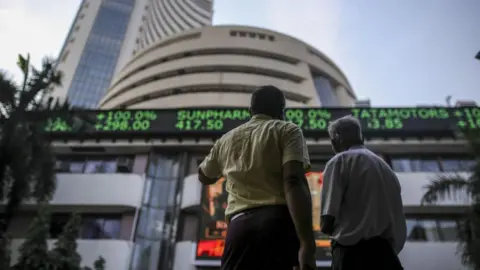
These include Tata Motors' $4.4bn acquisition of Turin-based vehicle maker Iveco, IT company Coforge's $2.35bn purchase of Silicon Valley-based AI firm Encora and the Bajaj Group buying a 23% stake in global insurance giant Allianz SE earlier in 2025.
Data from consultancy Grant Thornton shows that 162 Indian companies spent more than $18bn on outbound acquisitions in 2025 - a 34% increase from the previous year.
"We could cross $15bn in deal value in just the first half of this year," Sumeet Abrol, partner and national leader at Grant Thornton, told the BBC.
For many, this new wave of overseas acquisitions by India Inc evokes memories of the global buying spree led by companies such as the Tata Group two decades ago, when it made audacious bets for global trophy assets like Jaguar Land Rover and Corus Steel.
But several analysts told the BBC that the motivations this time are somewhat different. Indian companies are pursuing Western assets not simply as symbols of global ambition, but increasingly for strategic and operational reasons.

The broader economic backdrop has also changed sharply since the early 2000s. During the previous acquisition boom, India was in the midst of a roaring bull market. Today, the country is grappling with a rapid exodus of foreign portfolio investors, a sharp slowdown in net foreign direct investment (FDI) and stubbornly weak private sector investment despite tax cuts and production-linked subsidies offered by the government.
"Corporate profits [of India's top 500 companies post-Covid] grew at 30.8% per annum. But still, our overall capital formation rates from the private sector have been disappointing," India's chief economic advisor V Anantha Nageswaran recently said at a policy conference.
Experts say the rush to expand overseas - despite repeated exhortations from the government to invest more within India - reflects both growing disaffection with the domestic business environment and better diversification and capability-building opportunities abroad.
"There is plenty of Indian money heading abroad. Even among the companies that we own in our portfolio, many are setting up greenfield factories in the US and other places where industrial land is almost free and accessing working capital is much easier than here," Saurabh Mukherjea of Marcellus Investment Managers told the BBC.
And it's not just the big companies driving the trend.
While the Sun Pharma deal, or tycoon Mukesh Ambani's reported backing of a $300bn oil refinery project in Brownsville - announced by Donald Trump, though not publicly confirmed by the Ambanis - may be among the most high-profile examples, Mukherjea said "dozens of smaller Indian companies are making similar greenfield investments or pursuing smaller acquisitions".
This trend is supported by stronger balance sheets and improved access to global financing, according to Neha Singh, co-founder of the data intelligence company Tracxn.
"Indian companies are increasingly looking overseas to access markets, brands, technology capabilities, R&D expertise, and established distribution networks that may otherwise take years to build organically," Singh said.
These acquisitions have also picked up pace as companies look to protect their supply chains in a world where chokepoints and trade tariffs are being rampantly weaponised, say experts.
Overseas acquisitions, however, can be hit or miss.
Tata Steel's purchase of Corus Steel, for instance, turned out be an "albatross" around the company's neck for decades, says Mukherjea.
What is alsostriking, he adds, is that even after all these years, Indian companies are still unable to pay for these deals with shares. Even a deal as large as the Sun Pharma one was all-cash, which can be financially risky.
Still, this will not be the last of such acquisitions.
A spree of free trade deals between India and the UK, Europe, Australia and other countries could hasten the trend and lead to a "deluge of outbound deals from India as companies head off to invest in the West to build up bases in the years to come", Mukherjea says.
Moreover, many next-generation corporate scions are choosing to live and study abroad, so it is logical that they would want to hold their assets in foreign currency, "especially because the rupee loses 40% of its value to the dollar every decade", he adds.
But the overseas expansion is likely to be accompanied by "selective caution" on large domestic investments, says Singh.
India remains locked into a cycle of weak demand and anaemic private investment, a trend that has now also been further exacerbated by a global energy shock and the risks agentic-AI poses to its already weak job market.
Whether India surpasses last year's $18bn figure remains uncertain because of the current "geopolitical air pocket", says Abrol of Grant Thornton.
But the long-term trend, experts say, is directionally clear: Indian companies will hedge more and more against growing economic uncertainties in Asia's third largest economy at a time when its government is desperately trying to curb an outflow of dollars and attract foreign capital to kick-start the domestic growth engine.
Latest Stories
-
GAF sets Sept. 28–30 for Documentation, Body Selection Exercise
23 minutes -
I resigned five months ago – BoG Governor Asiama explains GoldBod Board exit
39 minutes -
Trump says men arrested at UK air base used by US were looking to do ‘big damage’
55 minutes -
Trump confirms meeting with Anthropic’s Amodei, repeats dismissal of AI fears
1 hour -
China pushes back against US on Iran and Cuba in UN speech
1 hour -
OpenAI, Anthropic CEOs called to appear at Australian AI probe
2 hours -
Nigeria come from benhind to win in AFCON 2027 qualifier
4 hours -
South African white genocide does not exist, new ambassador to US tells BBC
4 hours -
T-bills auction: Government exceeds target marginally; yield on 91-day bill remains unchanged
4 hours -
Pope says ‘scourge’ of abuse must be rooted out as he visits Lourdes
5 hours -
GPL 2026/27: 10-man Aduana hand Kotoko defeat in Kumasi
5 hours -
News media must stay relevant or ‘society will struggle’, says World News Day boss
5 hours -
Kenyan High Commissioner hosts Heads of Mission from 25 countries
5 hours -
Embattled Serbian president resigns, paving way for early elections
5 hours -
GPL 2026/27: Medeama ease past Basake Holy Stars
5 hours