

Audio By Carbonatix
Private capital is central to the financing West Africa's mining and energy projects. However, investors remain cautious about committing long-term funds amid regulatory uncertainty, project execution risks, and changing fiscal regimes.
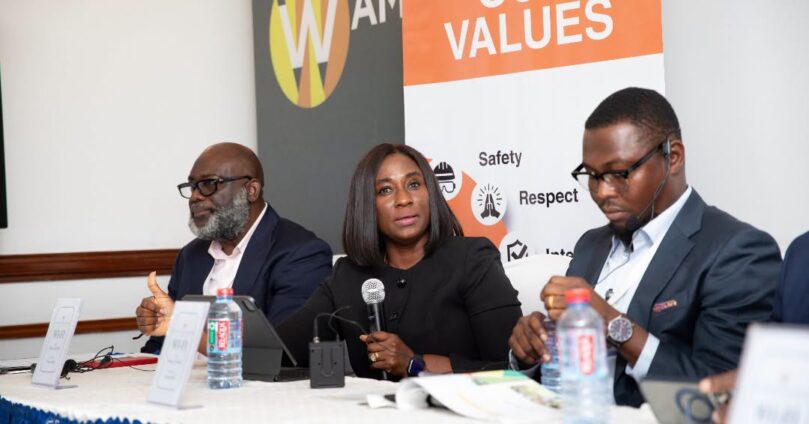
Speaking to Joy Business at the 19th West African Mining and Power Expo (WAMPEX) in Accra, Stanbic Bank's Executive Vice President for Mining and Metals, Lorraine Mac-Pod, said while interest remains strong, several structural problems are making financiers cautious.
She explained that mining projects need huge capital injection and long term investment which take years to pay back. However, most banks work with deposits that are short or medium term.
"One of the challenges is the sheer scale of capital required for these projects," she said. "The payback period is often much longer, while most banks operate with deposits that are largely short to medium term in nature. That mismatch can limit the amount of long-term financing available to the sector."
She also pointed to regulatory delays. When governments take too long to approve projects, it pushes back implementation and messes up funding schedules.
Frequent changes to taxes, royalties, or mining laws also make investors nervous, she added.
"Predictability is very important for investors," Mac-Pod said. "When fiscal regimes change frequently, it creates uncertainty around project economics and can make financiers more cautious."
Global mineral prices go up and down. That affects how much money a project can make. Mac-Pod noted that financial tools like hedging can help manage some of that risk.
Beyond traditional financing issues, Stanbic Bank says environmental, social, and governance standards have become central to investment decisions.
Mac-Pod stressed that ESG is no longer just a box to tick. It now determines whether a project gets funded.
"The ESG bar is rising," she said. "ESG is no longer a compliance overlay; it is a credit determinant."
She was blunt about what happens if a project fails the bank's ESG checks.
"If a project does not pass our ESG screening, it is unlikely to be funded," she said. "Every transaction is assessed through an ESG lens to ensure it meets the standards required by investors and financial institutions."
Mac-Pod's comments come as West African governments try to pull in private capital for mining and energy infrastructure. Many are now reforming regulations, tightening environmental and governance rules, and pushing public-private partnerships.
The 19th WAMPEX brought together industry players, investors, policymakers, and tech companies to discuss the future of the region's mining and power sectors.
The bottom line, according to industry watchers: countries that offer stable rules, strong governance, and sustainable investment climates will win the race for mining cash.
Latest Stories
-
The 7-foot giant of Ngleshie Amanfro: Seven-foot Ghanaian Ephraim Saawa dreams of joining the national basketball team
35 minutes -
Government promises support for Kumasi Central Market fire victims
42 minutes -
Vibes The Movie: Big Ghun’s Ghanaian film earns five nominations at 2026 REFFA
1 hour -
MamaCare CEO warns unresolved conflicts among health workers could undermine maternal and neonatal care
2 hours -
Health professionals urged to translate medical knowledge into practice to save mothers
2 hours -
Conflicts among care providers linked to maternal, neonatal deaths – Expert
3 hours -
GIS marks 10th TIME conference, champions improved teaching practices
3 hours -
BRICS Or Balance? What Ghana’s bid really means
4 hours -
GPRTU wants full TRAFFITECH-GH implementation to start in 2027
4 hours -
Mahama announces plans to import electric wheelchairs for PWDs
4 hours -
KGL U17 Colts 2026: Western beat Prempeh Elite Academy to set up final final with Greater Accra Region
5 hours -
Late Solanke strike salvages 10-man Spurs draw at Man United
5 hours -
Gender Ministry to monitor welfare of Nana Akua Addo’s children amid domestic violence case
5 hours -
Benedict Okyere Yeboah: Ghana’s football problem goes beyond sacking a coach
5 hours -
GPL 2026/27: Darkwah Wiafe’s winner sees All Blacks beat Kotoko
5 hours