

Audio By Carbonatix
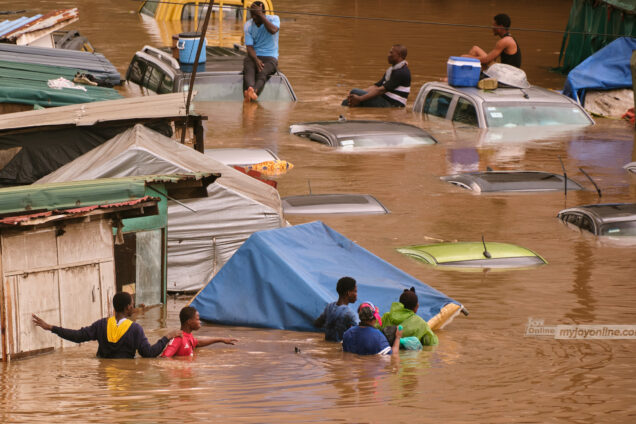
Former Member of Parliament for Adentan, Kojo Adu Asare, has blamed recurring flooding in Accra on poor leadership, weak planning and a lack of commitment to enforcing existing regulations.
According to him, Ghana already knows how to address the problem but has failed to act.
Speaking in an interview on Asempa FM’s Ekosii Sen show, Mr Adu Asare said Metropolitan, Municipal and District Assemblies (MMDAs) have focused mainly on issuing stop-work notices to developers instead of implementing comprehensive planning measures for communities.
“All the assemblies know is to issue stop-work notices on buildings, but they have no proper plan for the communities. We know what to do, but we won’t do it, so I have no solution to offer anymore,” he said.
According to the former MP, the country’s flood challenges are also driven by the collective actions of citizens and the failure of leadership at various levels to enforce planning and environmental regulations.
“Our contributions are also part of the problem and the lack of leadership at the various assembly levels. We are concentrating leadership at the apex, meanwhile leadership is even in our homes, churches and communities,” he stated.
Mr Adu Asare said people who insist on doing the right thing are often criticised, allowing indiscipline and impunity to persist.
“When you want the right thing to be done, you become the villain. We have allowed impunity to run for a very long time. We know what to do, but we won’t do it, so here we are,” he added.
He argued that although government can provide financial support after flood disasters, the problem will persist unless resources are backed by a long-term development plan.
“Money can be given out, but it won’t solve the problem if we don’t commit it to a plan that will make things work,” he noted.
Mr Adu Asare recalled proposing planning measures years ago, including requiring homeowners to leave portions of their compounds unpaved to allow rainwater to soak into the ground instead of flowing into already congested drains.
“Some years ago, I even suggested that everyone building should leave space for grass and not pave the entire house. All that water, when it rains, will try to find its way when the gutters are overflowing,” he said.
He lamented that discussions on flooding often fade once the rains subside, only to resurface after the next major downpour.
“Now the rains have stopped, we wait for next year and come and talk about the same problem,” he said.
Latest Stories
-
Africa not seeking Western cash in reparations campaign – Ablakwa
10 minutes -
Production decline, reserve depletion threaten Ghana’s upstream sector – Jinapor
15 minutes -
Surveyors caution against treating compensation disputes as professional misconduct
17 minutes -
Mahama calls for AU dialogue on migration after South Africa xenophobic tensions
22 minutes -
I haven’t experienced any envy in the gospel music industry — Ohemaa Mercy
2 hours -
Prayer does not solve everything — Ohemaa Mercy
2 hours -
New PURC office symbolises stronger consumer protection – Dr Jinapor
3 hours -
Rev. Wengam re-elected Assemblies of God, Ghana General Superintendent
3 hours -
Less than 20km of clearing left to connect Accra-Kumasi Expressway to Kumasi – Agbodza
3 hours -
US judge strikes down policy suspending immigrant visa processing for 75 nations
3 hours -
MCEs collecting fees from galamseyers are facilitating illegality – Ken Ashigbey
3 hours -
Developer LMI Holdings commits to completing first 700 Saglemi housing units
3 hours -
Africa’s next chapter will be built by institution-builders, not idea-havers
3 hours -
Wenchi Traditional Council suspends Twafohene indefinitely
4 hours -
Kpassa-Merimeri road undergoes filling and levelling works to improve accessibility
4 hours