

Audio By Carbonatix
Introduction
Across sub-Saharan Africa, urban flooding has evolved from a seasonal hydrological event into a persistent governance crisis. In Ghana, particularly within the Greater Accra Metropolitan Area, flooding is no longer an occasional inconvenience but a recurring urban emergency with significant human, economic, environmental, and public health consequences. Between 2015 and 2025, flooding in Greater Accra alone resulted in economic losses exceeding GHS 6.3 billion (approximately USD 510 million).
These losses include an estimated GHS 1.8 billion in damage to small and medium-sized enterprises (SMEs), GHS 2.1 billion in public infrastructure destruction, and GHS 800 million in residential property damage. Nationally, Ghana loses an estimated USD 200 million annually to natural disasters, equivalent to nearly 2 per cent of GDP, while more than two million people are affected each year. The persistence of these losses demonstrates that flooding in Ghana is no longer merely an environmental problem; it is fundamentally a governance challenge requiring coordinated institutional action.
The Crisis Persists
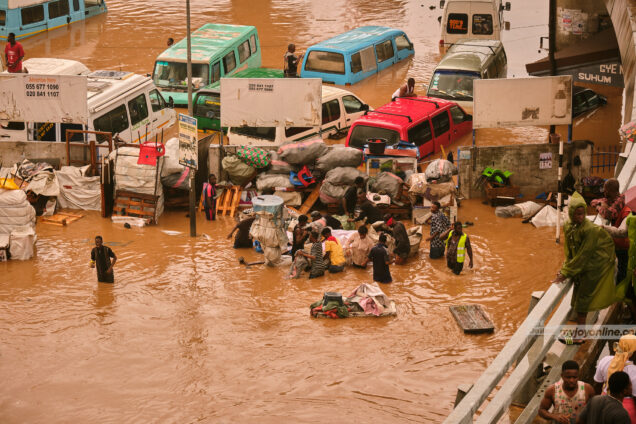
The devastating floods that followed the heavy rains in early June 2026 once again exposed the vulnerability of Accra's urban landscape. Communities including Kaneshie, Odawna, Adabraka and Kwame Nkrumah Circle were submerged within hours as roads became rivers and businesses came to a standstill. According to the National Disaster Management Organisation (NADMO), approximately 3,000 residents in the Odawna area were directly affected. By 30 June 2026, 12 fatalities had been confirmed, increasing to 13 the following day. Meanwhile, the Ghana National Fire Service reported rescuing more than 470 people trapped by the floodwaters.
These recurring disasters raise legitimate questions about the effectiveness of existing flood mitigation investments. The Greater Accra Resilient and Integrated Development (GARID) Project, financed by the World Bank, was initially approved at USD 350 million to address flooding within the Odaw Basin. However, USD 65 million was later reallocated to Ghana's COVID-19 response, reducing the available funding to approximately USD 285 million. By June 2025, USD 118 million of the USD 127 million drawn down had already been spent, yet flooding continues to devastate many of the same communities.
Where Are We Getting It Wrong?
The recurring floods are not simply the result of heavy rainfall. Rather, they reflect deep institutional fragmentation, weak enforcement of planning regulations, inadequate sanitation systems, and persistent behavioural challenges.
Weak Land Use Enforcement and Institutional Fragmentation
A major driver of flooding is the persistent disconnect between municipal spatial planning authorities and informal land allocation practices by traditional authorities. This institutional disconnect continues to permit construction within wetlands, natural waterways and statutory buffer zones. Field assessments and environmental mapping consistently reveal permanent structures occupying natural drainage channels. Unfortunately, political influence, social status and weak enforcement often delay or prevent the removal of illegal developments. Consequently, floodwaters are diverted into neighbouring communities, increasing downstream vulnerability.
The country's growing housing deficit has further encouraged informal settlements on public lands and waterways. Many landlords have converted temporary or substandard structures into rental accommodation under deplorable sanitary conditions. Numerous compounds lack basic toilet facilities, resulting in the indiscriminate discharge of liquid waste into open drains and surrounding environments.
Poor Sanitation and Waste Management
Solid waste remains one of the greatest contributors to Accra's flood problem. Approximately 70 per cent of the city's primary drainage channels are heavily silted with refuse, reducing their carrying capacity by nearly 50 per cent. Responsibility for cleaning drains and maintaining communal spaces is often unclear. Disputes among landlords, tenants and residents frequently delay waste collection, allowing refuse to accumulate in gutters and waterways. Following flood events, communities are exposed to elevated public health risks. Between 2015 and 2025, flood-related diseases, including cholera and other waterborne infections, generated an estimated GHS 360 million in public health losses.
Weak Compliance with Building Regulations
Urban expansion has significantly outpaced regulatory enforcement. Only about 35 per cent of buildings within Accra possess approved building permits, while Metropolitan, Municipal and District Assemblies (MMDAs) inspect fewer77 than 20 per cent of structures annually. Rapid urbanisation has also replaced natural permeable surfaces with concrete, increasing stormwater runoff while eliminating natural retention areas that previously absorbed excess rainfall.
Limited Preparedness and Community Ownership
Despite years of flooding, preparedness remains inadequate. Less than 15 per cent of flood-prone communities possess functional early warning systems or documented emergency response plans. Evidence increasingly demonstrates that household and community behaviour significantly influences flood risk. Yet sanitation and drainage maintenance continue to be perceived largely as the sole responsibility of government. Community participation in pre-rainy season clean-up exercises remains inconsistent, with fewer than 40 per cent of households regularly participating in communal labour. Illegal waste disposal and unauthorised construction have also become socially tolerated, partly because enforcement is often perceived as inconsistent or politically selective.
The Governance Challenge
Flood management in Ghana suffers from divided institutional mandates but shared consequences. Responsibility for land use planning, sanitation, drainage maintenance, disaster management and environmental protection is distributed across several institutions whose mandates frequently overlap without effective coordination. As a result, agencies often operate in silos, data sharing remains weak, and accountability becomes diffused. Meteorological forecasts are not consistently integrated into urban planning decisions, while digital technologies capable of monitoring illegal developments and flood risks remain underutilised. Ultimately, flooding in Accra reflects not only engineering failures but also governance failures.
Behavioural Challenges and Flood Risk
Flooding in Accra is not only the result of institutional failures and inadequate infrastructure; it is also driven by persistent behavioural practices that increase urban flood risk. Indiscriminate disposal of solid waste into drains, illegal construction in waterways, weak compliance with sanitation by-laws, and limited community participation in routine clean-up exercises continue to undermine flood prevention efforts. Many residents perceive sanitation, drainage maintenance and environmental protection as the sole responsibility of government, resulting in low levels of civic ownership and accountability. Furthermore, inconsistent enforcement of regulations has gradually normalised behaviours such as littering, encroachment on wetlands and unauthorised developments. Addressing these behavioural challenges requires sustained public education, consistent enforcement of environmental laws, incentives for community participation, and social behaviour change campaigns that promote shared responsibility for protecting public spaces and drainage infrastructure. Building a culture of environmental stewardship is essential if Ghana is to achieve long-term urban flood resilience.
Conclusion
Engineering interventions alone will continue to produce sub-optimal outcomes unless the underlying institutional ambiguities are addressed. Sustainable flood management requires a centralised and cross-sectoral urban resilience framework supported by statutory reforms that clearly define institutional responsibilities and impose sanctions for jurisdictional negligence. Flooding in Accra is as much a governance and behavioural challenge as it is a hydrological one. Lasting solutions require consistent enforcement of planning regulations, stronger community ownership of sanitation, investment in climate-resilient infrastructure, and greater integration of digital technologies into urban governance.
With mobile phone penetration exceeding 80 per cent, Ghana possesses a unique opportunity to deploy Geographic Information Systems (GIS), artificial intelligence, satellite monitoring and citizen reporting platforms to strengthen flood prediction, enforcement and emergency response. The challenge before Ghana is to move beyond reactive disaster response towards proactive, data-driven and community-owned urban resilience.
Recommendations
To strengthen flood governance and improve long-term resilience, the following actions are recommended:
- Strengthen enforcement of planning regulations. Metropolitan, Municipal and District Assemblies should conduct regular inspections of flood-prone communities and remove all unauthorised structures occupying waterways, wetlands and statutory buffer zones, irrespective of ownership or political influence.
- Institutionalise accountability for MMDCEs. The President's directive on sanitation should require every Metropolitan, Municipal and District Chief Executive (MMDCE) to submit a comprehensive report detailing the flooding and sanitation interventions undertaken during the two-day national clean-up exercise, the measurable outcomes achieved, and a sustainability plan for maintaining those gains. This exercise should mark the beginning of continuous institutional accountability rather than a one-off event.
- Improve sanitation and vector control. Assemblies should coordinate post-clean-up fumigation exercises to eliminate mosquitoes and their larvae and establish protocols requiring vector control activities within 72 hours after major flood events.
- Leverage technology for monitoring and enforcement. Government should publish GIS maps of waterways and buffer zones while deploying AI-powered satellite monitoring to detect illegal developments. A citizen reporting platform using geo-tagged WhatsApp images and AI image recognition should automatically route reports of blocked drains and illegal dumping to the appropriate MMDA within 48 hours.
- Strengthen early warning systems. Stakeholders should install low-cost hydrological sensors in priority drainage channels and deploy AI models to analyse rainfall and water-level data, enabling SMS and WhatsApp alerts to vulnerable communities 6–12 hours before anticipated flooding.
- Clarify community responsibilities. Assembly Members and Unit Committees should demarcate and publicly display sanitation and drainage maintenance zones for every community. Quarterly community engagement meetings should be institutionalised to monitor sanitation performance and resolve disputes.
- Address housing and sanitation deficits. Enforcement against encroachment on waterways must be accompanied by investments in affordable housing and adequate public sanitation facilities to prevent the re-emergence of informal settlements in high-risk areas.
- Invest in resilient infrastructure. Government should ensure complete desilting of primary drains before each rainy season, secure additional financing for GARID and related resilience initiatives, and achieve universal early warning coverage across all NADMO-designated flood-prone communities by 2030.
- Promote behavioural change through sustained public education and community engagement. MMDAs, the National Commission for Civic Education (NCCE), schools, faith-based organisations and traditional authorities should collaborate to implement continuous behaviour change campaigns on waste disposal, sanitation, flood preparedness and environmental stewardship. Digital platforms, social media and AI-enabled communication tools should be used to reinforce positive behaviours, monitor public engagement and encourage citizen participation in protecting drains and waterways.
KEY REFERENCES
1. National Disaster Management Organisation. (2025, November 11). Ghana loses approximately $200 million annually due to natural disasters, with over two million people affected each year. Ghana News Agency. Equivalent to nearly 2% of GDP.
2. United Nations Development Programme. (2025, October 14). Ghana suffers an estimated annual loss of over GHS 300 million due to floods and related disasters. The Greater Accra Region alone accounts for nearly GHS 200 million of these losses each year.
3. World Bank. (2023, May 25). World Bank Supports Ghana to Improve Flood Resilience for 2.5 million People. Press Release. Notes the $150 million additional financing for GARID and the June 3, 2015 flood that affected 53,000 people with $55 million in damages.
4. Ministry of Local Government, Chieftaincy and Religious Affairs. (2025). Ghana is losing more than GH¢6.2 billion annually through flood-related destruction, healthcare costs and environmental degradation caused by poor waste management.
5. UNDRR / MyJoyOnline. (2025). Accra Flood Risk Profile. Notes that approximately one-third of the Accra Metropolis is classified as flood-prone and that the June 3, 2015 disaster caused over 150 deaths and $55 million in damage.


-
Authored by: Victor Doke, PhD & Rebecca Y. Akatue, PhD
Latest Stories
-
I expect to win NPP Vice Chairman race – Nana B
5 minutes -
NDC’s failed 24-Hour Economy has become 24-Hour demolition – Dr. Bawumia
17 minutes -
Stampede at NPP conference leaves three injured in Kumasi
28 minutes -
Use power to serve Ghanaians, not to intimidate – Okoe Boye to NDC
32 minutes -
“I’ll have no honour if your arrears are not paid by October 30,” Haruna Iddrisu tells teachers
33 minutes -
Billboard collapses at NPP delegates conference, 4 vehicles damaged
37 minutes -
NPP Delegates Congress: The 14 approved constitutional amendments
38 minutes -
EOCO’s handling of arrests could cost NDC power – Kpebu
57 minutes -
Health sovereignty a priority for 1.4b Africans – President Mahama declares
1 hour -
NACOC begins pre-screening checks at Accra International Airport
1 hour -
‘I was stepping up into an alliance’ – Sammy Crabbe clarifies John Boadu backing
1 hour -
Turn CSIR research into commercially viable products for national dev’t – Dr Agyeman-Rawlings
2 hours -
Baffour Awuah thanks Bawumia, NPP supporters after GH¢10m bail
2 hours -
Ghana gaining notoriety for drugs – Bawumia demands bipartisan probe
2 hours -
Government urges SMEs to embrace digitalisation for growth and job creation
2 hours