

Audio By Carbonatix
For many households and businesses in Ghana, the real cost of owning an AC is not the amount paid at the showroom or the installation fee. It is the electricity bill that follows every month for the entire lifespan of the unit's operation. As temperatures continue to rise and air conditioning becomes increasingly necessary, many consumers believe that owning an AC is an unavoidable cost of staying cool in a hot environment. But a significant part of that bill is not just the cost of cooling your room. It is the cost of a unit that does not know when to stop wasting electricity, running on technology that is decades old and built around chemical refrigerants, which the world is now moving away from.
A conventional split AC commonly found in homes and offices often uses cooling technologies and refrigerants such as R22, R410A, and R32, which typically consume a high amount of electricity. Most of these units rely on a fixed-speed compressor that can only operate at full power or switch off completely, then turn back on. This constant switching on and off draws a surge of electricity each time the compressor kicks back in, making the system inherently inefficient and keeping energy consumption high throughout operation.
A split inverter AC is built differently, with an inverter compressor that is “smart” and speeds up when cooling is needed and slows down once the room reaches a comfortable temperature. The result is that the AC uses only as much electricity as is required. That efficiency alone can make a significant difference to how much you pay for your electricity bill every month.
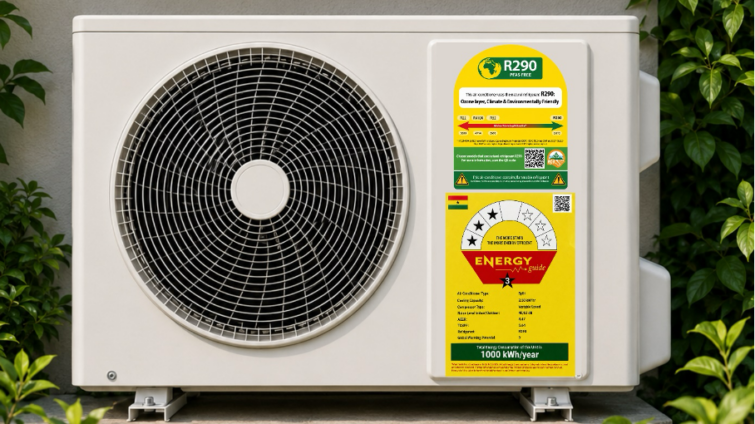
By combining an inverter AC with the superior performance of R290 refrigerant, you get an AC that delivers significantly higher energy efficiency than 98% of conventional units Ghanaians are running today. Moreover, R290 is a natural refrigerant with no negative impact on the environment, the ozone layer, and almost zero climate impact. Therefore, R290 ACs carry an EPA-designated eco-refrigerant label.
According to performance assessment and comparisons conducted by participating importers, 3-star R290 split-inverter AC, rated under Ghana’s Energy Efficiency Standards and Labelling framework (L.I 2458) can save consumers up to 67% on electricity costs per year, compared to running a standard conventional R410A or R32 AC unit. EPA Ghana's published data show average electricity cost savings of GH¢2,000-GH¢4,000 per unit per year, based on approximately 4,000 running hours per year, and electricity savings ranging from about 1,470 kWh to 2,256 kWh annually when compared to standard conventional inverter split AC units. For households and businesses that rely heavily on AC year-round, these savings can add up significantly over the unit's operational lifetime.
For businesses and offices running multiple split AC units, the combined savings across an entire facility can make a material difference to monthly operating costs. For example, if a company has 10 split-inverter ACs, the savings can be up to GH¢ 20,000 and GH¢40,000 per year on electricity costs alone. Improving cooling efficiency is becoming increasingly important as energy demand continues to grow alongside rising temperatures and urban expansion.
Complementing the electricity savings, the 3-star R290 split-inverter AC has a financial incentive mechanism designed to reduce the upfront purchase cost. The Ghana Green Cooling Programme, supported by the Swiss KliK Foundation and implemented by the EPA and GIZ, is incentivising a minimum of GH¢1,100 per AC unit and actively encouraging both households and businesses to make the switch. The R290 split-inverter ACs are available in showrooms across Ghana, through importers who have partnered with the Ghana Green Cooling Programme. These include Hisense, Midea (Electroland), GREE (Unique-Home-Appliances), and, in the near future, Haier (Electromat/Somotex). Think of it this way: an R290 split-inverter AC bought today starts saving you money every month. The lower electricity bill will not be a one-time bonus; it will be a recurring return for the lifespan of the unit, while also contributing to Ghana’s broader commitment to cleaner, more climate- and environmentally responsible cooling.
Consumers should also be aware that the R290 refrigerant, like other refrigerants including R32, requires proper technical handling during installation, servicing, and decommissioning. Refrigerants in ACs such as R22, R410A, and R32, when leaked into the environment, can contribute significantly to global warming. To address this, certified technicians are being trained to safely recover refrigerants before old units are dismantled. Therefore, it is important that consumers give their old AC to a trained technician so it can be recycled accordingly.
Now, as demand for cooling continues to grow in Ghana due to rising temperatures, the transition toward more energy-efficient, climate- and environmentally friendly technologies would play an increasingly important role in the country’s future cooling sector.
*******
The writer, Hilda Aku Asiedu, is a Climate Communications and Development Professional
Latest Stories
-
High cost of domestic airline fares: can the government do something about it?
8 minutes -
Fire brought under control near Osu Castle
10 minutes -
Eleven injured in shooting outside Turkish school
12 minutes -
Ten years after the blackouts, what changed in Ghana’s power story?
19 minutes -
Fisheries Commission inaugurates national-level fisheries co-management committees with support from GFRA
29 minutes -
Rafatu Inusah appointed Chef de Mission for 2027 Commonwealth Youth Games
31 minutes -
Production, market risks and poor records constrain agricultural lending – GIRSAL
35 minutes -
Photos: Gender Ministry presents 2027–2030 priorities at budget technical hearing
45 minutes -
Photos: Mahama engages global leaders in Presidential Roundtable in New York
46 minutes -
Ecobank deepens support for agriculture with dedicated expertise and training – Charlotte Amanquah
51 minutes -
High collateral, documentation requirements limiting farmers’ access to finance – PFA
1 hour -
NPP will be out of opposition in just two years – Afoko vows
1 hour -
5-month-old baby stolen at Asafo Market, police launch manhunt for female suspect
1 hour -
Forklift kills roadside pawpaw seller at Asokwa Brewery
1 hour -
When market traders want to lose weight: What are they doing and who are they listening to?
2 hours