

Audio By Carbonatix
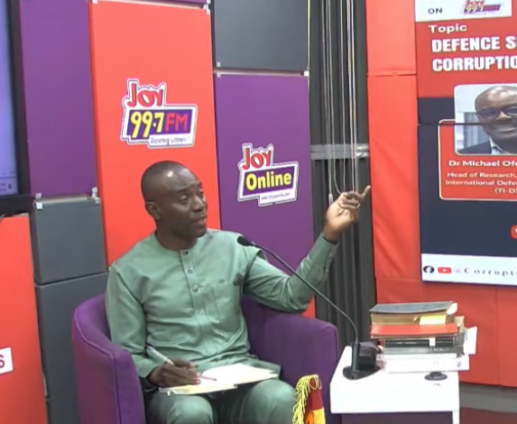
Criminologist and security analyst Dr Emmanuel Sowatey has called for reforms to Ghana's military budgeting process, stronger parliamentary oversight and improved public understanding of the security sector to address corruption risks in the country's defence sector.
Speaking on Joy FM's Super Morning Show during the Corruption Watch segment in collaboration with Transparency International on Wednesday, July 22, Dr Sowatey outlined what he described as four key recommendations for government following discussions on a report that rated Ghana's defence sector as being at high risk of corruption.
Responding to a question from the host on what advice he would give the government, Dr Sowate said the issues go beyond the findings of the report.
"I'll go outside the report to show that, one, the problem is systemic. It's referring to the issue of how to best have value for money in military expenditure. It's not only the expenditure. It's also the budgeting process."
He said the priority should be making military budgeting more consistent with the country's democratic values while striking the right balance between national security and public accountability.
"The first thing I would say is that let's make the military budgeting process more reflective of our democratic governance. The line between national security and transparency can be something very tricky, but it can always be dealt with."
His second recommendation focused on improving what he described as "security sector literacy" among the public, journalists and other stakeholders.
According to him, a better understanding of how the security sector operates would enable citizens to ask informed questions about the use of public resources and whether defence spending aligns with national security objectives.
"We need security sector literacy, because that will then let you ask the right questions about how resources are being used, and how those resources further the spirit and the letter of the defence policy... and then the security policy."
Dr Sowatey also urged young people to take a greater interest in issues affecting the country's security sector.
He observed that although Africa has one of the world's youngest populations and young people are increasingly active on social media and in the use of artificial intelligence, they are often left out of major national decision-making processes.
He suggested that Ghana's history of military coups may have contributed to a culture of self-censorship, discouraging citizens from questioning decisions related to national security.
"The youth, when you combine the youth, social media, AI... generally, the youth are usually outside the boardroom of such major decision-making process. Maybe because of our history of coup d'etat, this feature of self-censorship and fear to ask questions."
He therefore encouraged young people to become more interested in how the security sector is managed.
"I think that the other thing I'll advise is the youth to be more interested in security sector literacy, and ask questions about military budgeting processes and expenditures."
Dr Sowatey's final recommendation was directed at Parliament, particularly the relevant parliamentary committee responsible for defence matters.
He said that legislators must consistently scrutinise military expenditure regardless of whether they are in government or in opposition.
"Parliament, particularly the relevant select committee, should be more interested in asking very difficult questions. Unfortunately, it is when they are in opposition that they ask those questions."
Dr Sowatey referred to a passage from former First Lady Nana Konadu Agyeman-Rawlings' book, It Takes a Woman: Life Shaped by Heritage, Leadership and the Woman Who Defined It.
Quoting from the book, he said,
"It is refreshingly amazing to uncover when a person opens his mind to non-partisan thinking, and he focuses solely on what is best for Ghana, he cannot help but see the wisdom in places and moments where he did not see it before."
Dr Sowatey said the quotation highlights the need for political leaders to put Ghana's national interest above party considerations.
He urged Parliament to adopt that mindset when exercising oversight over the defence sector.
"We should get to a place where what Nana Konadu is saying comes so strongly to us, that we don't only have those robust and genuine questions when you're in opposition, but you also ask them when you're in government. When we put Ghana's security ahead of partisan interest, that is another way for Parliament to be moving ahead in the right direction."
Latest Stories
-
64 arrested over alleged unlawful possession of firearms at Achimota lounge
8 minutes -
Savannah Regional Minister calls for clear rules to distinguish generosity from vote-buying
11 minutes -
TOR secures 950,000 barrels of Sankofa crude from GNPC
13 minutes -
NAGRAT calls for probe into alleged inflation of School Feeding enrolment figures
19 minutes -
Three more arrested as investigation into alleged 2026 school placement fraud expands
22 minutes -
646 military recruits pass out after six-month infantry training at Shai Hills
39 minutes -
The importance of technology and artificial intelligence in tourism
43 minutes -
PURC warns of water supply challenges as Sekyere Hemang plant operates below capacity
51 minutes -
18-Years – A perfectly synchronous age of consent and marriage
59 minutes -
Livestream: ‘Democracy Not for Sale’ Forum underway in Damongo
1 hour -
Is Nkrumah’s glory fading? Nkrumah’s iconic fountain at Circle runs dry
1 hour -
Special agents’ blood and urine test results stolen in FBI hack
1 hour -
Photos: 3rd Republic Bank-JoyNews Habitat Fair Clinic at Junction Mall, Nungua
1 hour -
GCIF cautions public as criminals deploy AI in phishing attacks
1 hour -
Mortuaries and Funeral Facilities Agency gives unlicensed mortuaries 10 days to regularise operations
2 hours