

Audio By Carbonatix
A few days ago, I received on WhatsApp, a heart-breaking video of children wading through water in a community in the Ho West District of the Volta Region on their way to school.
Another one of school children climbing trees over a stream or being helped by a teacher to cross the same stream on a canoe also got me scratching my head over the development challenges stealing the joy of school children in some of the remotest communities in our country.
The situation gets worse every rainy season. School children wade through streams to get to class. Some turn back home. Others risk their lives because there is no bridge. At the same time, thousands of pupils continue to study under trees or in unsafe structures.
These are not engineering challenges. They are failures of local government and its ability to respond to the basic need of communities across the country.
Education Minister Haruna Iddrisu recently disclosed that about 5,000 schools across Ghana still operate under trees, with 759 requiring urgent infrastructure intervention. Other education advocates estimate the number at over 5,400 schools. Regardless of which figure one adopts, the conclusion is the same: too many Ghanaian children still lack decent classrooms.
A case for GAF engineers
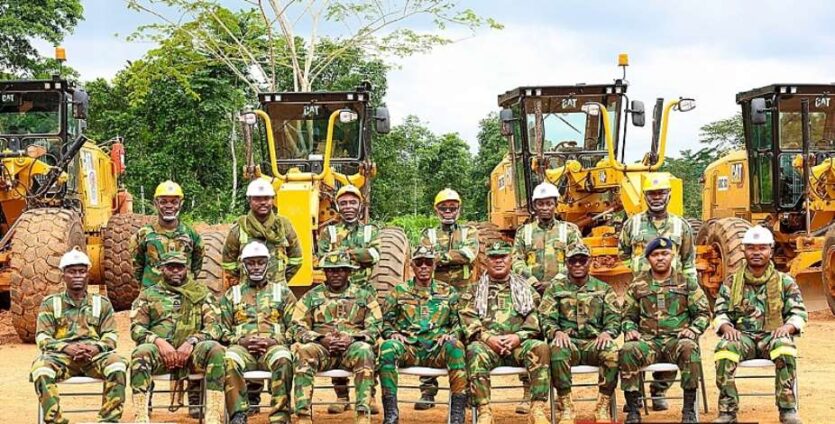
Yet, Ghana possesses a highly skilled national asset that is seldom discussed in conversations about education infrastructure, the 48 Engineers Regiment of the Ghana Armed Forces.
Military engineers exist primarily to support combat operations, but around the world they also build roads, bridges, schools and emergency infrastructure during peacetime. Their work keeps their technical skills sharp while delivering public value.
The Ghana Armed Forces already recognises the Engineers Corps as a key contributor to national development. The Corps comprises the 48, 49, 50 and 51 Engineer Regiments under the 14 Engineer Brigade, with capabilities in construction, bridging and field engineering.
Their expertise should not remain largely confined to military tasks when communities face problems that engineering can solve.
Take rural stream crossings.
Across the country, children still remove their shoes, lift their school bags above their heads and walk through streams to reach school. Every year, floods isolate communities and interrupt education. Building pedestrian bridges over these crossings does not require billion-cedi projects. Many can be solved with modular steel footbridges.
The model is straightforward. The Engineers Regiment provides the structural design, supervision and installation. Local welders fabricate the steel components. District Assemblies provide materials and identify priority sites. Communities contribute labour and maintain the structures.
Such a programme would create jobs for local artisans while delivering durable infrastructure at relatively low cost.
The same thinking should apply to classroom construction.
Rather than waiting years for contractors to mobilise for small projects in remote communities, government could establish a Military Community Infrastructure Programme focused exclusively on basic schools and essential rural infrastructure. Standard classroom designs could be replicated across districts, reducing procurement delays and construction costs.
This is not a case for replacing private contractors. Ghana's construction industry has an important role to play. But where projects are too small, too remote or too urgent to attract commercial interest, military engineers can fill the gap.
The Engineers Regiment has demonstrated its technical capability repeatedly through military engineering operations, infrastructure support and emergency works. The question is not whether they can build. It is whether the country is willing to deploy that capacity where it matters most.
Success should not only be measured by kilometres of highways or multi-million-cedi flagship projects. Sometimes the most important piece of national infrastructure is a simple bridge that allows a six-year-old to reach school without risking drowning.
Ghana does not lack engineers. It does not lack welders. It does not lack disciplined men and women capable of delivering quality public works.
What it lacks is a deliberate policy to bring them together.
If military engineers can build infrastructure to defend the nation, they can also build the small bridges and classrooms that secure its future. The child crossing a stream to attend school deserves nothing less.
Part of the District Assembly Common Fund can also be applied to solve this problem. The District Assembly Common Funds should be carefully monitored not to allow misuse of the funds.
In addition, business magnates are implored to fund first or second degree civil engineering students to adopt some of these projects. As a compliment civil engineering students in the technical universities can also be encouraged to undertake such ventures as part of their project endeavour.
By Dr Paul Kofi Fynn
The writer is the Founder and Chancellor of the Wisconsin International University College and President of the Private University Founders Association of Ghana (PUFAG).
Latest Stories
-
LA 2028: Black Queens hold final training session ahead of second leg against Mauritius
11 minutes -
Standards are not Seasonal: What the EC appointments teach both sides
25 minutes -
King Mohammed VI urges private sector to create youth jobs and spread benefits of growth
25 minutes -
KGL U17 Colts 2026: Greater Accra win title after penalties win over Western Region
26 minutes -
UK Investment Roadshow opens in London to advance UK-Ghana growth partnership
37 minutes -
Assemblies of God requires pastors to resign before entering partisan politics – Rev. Wengam
47 minutes -
Ghana targets 20% annual reduction in maternal deaths – Health Minister
52 minutes -
Cyber attacks in Africa grow faster than global rate, report finds
54 minutes -
Ghana signs UAE deal to create 5,000 overseas jobs
1 hour -
One Million Coders Programme targets 100,000 digital jobs in two years – Sam George
1 hour -
John Jinapor, Italian Ambassador explore opportunities for energy sector investment
1 hour -
NHIA seeks legal reforms to support Free Primary Healthcare
1 hour -
Beatrice Annan defends Afi Agbenyo’s EC appointment, cites record of gender advocacy
1 hour -
Ghana seeks investment deals in Bangkok amid global economic crises
1 hour -
IMF raises Ghana’s 2026 growth forecast to 5.7%, sees inflation falling to 4.8%
1 hour