

Audio By Carbonatix
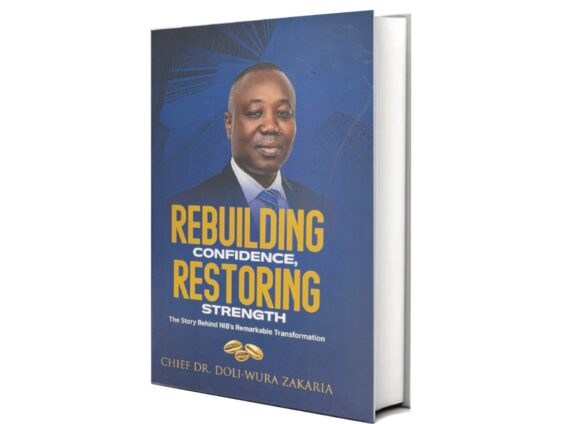
As a journalist, I approached Rebuilding Confidence, Restoring Strength: The Story Behind NIB’s Remarkable Transformation expecting a story about banking, numbers and the recovery of a struggling financial institution, but found something broader.
The book, authored by Dr Doliwura Awushi Abdul Malik Seidu Zakaria, is indeed about the remarkable transformation of the National Investment Bank (NIB), but its lessons stretch far beyond finance. It is a book about leadership, people, systems, accountability, technology and, perhaps most importantly, how leaders manage change when money, technology and people collide.
For me, that was one of the most compelling things about the book. As a journalist, I am constantly looking for the story behind the numbers. This book holds the key to both. It explains not only what changed at NIB, but the thinking, discipline and leadership behind the transformation.
The numbers tell one part of the story. The narrative tells us how those numbers became possible.
As I turned the pages, I found myself drawing lessons that can be applied far beyond the banking sector. Whether you are a journalist, entrepreneur, public servant, manager or young professional, the book offers practical insights into what it takes to lead people and institutions through difficult periods.
Here are seven leadership skills I learnt from reading the book.
1. Visionary thinking: Leaders must see beyond the crisis
One of the strongest lessons from the book is the importance of visionary thinking.
When Chief Doliwura was appointed Managing Director of NIB, he inherited an institution facing serious challenges. But leadership, as the book demonstrates, is not simply about looking at a difficult situation and describing how bad it is. It is about seeing what is possible beyond the crisis.
The transformation was built around the Reset Agenda Strategy, which focused on five pillars: People, Performance, Premises, Assets and Digital Transformation.
That immediately stood out to me.
A leader cannot rebuild an institution by fixing only one problem. You cannot focus only on money while ignoring people. You cannot invest in technology while neglecting culture. You cannot demand performance without strengthening systems.
Visionary leadership means seeing the entire picture and creating a direction that helps people understand where they are going.
2. Leading people through change and resistance
Change sounds exciting until people are asked to participate in it. This is another important lesson I took from the book. Transformation is not simply about announcing a new strategy. Leaders must help people understand why change is necessary.
They must also deal with resistance.
The story of NIB's turnaround shows that people are more likely to embrace change when they can see progress and believe that they are part of the process. Quick wins matter because they build confidence. They help people move from doubt to belief.
The restoration of staff promotions, investment in employees and efforts to rebuild confidence within the institution were therefore not just administrative decisions. They were leadership tools.
The lesson for me was simple: if people do not understand the change, they may resist it. If they do not see progress, they may stop believing in it.
A good leader therefore does not merely introduce change. A good leader brings people along.
3. Data-driven decision-making: Move from “I think” to “the data shows”
Perhaps one of the most practical leadership lessons in the book is the importance of making decisions based on evidence.
The book demonstrates a movement away from assumptions and towards measurable performance.
In simple terms, leadership should move from saying, “I think,” to being able to say, “The data shows.”
That requires dashboards, key performance indicators, cost analysis and a clear understanding of what is happening inside an institution.
For me, this lesson goes beyond banking.
As journalists, we work with information every day. The difference between a weak story and a strong one is often the evidence behind it. The same applies to leadership. Decisions based purely on instinct may sometimes work, but institutions cannot depend on guesswork.
The book reinforces the importance of asking: What do the numbers say? What are the trends? Where are the losses? What is improving? What needs urgent attention?
Data does not replace leadership, but it gives leadership a stronger foundation.
4. Transparency and accountability: Fight corruption by design, not by speech
One of the most important lessons in Rebuilding Confidence, Restoring Strength is that transparency cannot be reduced to speeches and promises.
It must be built into the system.
The publication of audited accounts after more than a decade was a powerful example of this. Transparency can sometimes be uncomfortable, particularly when the numbers reveal difficult realities. But the book makes a compelling case that confidence cannot be rebuilt by hiding problems.
It can only be rebuilt by confronting them.
I was also struck by the author's willingness to acknowledge mistakes, including the late submission of a prudential return to the Bank of Ghana.
That moment matters because accountability is often discussed as something leaders demand from others. The book presents it differently. Leadership begins with the willingness to accept responsibility.
To me, this is a critical lesson for institutions everywhere.
The best way to fight corruption and build trust is not through powerful speeches alone. It is through systems, records, checks, transparency and leaders who are prepared to take responsibility when things go wrong.
5. People leadership: Pay the people before asking them to perform
One of the most memorable ideas in the book is that institutions cannot succeed if the people inside them have lost confidence.
Numbers may be important, but people make the numbers possible.
The renewed attention to staff, including the promotion of more than five hundred long-serving employees, showed that transformation was not treated as a purely financial exercise.
That is an important leadership lesson.
Leaders often demand productivity, commitment and sacrifice from employees without first asking whether the people have been given the support, recognition and opportunity they need to perform.
The book makes the opposite argument. Invest in people. Respect them. Trust them. Give them opportunities to grow.
Then ask them to perform.
For me, this is one of the most transferable lessons in the book. Whether in a newsroom, a business, a government institution or a small organisation, people are more likely to believe in a vision when they feel that they matter to the people leading them.
6. Risk and cost leadership: Balance investment with efficiency
Leadership is also about making difficult choices.
The book offers useful lessons on balancing investment with efficiency. Transformation requires money, but spending money alone does not create transformation.
Every leader must understand the difference between necessary investment and waste.
The efforts to improve working capital, strengthen systems, shift procurement approaches and expand operations demonstrate that financial decisions must always be connected to a broader strategy.
This is what I describe as risk and cost leadership.
A leader must know when to invest, when to cut costs, when to take calculated risks and when to protect the institution from unnecessary exposure.
The goal is not simply to spend less but to spend wisely.
That distinction is important. An institution can become inefficient by spending too much, but it can also damage its future by cutting investment in the areas that matter most.
Good leadership is therefore about finding the balance.
7. Turn slow systems into fast and transparent ones
The final lesson I took from the book is about execution. Many institutions have good policies. Many have strategic plans. Many have committees and meetings. But transformation happens when ideas move into action.
The NIB story demonstrates the importance of turning slow and dormant systems into structures that can respond faster, make decisions more efficiently and operate with greater transparency.
Digital transformation is part of that process, but technology alone is not the answer. Technology must work alongside people and systems.
That is why the book's approach to transformation is so relevant. It does not treat technology as a magic solution. It places it alongside people, performance, premises and assets.
The lesson is that leaders must create systems that allow people to work better, make information available and improve accountability.
And perhaps most importantly, they must get people to follow them through the change.
The letter and the spirit of leadership
As lawyers often say, there is the “letter” and the “spirit.” This book has both.
The letter is in the numbers, the strategies, the reforms and the transformation of an institution.
But the spirit is found in the life experiences of the author.
It is found in the story of a young boy in Lamashegu in Tamale who started keeping records of his small kerosene business without anyone teaching him bookkeeping.
It is found in the discipline of recording every transaction. It is found in the habits formed long before leadership titles arrived. That, for me, is where the book becomes even more powerful.
The leadership decisions made at NIB did not emerge from nowhere. They were shaped by a lifetime of experiences, discipline, public service and observation.
The young boy who carefully kept records in Lamashegu would later lead an institution where numbers, accountability and decision-making mattered on a much larger scale.
That connection between childhood experience and institutional leadership gives the book its depth.
More than a banking story
Rebuilding Confidence, Restoring Strength is a masterpiece because it speaks to different people in different ways.
A banker may read it as a story of institutional recovery. A public servant may read it as a lesson in governance. A business leader may find lessons in change management and organisational performance. A young professional may see the importance of discipline and character.
And as a journalist, I found a book that helped me understand the connection between numbers and narrative.
It reminded me that behind every statistic is a story, behind every successful institution are people, and behind every transformation are decisions that often began long before the public saw the results.
The book is a must-read, irrespective of the field in which you find yourself.
Its greatest lesson may be the simplest: institutions do not change because leaders make announcements. They change because leaders build systems, trust people, use evidence, accept responsibility and remain disciplined enough to finish what others may have left unfinished.
And in that sense, Rebuilding Confidence, Restoring Strength is not just the story of NIB.
It is a book about how leadership works when it is tested.
Latest Stories
-
24-hour market: Who is actually in charge?
13 minutes -
OSP’s swift response to extortion allegation doesn’t mean selective investigations – Senanu
14 minutes -
Maradona’s ‘Hand of God’ ball sells for £2.5m
20 minutes -
WAFU B WCLQ: Ampem Darkoa Ladies beat ASEC Mimosas in Group B opener
27 minutes -
We will take action against Sammy Gyamfi over false allegations against Afenyo-Markin — Suame MP vows
32 minutes -
Bagbin refers Mahama’s 3 Supreme Court nominations to Appointments Committee
38 minutes -
Opong-Fosu engages NDC Western region caucus ahead of formal declaration
40 minutes -
Kakum National Park killing: Brother recounts how resource guard was shot during patrol
44 minutes -
Mahama officially nominates James Agalga as Acting Majority Leader
54 minutes -
NSMQ 2026: Sad day for Aggrey Memorial SHS as Osino Presby snatch the final one-eighth stage ticket
1 hour -
€2m boost for Ghana pharmaceutical research and vaccine innovation
1 hour -
Afenyo-Markin may struggle to wriggle out of GoldBod loss claims – Edem Senanu
1 hour -
GES opens WAEC portal for 2026 school placement data submission
1 hour -
Livestream: Parliament’s emergency sitting underway
1 hour -
Education Minister inducts KNUST Vice Chancellor as Chair of Technology and Consultancy Centre
1 hour