

Audio By Carbonatix
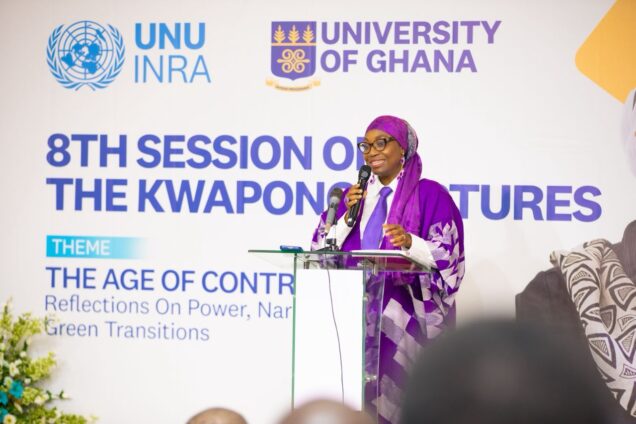
Africa must define its own path in the global green transition, taking into account the continent’s development needs rather than simply following narratives shaped elsewhere, Professor Fatima Denton, Director of the United Nations University Institute for Natural Resources in Africa (UNU-INRA), has said.
She said Africa’s green transition could not be reduced to achieving net-zero emissions when about 600 million people on the continent still lacked access to electricity.
According to Prof Denton, Africa must simultaneously expand energy access, create jobs and drive economic development while responding to the global push for decarbonisation.
She made the remarks in Accra at the 8th Kwapong Lecture Series, where she delivered a lecture on the theme, “The Age of Contradictions: Reflections on Power, Narratives and Green Transitions.”
The lecture was co-hosted by UNU-INRA and the University of Ghana.
Prof Denton said Africa needed to move beyond the language of “transition” and focus on a long-term transformation that reflected the continent’s realities and aspirations.
She argued that African countries should strategically harness their natural resources to promote inclusive growth rather than sideline them in response to global energy-transition narratives.
“We need a narrative that recognises the importance of Africa’s resources to the global economy,” she said.
She also called for greater confidence among African countries in defining their own development pathways.
Prof Denton questioned the assumption that African countries could simply leapfrog conventional stages of development through the adoption of new technologies.
“Leapfrogging is good, but do we have the space to land comfortably?” she asked.
She said technological innovation alone would not guarantee development, stressing the need for strong institutions, sound economic systems and robust social foundations to ensure that new technologies delivered tangible benefits.
Contradictions in the green transition
Prof Denton said the global push towards low-carbon economies was marked by a number of contradictions.
While countries continue to pursue decarbonisation, she noted that demand for oil and gas remains strong and production continues in industrialised economies, including major European producers.
This, she said, was happening alongside widespread energy poverty across Africa.
She cited Mozambique’s natural gas and liquefied natural gas resources as an example of the difficult choices confronting African countries as they seek to balance economic development with decarbonisation.
Prof Denton also questioned some of the assumptions surrounding critical minerals and technologies associated with the green transition.
She said critical minerals were often presented as “green” without sufficient attention to the environmental and social costs associated with their extraction.
She also noted that green hydrogen could place significant demands on water resources, while deep-seabed mining raised concerns about potentially fragile marine ecosystems.
Climate finance and carbon markets
Prof Denton questioned whether climate finance could deliver a just and sustainable transition if it deepened the fiscal vulnerabilities of developing countries.
She also argued that carbon markets were shaped not only by market forces but also by politics and institutions.
The issues, she said, raised broader questions about power and decision-making in the global transition.
“Who defines what constitutes a transition? Whose terms are being used?” she asked.
“Who decides what is green or what makes a mineral critical?”
Prof Denton called for greater recognition of African expertise and priorities in shaping the continent’s development and energy pathways.
She urged African leaders and policymakers to adopt a deliberate and strategic approach to development.
“We must be intentional,” she said.
Drawing lessons from China’s experience in building its manufacturing base, Prof Denton said African countries needed to think carefully about how to organise themselves to turn their natural resources and other opportunities into sustainable development.
She said research remained important but stressed that African countries also needed to learn from the private sector and local communities.
“It is a whole-of-society approach,” she said.
The Kwapong Lecture Series brings scholars and practitioners together to discuss issues relating to Africa’s natural resource governance and sustainable development.
Latest Stories
-
Stop touring state agencies and focus on the Judiciary’s problems – Arthur Kennedy to CJ
4 minutes -
Apologise and don’t do it again – Arthur Kennedy to Chief Justice over SOE comments
9 minutes -
Chief Justice remains committed to judicial independence, justice and equality – Judicial Service
42 minutes -
Ghana concludes evacuation of citizens from South Africa; total returnees reach 1,900 – Ablakwa
1 hour -
Africa must define its own green transition path – Prof Fatima Denton
1 hour -
WASSCE 2026: English Language performance falls to 62.4% – WAEC
2 hours -
WASSCE 2026: Social Studies records sharp rebound as Maths, Science also improve
2 hours -
2026 WASSCE entry rises by 11% as 512,862 candidates sit exams
2 hours -
WASSCE 2026: English Language performance falls to 62.4% – WAEC
2 hours -
WAEC cancels 2026 WASSCE results of 8,295 candidates over examination irregularities
3 hours -
WAEC releases provisional 2026 WASSCE results for 512,862 candidates
3 hours -
CJ’s remarks on SOEs were made in good faith, not to undermine judicial independence – Judicial Service
6 hours -
Bright Future Alliance pays courtesy call on Akufo-Addo, invites him to African Leaders of Influence Lectureship Series
6 hours -
This is an attempt to break the Minority caucus – Patricia Appiagyei on alleged GH¢70k payment
7 hours -
‘OSP hasn’t contacted me’ – Patricia Appiagyei assures cooperation if invited
7 hours