

Audio By Carbonatix
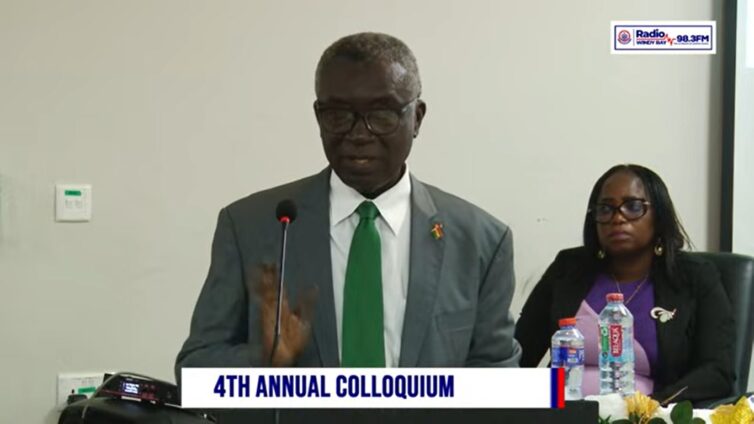
Former Minister for Environment, Science, Technology and Innovation, Prof Kwabena Frimpong-Boateng, says Ghana’s mining licensing system has become distorted, making it easier for operators to secure concessions unlawfully than to follow the legal process.
He attributed the problem to the alleged capture of land-use planning and state authority by influential actors, including politicians, traditional leaders and some security personnel.
“A concession is difficult and slow to obtain lawfully, and easy to obtain unlawfully, otherwise,” he said. “Where that is true of any system, the system is not underfunded; it is inverted.”
Prof Frimpong-Boateng made the remarks during a keynote lecture at the Fourth Annual Colloquium organised by the Department of Political Science Education at the University of Education, Winneba, on Wednesday, September 2, 2026.
The programme was held under the theme, “Politics, the Environment, and Our Future: Ghana at Crossroads?”
According to him, chiefs, security personnel and politicians are not peripheral actors in the country’s environmental crisis but are situated at the centre of the governance failures sustaining illegal mining and unregulated development.
He said the slow and cumbersome process for obtaining legal mining concessions had made unlawful operations more attractive, weakening enforcement and public confidence in state institutions.
Prof Frimpong-Boateng argued that Ghana should regularise, mechanise and trace small-scale mining instead of relying principally on its criminalisation.
He proposed a faster cooperative licensing system supported by reliable geological information to make lawful mining the easiest and most practical option for operators.
The reforms, he said, should include mercury-free processing equipment, reclamation bonds paid before licences are issued and traceability at the point of sale to prevent gold produced through environmentally destructive activities from entering the legitimate market.
“Trace the buyer, and you need not chase every pit; you make the pit unprofitable,” he stated.
Prof Frimpong-Boateng also called for forest reserves and river bodies to be placed completely outside the mining licensing system, without ministerial discretion or exemptions from any state institution.
He maintained that small-scale mining, which provides employment to hundreds of thousands of Ghanaians and contributes significantly to national gold production, could not simply be abolished.
“It will not be abolished; it can be governed,” he said, stressing that the government must create a licensing regime under which compliance becomes more accessible and beneficial than illegality.
Latest Stories
-
140 migrants in single dinghy rescued in English Channel
19 minutes -
FIFA president Infantino will stand for re-election
28 minutes -
Catholic Bishops reject calls for Chief Justice’s resignation over political remarks
37 minutes -
Germany’s far-right AfD set for big win in eastern state, just short of majority
58 minutes -
Catholic Bishops urge Chief Justice to avoid remarks that could raise doubts about impartiality
1 hour -
Mrs Doris Emma Doryumu (Nee Dove)
1 hour -
Illegal mining concessions easier to obtain than lawful ones in Ghana – Prof Frimpong-Boateng
2 hours -
At least 5 dead after Amazon cargo plane barreled off runway at Miami airport
2 hours -
Frimpong-Boateng proposes Environmental Restoration Fund funded by mineral royalties
2 hours -
Corrupt individuals are worse than pathogens; their actions cause premature deaths – Prof Frimpong-Boateng
2 hours -
No illegal mining operation will find refuge on Akyem Essase lands — Chief declares
2 hours -
Flight price rises due to ‘foolish leaders’ starting wars, Virgin’s Branson says
2 hours -
Consult traditional authorities before granting mining concessions on stool lands — Baffour Sikabede to gov’t
2 hours -
Why are European countries moving their gold out of North America?
2 hours -
Galamsey: Chiefs must not trade rivers for mining royalties – Baffour Sikabede
2 hours