

Audio By Carbonatix
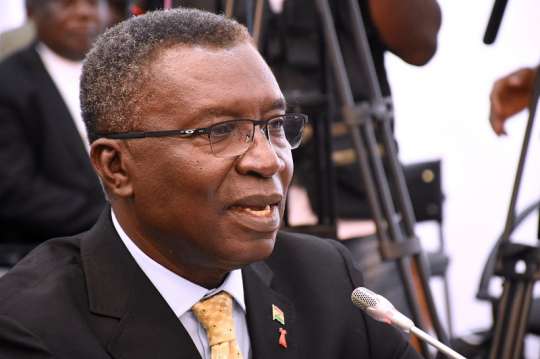
Former Environment, Science, Technology and Innovation Minister Professor Kwabena Frimpong-Boateng has blamed Ghana’s persistent environmental crisis on a political system in which officials who enforce environmental laws bear the political consequences while those who fail to act face little or no cost.
He said the imbalance had weakened successive efforts to combat illegal mining, popularly known as galamsey, despite the extensive damage it continues to cause to the country’s rivers, forests and farmlands.
“In Ghana, the political cost of enforcing environmental law falls on the enforcer, and the political cost of not enforcing it falls on nobody,” he said.
Prof. Frimpong-Boateng made the remarks in a keynote address at the Fourth Annual Colloquium of the Department of Political Science at the University of Education, Winneba, on Wednesday, September 2, 2026.
The colloquium was held under the theme, “Politics, the Environment, and Our Future: Ghana at Crossroads?”
Prof. Frimpong-Boateng, who chaired the Inter-Ministerial Committee on Illegal Mining between 2017 and 2021, said successive governments had introduced policies, task forces and military operations to tackle galamsey but had struggled to sustain them.
He cited the 2017 ban on artisanal and small-scale mining, Operation Vanguard, the establishment of 72 district committees, the training of 3,000 miners and the introduction of systems to track mining concessions and excavators.
According to him, the measures initially produced results, with sections of the Pra River becoming clear and water treatment costs falling at some affected intake points.
However, he said many of the safeguards introduced during the period were subsequently abandoned after the mining ban was lifted on December 21, 2018.
“The permission survived. The architecture that made the permission defensible did not,” Prof. Frimpong-Boateng said.
Report on galamsey
Prof. Frimpong-Boateng also recalled submitting a report to the Presidency at the end of his tenure detailing the state of illegal mining and what he described as efforts to obstruct attempts to combat it.
He said that when the report became public in 2022, the national debate focused more on his motives for writing it than on the substance of the allegations.
“The country did not ask: is it true? The country asked: why did he write it, and whom does it help? The substance was set aside and the messenger was examined,” he said.
The former minister argued that Ghana’s approach to environmental protection was constrained by short-term political considerations because the immediate political cost of enforcement could affect electoral fortunes, while the benefits of restoring rivers and forests might take years or generations to become visible.
He said the country needed a framework that would protect critical environmental policies from being discarded whenever there was a change of government.
Call for National Environmental Compact
Prof. Frimpong-Boateng proposed the establishment of a National Environmental Compact, negotiated across political parties and approved by Parliament, to provide continuity for key environmental commitments.
Under his proposal, any administration seeking to discontinue such a commitment would have to present a report to Parliament stating who took the decision, the reasons for it, and the public resources already invested in the policy.
He argued that creating consequences for abandoning environmental commitments would discourage governments from easily reversing policies introduced by their predecessors.
“Abandonment in Ghana is currently free. Make it merely expensive and half of it will stop,” he said.
Latest Stories
-
ECG announces planned power outages in parts of Tema from Sept. 29 to October 1
13 minutes -
Sylvester Mensah urges Latenu FM to promote trade, export opportunities in Ga
27 minutes -
Ga language under threat of decline as children shy away from speaking it – Sylvester Mensah
32 minutes -
‘Let every Ga child you raise know the Ga language and story’ – Sylvester Mensah
38 minutes -
‘We are not deterred’ – Ablakwa responds to backlash over South Africa evacuation
40 minutes -
NCA announces major voice and data disruption across Northern Ghana due to fibre cuts
1 hour -
Photos: Housing solutions take centre stage at Day 2 of the 3rd Republic Bank-JoyNews Habitat Fair
2 hours -
Ghana Air Force passes out 293 recruits after six months of intensive training
3 hours -
EOCO vrs Baffour Awuah: EOCO should have secured warrant before arrest attempt at court – Inusah Fuseini
3 hours -
Triple fibre cuts disrupt telecom services across Northern, Oti regions – Sam George
3 hours -
Politicisation could undermine parliamentary probe into cocaine seizures – Dr Osae-Kwapong
3 hours -
EOCO chases MP: Can Section 41 cure lacuna in EOCO Act? – Inusah Fuseini asks
3 hours -
GNFS, GWL inspect fire hydrants in Ministries enclave; 23 found faulty
3 hours -
Gov’t directs release of 50,000 bags of grain to ECOWAS
3 hours -
Ghana, Germany deepen cooperation on railways, labour mobility
3 hours