

Audio By Carbonatix
Former Minister for Environment, Science, Technology and Innovation, Prof Kwabena Frimpong-Boateng, says Ghana’s mining licensing system has become distorted, making it easier for operators to secure concessions unlawfully than to follow the legal process.
He attributed the problem to the alleged capture of land-use planning and state authority by influential actors, including politicians, traditional leaders and some security personnel.
“A concession is difficult and slow to obtain lawfully, and easy to obtain unlawfully, otherwise,” he said. “Where that is true of any system, the system is not underfunded; it is inverted.”
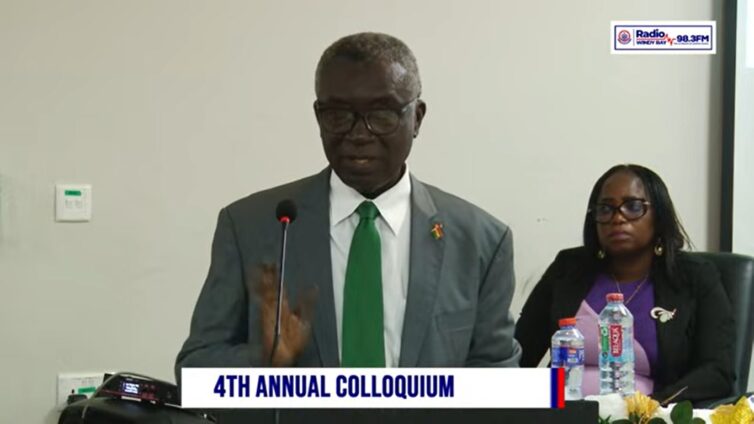
Prof Frimpong-Boateng made the remarks during a keynote lecture at the Fourth Annual Colloquium organised by the Department of Political Science Education at the University of Education, Winneba, on Wednesday, September 2, 2026.
The programme was held under the theme, “Politics, the Environment, and Our Future: Ghana at Crossroads?”
According to him, chiefs, security personnel and politicians are not peripheral actors in the country’s environmental crisis but are situated at the centre of the governance failures sustaining illegal mining and unregulated development.
He said the slow and cumbersome process for obtaining legal mining concessions had made unlawful operations more attractive, weakening enforcement and public confidence in state institutions.
Prof Frimpong-Boateng argued that Ghana should regularise, mechanise and trace small-scale mining instead of relying principally on its criminalisation.
He proposed a faster cooperative licensing system supported by reliable geological information to make lawful mining the easiest and most practical option for operators.
The reforms, he said, should include mercury-free processing equipment, reclamation bonds paid before licences are issued and traceability at the point of sale to prevent gold produced through environmentally destructive activities from entering the legitimate market.
“Trace the buyer, and you need not chase every pit; you make the pit unprofitable,” he stated.
Prof Frimpong-Boateng also called for forest reserves and river bodies to be placed completely outside the mining licensing system, without ministerial discretion or exemptions from any state institution.
He maintained that small-scale mining, which provides employment to hundreds of thousands of Ghanaians and contributes significantly to national gold production, could not simply be abolished.
“It will not be abolished; it can be governed,” he said, stressing that the government must create a licensing regime under which compliance becomes more accessible and beneficial than illegality.
Latest Stories
-
Labour Minister wants SOEs to help shape new public pay system
2 hours -
IPEC will ensure Equity and Sustainability in SOEs Compensation
2 hours -
White House bars CNN from travelling with Trump on Air Force One
3 hours -
Fennis wins second consecutive ITF J60 title in Accra
3 hours -
Spain beat England in thriller after Kane penalty miss
3 hours -
GPL 2026/27: Zaidan’s late goal ends Hearts of Oak unbeaten start
3 hours -
CEOs demand clarity on pay harmonisation, board autonomy as FWSC engages SOEs bosses over IPEC transition
3 hours -
2026 Women’s Super Cup: FC Savannah, Epiphany Warriors maintain top spots ahead of final group games
3 hours -
‘Is EOCO responsible for determining lawyers’ fees?’ – Baffour Awuah
3 hours -
David Beckles claims second J60 Accra title
4 hours -
No France cocaine suspect linked to Mahama, Vice President’s security details – NACOC
4 hours -
Anwelle Foundation launched in Jirapa to tackle poverty, youth unemployment
4 hours -
Joy Sports Editor Fentuo Tahiru Fentuo to moderate inaugural Music Meets Football Summit in Zambia
4 hours -
Court premises too volatile for Baffour Awuah’s attempted arrest by EOCO – Inusah Fuseini
4 hours -
Drug bust: Under no circumstances will NACOC leadership be compromised – Twum-Barimah
4 hours