

Audio By Carbonatix
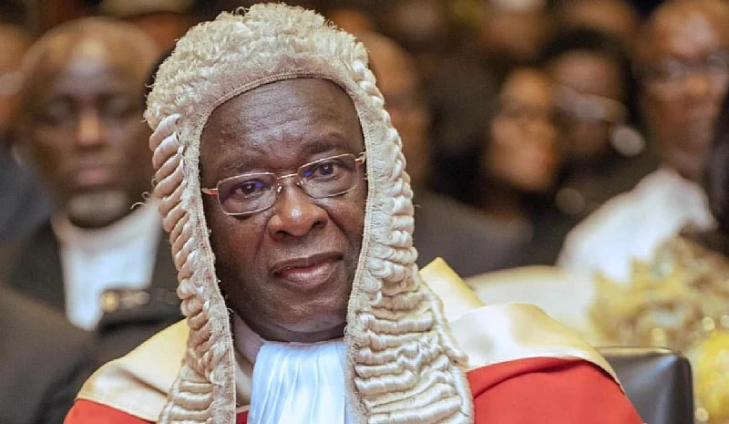
The Ghana Catholic Bishops’ Conference has cautioned Chief Justice Paul Baffoe-Bonnie against public remarks that could create doubts about the political neutrality of the Judiciary.
The Conference said the concern followed comments made by the Chief Justice during visits to the Social Security and National Insurance Trust (SSNIT) and the Minerals Income Investment Fund (MIIF) on September 2, 2026.
In a statement signed by its President, Most Rev. Matthew Kwasi Gyamfi, the Bishops said there was nothing improper about the Chief Justice visiting public institutions or commending improvements in their operations.
They, however, said his reference to the “past eight years” could reasonably be understood in a political context.
“In our national context, such a phrase is readily heard as a comparison between the present administration and its predecessor,” the Conference said.
It said the comment, although possibly intended as an assessment of institutional performance, “took on, at least in appearance, the character of a partisan judgment.”
The Bishops noted that the Ghana Centre for Democratic Development had also raised concerns that such remarks could create an impression of political endorsement and weaken confidence in judicial impartiality.
They acknowledged a subsequent clarification from the Judicial Service that the Chief Justice’s observations were made in good faith and were not intended to compromise judicial independence.
The Conference said it received that clarification in good faith but maintained that the incident raised an important question about public confidence in the Judiciary.
“The office of Chief Justice is not that of an ordinary public commentator,” it said.
The Bishops stressed that courts could be called upon to determine disputes involving the government, political parties and public institutions.
They said citizens must therefore be able to approach the courts without wondering whether the Chief Justice had aligned himself with one political era over another.
“Judicial independence is not only a matter of actual impartiality; it also depends on the visible, unmistakable appearance of impartiality,” the Conference said.
It added that a judge, particularly the head of the Judiciary, “must be, and must be seen to be, above the partisan contest.”
The Bishops were careful not to accuse the Chief Justice of partisanship or suggest that the Judiciary had been compromised.
They also rejected calls for his resignation over the remarks, describing such demands as disproportionate.
“The Chief Justice, like any citizen, is entitled to his own convictions,” they said.
The Conference suggested that the Chief Justice could have commended SSNIT and MIIF for their achievements without comparing their performance to that of a previous administration.
It further urged political actors to treat the controversy as an opportunity for reflection rather than partisan advantage.
“The governing party ought not to treat criticism of the Chief Justice as an attack on its own record, nor should the opposition treat his remarks as proof that the courts have been captured,” the Bishops said.
They called for the same standard of restraint from all public office holders, regardless of which party is in government.
Latest Stories
-
Labour Minister wants SOEs to help shape new public pay system
3 hours -
IPEC will ensure Equity and Sustainability in SOEs Compensation
4 hours -
White House bars CNN from travelling with Trump on Air Force One
4 hours -
Fennis wins second consecutive ITF J60 title in Accra
4 hours -
Spain beat England in thriller after Kane penalty miss
5 hours -
GPL 2026/27: Zaidan’s late goal ends Hearts of Oak unbeaten start
5 hours -
CEOs demand clarity on pay harmonisation, board autonomy as FWSC engages SOEs bosses over IPEC transition
5 hours -
2026 Women’s Super Cup: FC Savannah, Epiphany Warriors maintain top spots ahead of final group games
5 hours -
‘Is EOCO responsible for determining lawyers’ fees?’ – Baffour Awuah
5 hours -
David Beckles claims second J60 Accra title
5 hours -
No France cocaine suspect linked to Mahama, Vice President’s security details – NACOC
5 hours -
Anwelle Foundation launched in Jirapa to tackle poverty, youth unemployment
6 hours -
Joy Sports Editor Fentuo Tahiru Fentuo to moderate inaugural Music Meets Football Summit in Zambia
6 hours -
Court premises too volatile for Baffour Awuah’s attempted arrest by EOCO – Inusah Fuseini
6 hours -
Drug bust: Under no circumstances will NACOC leadership be compromised – Twum-Barimah
6 hours