

Audio By Carbonatix
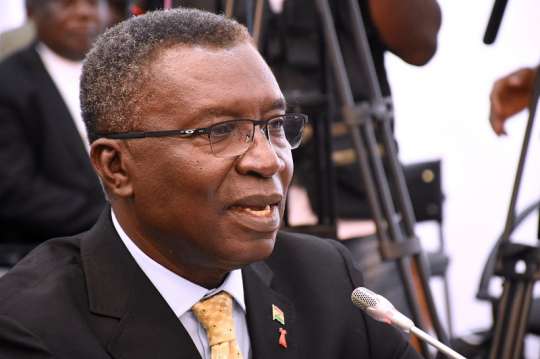
Former Minister for Environment, Science, Technology and Innovation, Professor Kwabena Frimpong-Boateng, has proposed the establishment of a statutory Environmental Restoration Fund outside Ghana’s regular budget cycle to finance the reclamation of mining-degraded lands and restoration of polluted water bodies.
He wants a defined proportion of mineral royalties to be paid into the fund and used exclusively for environmental restoration, with its management and expenditure subject to independent oversight and public disclosure.
Prof. Frimpong-Boateng argued that placing the fund within the national budget could expose it to diversion when governments face fiscal difficulties.
“A defined share of mineral royalties [should go] into a statutory Environmental Restoration Fund, independently governed, spent on river remediation and land reclamation, with site-level accounts published annually,” he proposed.
He added: “Outside the budget cycle, because anything inside it will be raided in the second year of a hard fiscal programme. It always is.”
Prof. Frimpong-Boateng made the proposal while delivering the keynote address at the Fourth Annual Colloquium organised by the Department of Political Science Education at the University of Education, Winneba, on Wednesday, September 2, 2026.
The colloquium was held under the theme, “Politics, the Environment, and Our Future: Ghana at Crossroads?”
$21bn needed to restore degraded land
According to Prof. Frimpong-Boateng, about 10% of Ghana’s surface area, equivalent to approximately 23,853 square kilometres, has been degraded, with restoration estimated to cost about $21 billion.
He said the rehabilitation of the Ankobra River alone was estimated at $400 million, excluding the cost of restoring other polluted water bodies, including the Pra, Offin, Birim, Anum and Oda rivers, as well as the Black, White and Red Volta rivers.
He said the scale of the environmental damage required predictable and protected financing rather than temporary allocations that could be withdrawn or redirected by successive governments.
Prof. Frimpong-Boateng proposed that the fund be independently managed and required to publish annual accounts detailing expenditure at each restoration site.
Annual State of Environment audit
The former minister also called for an annual State of the Environment audit to be presented to Parliament alongside the national budget.
He said the audit should provide independently verified information on water quality across river basins, forest cover, degraded and reclaimed land, waste management and wetland loss.
“What is not measured publicly is not governed,” he said.
Prof. Frimpong-Boateng maintained that securing dedicated restoration financing and ensuring transparency in its use would help guarantee that part of the revenue generated from Ghana’s mineral resources was reinvested in repairing the environmental damage caused by their extraction.
Latest Stories
-
Labour Minister wants SOEs to help shape new public pay system
2 hours -
IPEC will ensure Equity and Sustainability in SOEs Compensation
2 hours -
White House bars CNN from travelling with Trump on Air Force One
3 hours -
Fennis wins second consecutive ITF J60 title in Accra
3 hours -
Spain beat England in thriller after Kane penalty miss
3 hours -
GPL 2026/27: Zaidan’s late goal ends Hearts of Oak unbeaten start
3 hours -
CEOs demand clarity on pay harmonisation, board autonomy as FWSC engages SOEs bosses over IPEC transition
3 hours -
2026 Women’s Super Cup: FC Savannah, Epiphany Warriors maintain top spots ahead of final group games
3 hours -
‘Is EOCO responsible for determining lawyers’ fees?’ – Baffour Awuah
3 hours -
David Beckles claims second J60 Accra title
4 hours -
No France cocaine suspect linked to Mahama, Vice President’s security details – NACOC
4 hours -
Anwelle Foundation launched in Jirapa to tackle poverty, youth unemployment
4 hours -
Joy Sports Editor Fentuo Tahiru Fentuo to moderate inaugural Music Meets Football Summit in Zambia
4 hours -
Court premises too volatile for Baffour Awuah’s attempted arrest by EOCO – Inusah Fuseini
4 hours -
Drug bust: Under no circumstances will NACOC leadership be compromised – Twum-Barimah
4 hours