

Audio By Carbonatix
Former Minister for Environment, Science, Technology and Innovation, Prof Kwabena Frimpong-Boateng, has described corruption as a deadly social disease whose consequences extend beyond financial losses to illness, disability and premature death.
According to him, the diversion of public resources through corruption creates hardship and deprives citizens of essential services, including healthcare, clean water and environmental protection.
“Corruption is not merely theft; it is a disease with a mortality rate,” he said.
“When a country’s resources are diverted, the consequence is hardship, and hardship arrives in our wards as disease, disability and premature death. Corrupt individuals are worse than any pathogen,” he added.
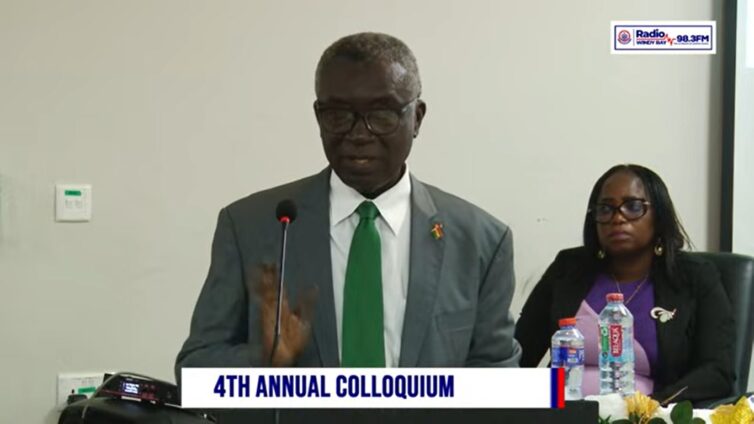
Prof. Frimpong-Boateng made the remarks during a keynote lecture at the Fourth Annual Colloquium organised by the Department of Political Science Education at the University of Education, Winneba, on Wednesday, September 2, 2026.
The event was held under the theme, “Politics, the Environment, and Our Future: Ghana at Crossroads?”
The cardiothoracic surgeon argued that Ghana’s inability to manage its environment was driven mainly by corruption and the country’s limited technological capacity—not a lack of knowledge about its challenges.
“Our inability to manage our own environment has two engines, not one: corruption, and the absence of technological capacity,” he stated.
He said Ghana had developed several policies, laws and programmes to protect its natural resources and address illegal mining, yet implementation had repeatedly been abandoned without accountability.
Prof. Frimpong-Boateng cited the destruction of water bodies and forest reserves through illegal mining as an example of how corruption and weak institutional oversight directly endanger human health.
He noted that mining activities had exposed communities to mercury, arsenic, lead, cadmium and chromium, which could cause kidney damage, neurological disorders, cancer and pregnancy complications.
He also raised concerns about what he described as the capture of land-use planning and public authority, claiming that chiefs, politicians and security personnel were central to the problem.
“A concession is difficult and slow to obtain lawfully, and easy to obtain unlawfully — and where that is true of any system, the system is not underfunded, it is inverted,” he said.
Prof. Frimpong-Boateng called for stronger personal accountability for public officials, transparent records of environmental decisions and an annual State of the Environment audit to be presented to Parliament.
He maintained that Ghana could not achieve sustainable development without eliminating corruption, strengthening the rule of law and ensuring public confidence in law enforcement and the judiciary.
Latest Stories
-
Labour Minister wants SOEs to help shape new public pay system
52 minutes -
IPEC will ensure Equity and Sustainability in SOEs Compensation
1 hour -
White House bars CNN from travelling with Trump on Air Force One
2 hours -
Fennis wins second consecutive ITF J60 title in Accra
2 hours -
Spain beat England in thriller after Kane penalty miss
2 hours -
GPL 2026/27: Zaidan’s late goal ends Hearts of Oak unbeaten start
2 hours -
CEOs demand clarity on pay harmonisation, board autonomy as FWSC engages SOEs bosses over IPEC transition
2 hours -
2026 Women’s Super Cup: FC Savannah, Epiphany Warriors maintain top spots ahead of final group games
3 hours -
‘Is EOCO responsible for determining lawyers’ fees?’ – Baffour Awuah
3 hours -
David Beckles claims second J60 Accra title
3 hours -
No France cocaine suspect linked to Mahama, Vice President’s security details – NACOC
3 hours -
Anwelle Foundation launched in Jirapa to tackle poverty, youth unemployment
3 hours -
Joy Sports Editor Fentuo Tahiru Fentuo to moderate inaugural Music Meets Football Summit in Zambia
4 hours -
Court premises too volatile for Baffour Awuah’s attempted arrest by EOCO – Inusah Fuseini
4 hours -
Drug bust: Under no circumstances will NACOC leadership be compromised – Twum-Barimah
4 hours