

Audio By Carbonatix
The Minister for Communication, Digital Technology and Innovations, Sam George, has cautioned government ministers against delivering speeches generated by artificial intelligence (AI) without verifying their accuracy, revealing that some directors are already using the technology to prepare speeches for their ministers.
He is concerned that the growing reliance on AI-generated content could result in government officials presenting inaccurate or unverified information, particularly when adequate background research and fact-checking are overlooked.
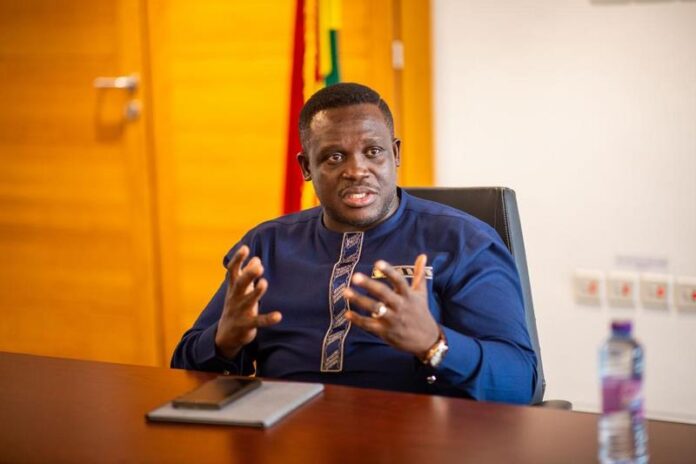
Speaking in an interview ahead of the second episode of the Digital Economy Forum, Mr. George disclosed that he had raised the concern during an AI retreat for Cabinet ministers.
“Ministers must be careful about the speeches they read, because right now we're seeing directors use AI to prepare those speeches for ministers,” he cautioned.
He explained that although AI tools can significantly reduce the time required to prepare documents, their output may contain information drawn from sources that have not been properly verified.
“Now, what that means is there's little background research that's been done. But don't forget that the AI tool that's writing that speech is pulling from a number of multiple sources online, verified and unverified,” he said.
The minister warned that the ability of AI systems to produce convincing responses within seconds should not be mistaken for a guarantee of accuracy.
“And that's the danger of AI. Because AI is unable to tell what is verified information and what is not verified information, because it's basically pulling from the entire web anything related to the subject matter and the prompt that you've given to it,” he explained.
His concerns raise questions about how government ministries and public institutions are integrating artificial intelligence into their daily operations, particularly in the preparation of official communications and other documents used to inform the public.

AI changing the future of journalism
Beyond government communications, the minister also expressed concern about the implications of AI-generated content for journalism, arguing that media professionals must develop new skills to distinguish accurate information from potentially misleading material.
He believes journalism training institutions must reconsider how they prepare students for a media industry in which AI can increasingly perform tasks traditionally undertaken by reporters and editors.
“So our academic institutions, GIJ, for example, needs to begin to look at what kind of journalist are you training in an AI world?” he questioned.
He explained that journalists would increasingly require skills in verifying, editing and critically assessing AI-generated material before it is published or broadcast.
“A journalist who is able to then pick what the AI has generated and proofread it and fact check it before pushing it to the newsroom. Because if you're not careful, you have the newscaster reporting news that is not 100 percent verified,” he said.
The minister's concerns come as Ghana seeks to accelerate the adoption of artificial intelligence across government institutions, businesses and other sectors of the economy.
He disclosed that the government has already organised AI training for Cabinet ministers and appointed AI focal persons across ministries as part of the implementation of its national AI strategy.
The ministry is also working with UNESCO and the United Nations Development Programme to build the capacity of civil servants, including chief directors and directors, to support the responsible deployment of the technology.

Human intelligence remains critical
Despite his concerns about misinformation and the potential displacement of certain jobs, Mr. George maintains that artificial intelligence presents significant opportunities for Ghana if workers and institutions learn to use it responsibly.
He argued that AI should be seen as a tool to improve productivity rather than a substitute for human judgement and critical thinking.
“So, yes, AI is fantastic. AI gives you speed. It gives you scale. But what AI cannot replace is human intelligence. So the AI tools are only as good as they're structured to be,” he added.
He consequently urged workers, including those already established in their careers, to acquire new skills that would allow them to remain relevant as AI transforms their professions.
The Ningo-Prampram MP pointed to the government's One Million Coders programme as one of the initiatives intended to help Ghanaians acquire the skills required to participate in an AI-driven economy.
“We have multiple AI programmes in there. It's for everybody. I keep saying that the One Million Coders programme is for skilling, reskilling and upskilling,” he said.
The opportunities and risks associated with AI adoption will be examined in the second episode of the Digital Economy Forum, under the theme “AI and the Ghana Economy: Opportunity or Disruption?”
The forum, held in partnership with Hubtel, will feature Sam George; Technical Advisor at the Finance Ministry, Dr Theo Acheampong; Founder of AI for Ghana, Adam Watkins; Head of Engineering at Hubtel, Augustine Adjei; and Vice President of IMANI Africa, Bright Simons.
It will air live on JoyNews and Joy 99.7 FM on Wednesday, October 21, 2026, at 8 p.m.
Latest Stories
-
GloMeF CEO urges intensified public education on new road traffic regulations
9 minutes -
‘Any tax on ChatGPT is an attack on education and innovation’- Akim Swedru, MP
12 minutes -
Obuasi SHTS sexual abuse scandal exposes systemic failure in child protection – Moving Masculinity
13 minutes -
Hubtel CEO calls for national data-sharing framework to boost AI development
15 minutes -
Twelve Golden Rules of real estate development in Ghana, Africa
20 minutes -
Five new telephony cell sites in Ashanti Region to be activated in October 2026 – Sam George
20 minutes -
Mahama cuts sod for Afienya Industrial Park, targets 120 enterprises
25 minutes -
Rush for fuel from accident tankers is stealing, punishable by law – NPA boss, Edudzi Tamakloe
31 minutes -
GhIG pushes for legislation to regulate geoscientists’ activities
37 minutes -
Mfantsipim @150: Ace Anan Ankomah leads project to preserve school’s musical heritage
41 minutes -
Gov’t launches rCOMSDEP in Ahanta West, Mpohor Fiase to promote responsible community mining
42 minutes -
AI is forcing professionals to rethink how they deliver value – Hubtel CEO
45 minutes -
Daily Insight for CEOs: Strengthening the CEO’s Leadership Legacy
46 minutes -
Jimmy Aglah’s ‘When the River Testified’ approved by NaCCA as Supplementary Reader
55 minutes -
Hubtel willing to contribute to Ghana’s proposed AI fund – CEO
59 minutes