


Audio By Carbonatix
Kenya's government has ordered the closure of 13 money transfer firms to prevent militant Islamists from using them to finance attacks, the interior minister has told the BBC.
The bank accounts of 86 individuals and "entities" had also been frozen, Joseph Nkaissery added.
Those targeted are believed to include a Somali-linked bus company and hotel.
An assault by the Somalia-headquartered al-Shabab group killed 148 people at Kenya's Garissa University last week.
Kenyan officials have repeatedly accused Somalis in the country of colluding with the militants.
Nearly 500,000 refugees are in the country - many of whom fled decades of conflict and drought in Somalia.
'Lifeline for Somalis'
Kenya also has its own Somali population - most of whom live in the capital, Nairobi, and in the north-east, where the university attack took place.
Somalis say most of them are law-abiding citizens of Kenya, and they have also bore the brunt of al-Shabab's insurgency.
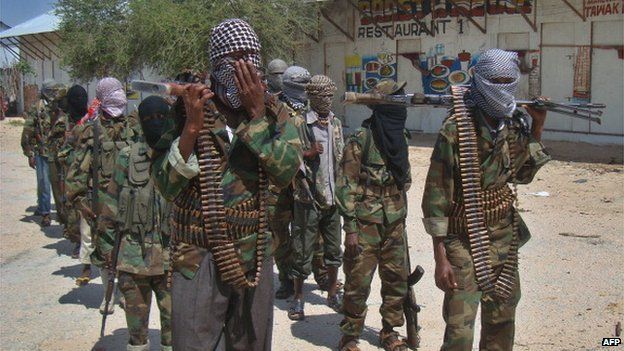
Al-Shabab carried out its bloodiest attack in Kenya at the university in Garissa
They have condemned the government's crackdown as "blanket punishment" of the community.
BBC Africa's Abdullahi Abdi in Nairobi says a leaked document shows that hotel and transport companies, as well as Muslim clerics and human rights organisations, risk having their bank accounts frozen.
Somalis around the world rely heavily on the informal money transfer firms, known as "hawalas", to do business and to send cash to relatives because of the almost non-existent banking sector in Somalia.
There have been a similar crackdown on the companies in the UK and US.
A spokesman for the Somali money transfer agencies in Kenya, Abdi Ali, told the BBC they would oppose moves to shut them down.
"To us, it is only a ministerial directive which is sent to the central bank. We will talk to the Kenyan government about this issue and use its justice system to settle matter," he said.
The United Nations estimates Somalis in the diaspora send home about $1.6bn (£1.1bn) annually, significantly more than foreign aid.
More than 40% of Somalis receive remittances, the bulk of which are used for basic needs, including food, clothes, medicine and education, according to a UN survey.
Somalia has not had a functioning government since the fall of Siad Barre's government in 1991, and has been hit by religious and clan conflicts.
Latest Stories
-
Drug bust case: Only Customs officers, MPS officials in scanning room – NACOC
53 minutes -
I don’t mind being insulted; I have a crocodile skin – President Mahama
1 hour -
Samson’s Take: Verify the badge – and verify the story
1 hour -
President Mahama explains why Ghana must rethink regulation of TikTok, other new media platforms
1 hour -
Rule of law must be protected – GBA condemns EOCO action against Baffour Awuah
3 hours -
950,000 barrels of Sankofa crude head to TOR as GNPC deepens domestic refining
3 hours -
Scales of deception removed – Annoh-Dompreh attacks new cocoa price
3 hours -
Young Positivist Writes : My Experience with GCLP
5 hours -
Strong Day 1 turnout sets tone for Day 2 of Republic Bank-JoyNews Habitat Fair Clinic
5 hours -
Ghana Army warns new soldiers against social media misuse, uniform abuse
5 hours -
AMA calls for science-led action to tackle environmental health risks in Accra
5 hours -
NPP Canada Organizer BigMo urges Diaspora to support Kodua Frimpong
6 hours -
He entered at eight; he is now 16: Ghana’s children growing up in prayer camps
9 hours -
‘Development must not always begin from Accra’ — Anwelle Foundation launched in Jirapa
9 hours -
PKO trio eye victories at Odwira Festival
12 hours