


Audio By Carbonatix
About 30,000 people are marching through South Africa's main city, Johannesburg, to demand an end to a recent wave of xenophobic attacks.
Both locals and immigrants are taking part, with placards saying "Africa Unite" and "Welcome foreigners".
An anti-xenophobic protest is also taking place in the coastal city of Port Elizabeth.
South Africa's army was deployed to flashpoints on Monday to prevent further violence.
At least seven people have been killed, 5,000 left homeless and many foreign-owned shops looted since the attacks started about three weeks ago.
"We will defeat xenophobia like we defeated apartheid," the premier of South Africa's Gauteng province, David Makhura, told the crowd in Johannesburg.
Gauteng is the economic heartland of South Africa and includes Johannesburg.
Many unemployed South Africans accuse foreigners of taking their jobs.
South Africa has an official unemployment rate of around 25%.
The BBC's Pumza Fihlani reports from the scene that the crowd marched through Johannesburg's Hillbrow suburb, which some describe as Lagos because of its huge Nigerian population.
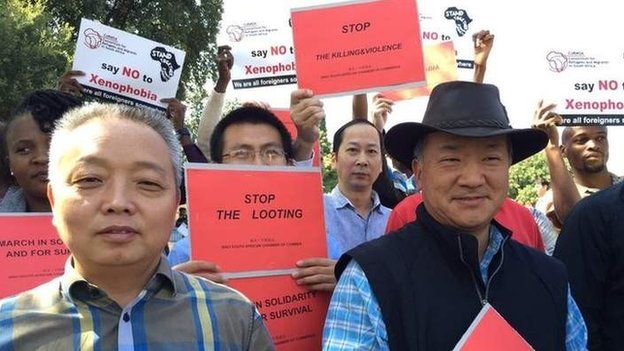
Many shops owned by African and Asian immigrants have been looted and burnt
Protesters sang a sorrowful song, Senzenina, or "What have we done?" It was popular at funerals of anti-apartheid activists during white-minority rule.
"Mandela must be turning in his grave. This is not the South Africa he fought for," Johannesburg resident Vusi Hlongwane told the BBC.
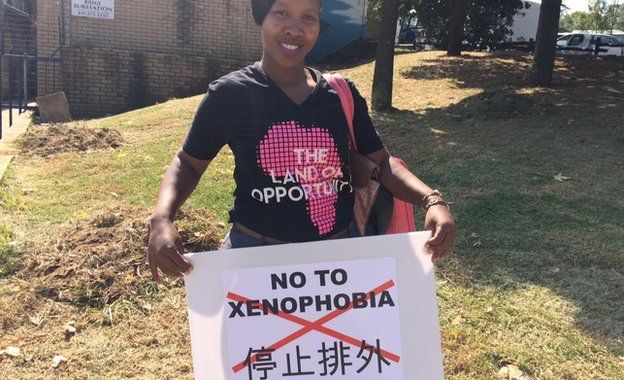
Protesters say the xenophobia shames South Africa
South Africa's freedom was won through such solidarity. "Africa for all" was the message shared by the tens of thousands who marched through the streets of Johannesburg.
A sea of people from different parts of the continent carried banners in support of the day's event. They are hoping the same spirit that led this country to freedom will help bring unity here.
The events of the past few weeks have brought shame to many South Africans and the country.
But many speakers sought to remind South Africans that in the days of apartheid it was the rest of Africa that became a home for this country's leaders, remind them that its liberation was won with the support of the entire continent.
"They were welcomed with open arms and never treated how some of you are treating them now," one leader said.
As they danced and sang together, calling for an end to the violence that has brought fear to some communities here, a group shouted: "This is for Mandela" another: "Mayibuye iAfrika" - an old slogan calling for the revival of Africa. For those hours, it seemed that Africa stood united.
In Port Elizabeth, a silent march has been held, with some protesters waving a Zimbabwean flag and and carrying placards which said: "Diversity is our strength".
South Africa has faced a backlash across Africa over the attacks.
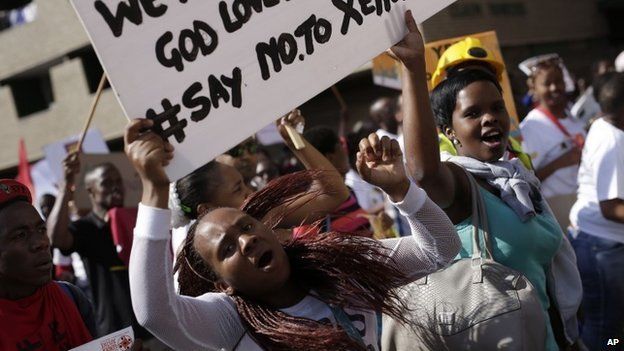
The crowd marched through areas where many immigrants live
Official data suggests there are about about two million foreign nationals in South Africa, about 4% of the total population. But some estimates put the number of immigrants at five million.
Most of them are Africans and Asians who came to South Africa when apartheid ended in 1994, with the election of Nelson Mandela as South Africa's first black leader.
Latest Stories
-
Black Sherif drops new 6-track EP ‘Sun Sherif’
40 minutes -
GTA partners Africa’s Brain Bank for Medical City groundbreaking
51 minutes -
How to check 2026 WASSCE results on mobile phone
57 minutes -
President Mahama is a professional comedian – DKB
1 hour -
Final day of Joy FM Back-to-School Fair: Come shop, save and prepare for the new school year
2 hours -
GSE showed strong performance in August 2026 despite recording more stock losses
4 hours -
If CJ needs ethics law to know SOE comments were wrong, he may not be worthy of office – Arthur Kennedy
5 hours -
Stop touring state agencies and focus on the Judiciary’s problems – Arthur Kennedy to CJ
5 hours -
Apologise and don’t do it again – Arthur Kennedy to Chief Justice over SOE comments
5 hours -
Chief Justice remains committed to judicial independence, justice and equality – Judicial Service
6 hours -
Ghana concludes evacuation of citizens from South Africa; total returnees reach 1,900 – Ablakwa
6 hours -
Africa must define its own green transition path – Prof Fatima Denton
6 hours -
WASSCE 2026: English Language performance falls to 62.4% – WAEC
7 hours -
WASSCE 2026: Social Studies records sharp rebound as Maths, Science also improve
7 hours -
2026 WASSCE entry rises by 11% as 512,862 candidates sit exams
7 hours