


Audio By Carbonatix
China's capital is notorious for its chronic pollution. Even indoors it's a struggle to find clean air, says John Sudworth.
Having already taped most of my windows shut, I have now started on the air conditioning vents. The aim is simple - to close off every access point through which the toxic outside air leaks into our Beijing home.
Even our double-glazing doesn't keep out the smog. The most dangerous constituent, particulate matter smaller than 2.5 microns in diameter - or PM2.5 as it's known - finds a way through the tiniest of gaps where the windows close.
So the only solution there is duct tape.
It's like a re-enactment of a 1970s government information film on surviving a nuclear holocaust. Only it's not radiation we're trying to keep at bay, but the fallout from fossil fuels.

The most useful device in our armoury is our PM2.5 monitor. We have two, one upstairs and one downstairs, which we glance at frequently, and it was their arrival that prompted the frenzy of taping and draught-excluding that continues to this day.
When I first arrived in China, five years ago, there was no way of monitoring the quality of air in our home. Like everyone else, we left it to blind faith that our air purifiers were doing the trick.
It now transpires they weren't. Even now on highly polluted days, we struggle to get our PM2.5 count much below 25 micrograms per cubic meter, the World Health Organization's maximum standard for safe air.
And that's with multiple purifiers running at full tilt, large box-like machines that sit in the corner of every room - two in some - the combined noise output of which is akin to living in the engine room of an aircraft carrier.

Shoppers look at air purifiers in Beijing
China's air pollution problem is now so bad that its effects are measured in more than a million premature deaths a year and markedly reduced life expectancy - an average of more than five years or so - in the worst-affected regions.
Over the past few weeks, a period of particularly acute and prolonged air pollution, the average air quality in Beijing has been well above 200 micrograms of PM2.5 particles per cubic metre - many times the maximum safe limit.
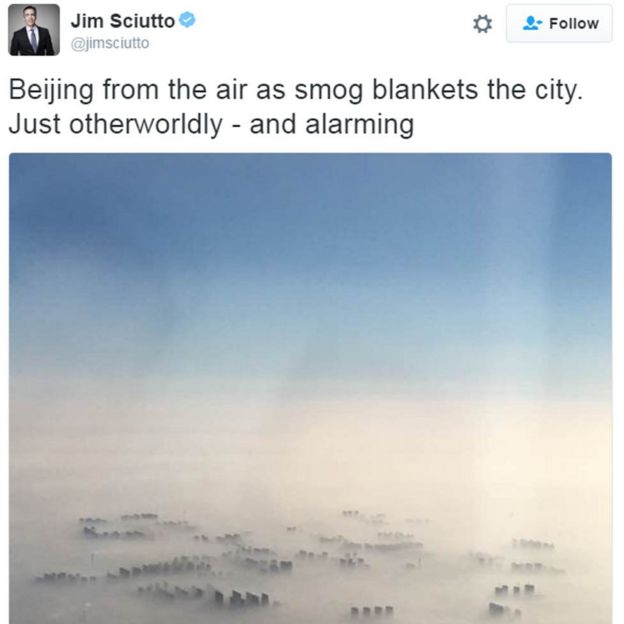
During the worst of it, it's been like living under house arrest, our children confined to the small, deafening but breathable indoor space of our home for days on end.
And across China, the smog becomes a dominant topic on social media, with the population tracking the foulness of the air via mobile phone apps.
One group of Beijing mothers, armed with their own PM2.5 counters, have even been roaming the city in search of shopping malls or cafes with filtered air - and then sharing their discoveries online.
Of course, humanity's dependence on oil and coal long predate China's economic rise. But China offers a vision of environmental degradation far in excess of the pea-souper fogs of 1950s London or Manchester.

While growing awareness means that more of them are now taking action to protect their health, many others are either not fully informed about the danger or don't have the means to do much about it.
A set of new filters for a single air purifier can cost £100 ($120) or more and needs changing every six months or so.
It is, of course, not a problem only of China's making. The smartphones, computers, TV screens, jeans and shoes that have been pouring out of its factories over the past few decades are cheap, in part at least, precisely because they're made without environmental safeguards.

The interests of the rich world and an unaccountable Chinese Communist elite have neatly dovetailed. The West gets its cheap consumer desirables and China gets rich without the inconvenience of the independent scrutiny, regulation or democratic oversight of other markets.
The true cost is measured by the numbers on my pollution monitors, and it is one being borne disproportionately by ordinary Chinese people.
Following a crackdown on a rare protest against pollution in the central city of Chengdu recently, one blogger dared to speak out in favour of the protesters. The police, he suggested, should bear in mind that the elites, whose interests they protect, have sent their families to breathe clean air overseas.
He was promptly detained.
Latest Stories
-
NDC threatens sanctions over oversized campaign posters, gives aspirants 5 days to comply
51 minutes -
Star Oil paid GH¢2.7bn in taxes, levies in nine months of 2026
1 hour -
Samson’s Take: The rule of law is cheaper before the bulldozer
1 hour -
GRA blames system failure for delay in issuing receipt over passenger’s customs duty
1 hour -
Livestream: Newsfile discusses World Cup visa scandal, beach demolitions, education strikes, BRICS bid
2 hours -
NC-PTAs welcomes end of teachers’ strike, urges parents to prepare children for Monday
2 hours -
Government procures over 2,000 transformers as Ghana’s electricity access hits 89.13% – Energy Minister
2 hours -
UTAG-UG threatens strike on October 19 over unpaid allowance
2 hours -
Let The Constitution direct Chieftaincy to deliver “All Development Is Local”
3 hours -
John Jinapor outlines renewable energy, nuclear power priorities for 2027
4 hours -
Ghana explores centre of excellence for hearing, communication and cochlear implant care
5 hours -
Schizophrenia-related disorders lead mental health cases recorded in Ghana
5 hours -
Dutch authorities enlist Ghana in hunt for fugitive drug lord Bolle Jos
6 hours -
Ghana housing finance conference adopts communiqué to improve affordable housing access
10 hours -
Special Initiatives Minister urges Wa Technical Institute to enrol more girls as EU-backed solar training lab opens
10 hours