


Audio By Carbonatix
Zimbabwe has auctioned cattle worth $1m (£770,000) to raise money for the African Union (AU) Foundation to help end the "donor dependency syndrome", President Robert Mugabe has said.
He added that he had donated 300 cattle from his herd, and other Zimbabweans doubled the number as they wanted to contribute towards a "noble cause".
Mr Mugabe handed the $1m cheque to the AU at its leaders' summit in Ethiopia.
The donation comes amid a severe cash and food crisis in Zimbabwe.
Last year, more than four million people were in need of food aid in the southern African state after rains failed.
However, there has been a bumper harvest this year, with the country expected to be self-sufficient for the first time in years.
The opposition blames the government for food shortages, saying its controversial land reform programme has ruined the farming sector.
Zimbabwe has also been forced to introduce so-called bond notes after running out of the US dollar, the main currency people use.
Hyperinflation forced the government to abandon the Zimbabwe dollar in 2009.
Foreign Minister Simbarashe Mumbengegwi said the cattle had been donated mostly by farmers who had benefited from the land reform programme, the state-run Herald newspaper reported.
Their donation was an "expansion" of a 2015 pledge by Mr Mugabe to donate 300 cattle, he added.
Speaking at the summit, Mr Mugabe said it was a "modest contribution" and a "symbolic step" towards helping to end the "donor dependency syndrome" in Africa.
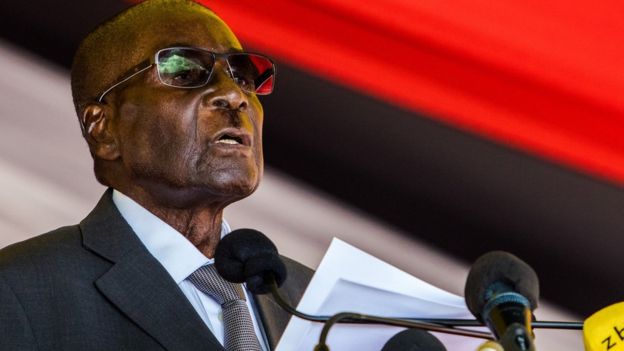
"As an African and a farmer, the donation of cattle came naturally to me, given that our continent is rich in cattle and cattle are held as a store of wealth," Mr Mugabe said.
On its website, the AU Foundation says it focuses on development programmes for youth and women, and promoting gender equality.
Mr Mumbengegwi said the donation was significant as it showed that the AU could find innovative ways to raise money for its projects.
Mr Mugabe, during his term as AU chairman in 2015 and 2016, campaigned for the AU to be self-financed as about 60% of its budget came from foreign donors, the Herald reported.
Latest Stories
-
Health Minister to brief media on Free Primary Healthcare programme on Monday
10 minutes -
‘It was inappropriate to make that comparison’ – Dr Pumpuni Asante on CJ’s SOE comment
23 minutes -
Photos: Final-day shopping continues at Joy FM Back-to-School Discount Fair
51 minutes -
Darkey and Frimpong set up J30 Accra boys’ doubles final
53 minutes -
When war takes more than territory: The human cost of conflict
55 minutes -
Review SHS placement policy to give more BECE candidates access – Kwesi Kwarteng
1 hour -
Tano South Municipal Assembly moves to curb road carnage with speed ramps
1 hour -
Duvor Klu, Gakpo win J30 Accra girls’ doubles title
1 hour -
ITF Juniors Tournament: Duvor Klu claims with straight-sets victory over Gakpo
1 hour -
‘Decision to retire has been tough’ – Isaac Dogboe
2 hours -
Domelevo backs OSP probe into alleged GH¢70,000 payment to Appiagyei
2 hours -
Crowds swell as families make final shopping at Joy FM Back-to-School Fair
2 hours -
‘Apologise if you accept you erred’ – Political analyst tells Chief Justice
3 hours -
Mahama’s board shake-up should not be linked to indiscipline – Akwatia MP
3 hours -
‘My Police, Your Police, Our Police’: the Aboso fire and a lesson in Policing together
3 hours