


Audio By Carbonatix
A mass burial of more than 70 people has been held in Nigeria's central Benue State.
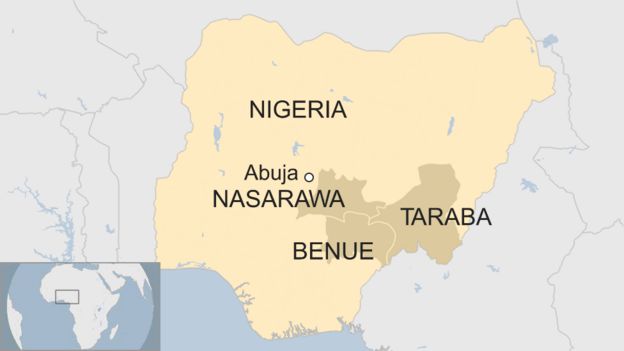
Dozens have been killed in conflicts between nomadic herdsmen and farming communities in three states - Benue, Nasarawa and Taraba - in recent weeks.
The Nigerian army says it has deployed special forces to all three to "stem the menace".
Herders, mostly from the Fulani ethnic group, and farmers often clash over land in the region.
Since the New Year, the number of clashes has intensified, with more than 100 deaths reported in Benue and Taraba states.
Fighting has been particularly heavy in Benue state, where 80 people have been killed and 80,000 displaced.
"Thousands are attending today's funeral service to honour those killed," Benue's information commissioner Lawrence Onoja told the BBC.
Mr Onoja, who was at the funeral, said 73 people were being buried.
He defended his state's controversial ban on open cattle grazing implemented in November, which Fulani herders have complained targets them unfairly.
"Our economy in Benue State depends on agriculture," he said. "Take that away and we have a serious problem."
Live Photos From Mass Burial For Victims Of Benue Killings https://t.co/xz9gnNTTsu pic.twitter.com/y56He6WQLp
— Benue News Updates (@benueinfo) January 11, 2018
Mr Onoja said that herdsman had a "misconception" the law was against them, saying they had not taken the time to look at it closely.
"[Until now] Fulani herders have been a law unto themselves. We want them to adopt ranching. These clashes result from the encroachment of cattle on farmers' land."
The BBC's Haruna Shehu in the capital, Abuja, says Fulani herders' associations have told him they only mount retaliatory attacks when others steal their cattle or kill members of their community.
"They prepare attacks months in advance and enlist fellow herdsmen from as far as Guinea," he said.
The Fulanis are spread across West Africa, from Senegal to Central Africa Republic.
While these tit-for-tat clashes often begin over land, the crisis seems to be taking on an ethnic and religious dimension.
Earlier this week, President Muhammadu Buhari ordered the head of police to relocate to Benue to manage the crisis.
The president's office later confirmed the deployment of special forces to Nigeria's central region in a tweet:
UPDATE: @HQNigerianArmy has deployed Special Forces To Benue, Taraba and Nasarawa States to secure vulnerable communities and prevent further attacks.
— Presidency Nigeria (@NGRPresident) January 10, 2018
Analysts say the deployment to more states is likely to overstretch the Nigerian military, as it currently has thousands of troops fighting Boko Haram in the north-east.
Many other troops are operating in the oil-rich Niger Delta in the south, where militants are demanding a greater share of the oil wealth.
Latest Stories
-
Isaac Dogboe opens reveals mental health battles, calls for support for athletes
11 minutes -
MTN Ghana webinar urges SMEs to get financial discipline right
43 minutes -
Duvor Klu, Hua crowned champions as J30 Accra Week 1 concludes
56 minutes -
Gov’t to make rural telephony services cheaper by first quarter of 2027 – Sam George
1 hour -
National Chief Imam remains Ghana’s strongest symbol of interfaith harmony – Mahama Ayariga
2 hours -
Gov’t to upgrade all rural telephony networks to 4G capability – Sam George
2 hours -
‘We’ve never seen a CJ in our judiciary system who is everywhere like MTN’ – Janet Nabla
2 hours -
Lawyers, prosecutors fume over abandoned 26-year-old Upper West High court project
2 hours -
At least two dead in blast at Bolivia military barracks
3 hours -
Tate brothers officially indicted with trafficking and sex crimes in Romania
3 hours -
US envoys arrive in Moscow ahead of Ukraine talks
3 hours -
Health Minister to brief media on Free Primary Healthcare programme on Monday
3 hours -
‘It was inappropriate to make that comparison’ – Dr Pumpuni Asante on CJ’s SOE comment
3 hours -
Photos: Final-day shopping continues at Joy FM Back-to-School Discount Fair
4 hours -
Darkey and Frimpong set up J30 Accra boys’ doubles final
4 hours