


Audio By Carbonatix
The Democratic Republic of Congo has moved to increase taxes on mining firms and increase government royalties from the industry despite fierce opposition from international mining companies.
President Joseph Kabila signed a new mining code into law on Friday.
The country is Africa's biggest producer of copper and cobalt, a vital component in mobile phone batteries.
Foreign mining firms strongly opposed the law, saying their operations in DR Congo would stop being profitable.
Several chief executives flew to the Congolese capital Kinshasa this week in the hopes of persuading Mr Kabila to change his mind.
They argued that the legislation would deter future investment and violate existing agreements, reported Reuters news agency.
The government however has agreed to consider their concerns on a case by case basis, and work with them in executing the new code.
DR Congo has talked for years about changing its 2002 mining code, which it believed put too many profits in the hands of foreign companies, says BBC World Service Africa editor Mary Harper.
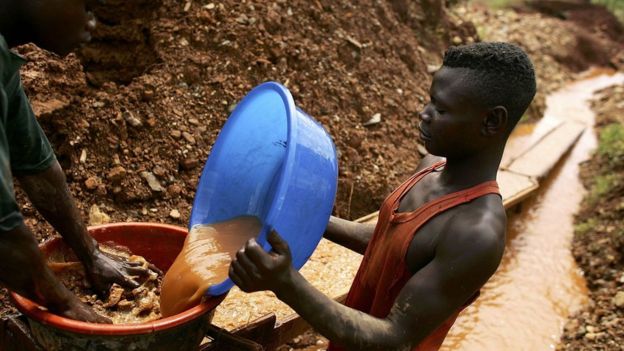 Its mining industry - which also produces diamond, tantalum, tin and gold - is the country's largest source of export income.
The law, which was passed by parliament in January, will double government royalties on all minerals.
The impoverished yet mineral-rich nation provides more than 60% of the world's cobalt. Prices for it more than doubled last year thanks to an increased demand for electric cars, which require cobalt for batteries.
Royalties on cobalt could also more than quadruple if the government labels it a "strategic substance".
Its mining industry - which also produces diamond, tantalum, tin and gold - is the country's largest source of export income.
The law, which was passed by parliament in January, will double government royalties on all minerals.
The impoverished yet mineral-rich nation provides more than 60% of the world's cobalt. Prices for it more than doubled last year thanks to an increased demand for electric cars, which require cobalt for batteries.
Royalties on cobalt could also more than quadruple if the government labels it a "strategic substance".
Its mining industry - which also produces diamond, tantalum, tin and gold - is the country's largest source of export income.
The law, which was passed by parliament in January, will double government royalties on all minerals.
The impoverished yet mineral-rich nation provides more than 60% of the world's cobalt. Prices for it more than doubled last year thanks to an increased demand for electric cars, which require cobalt for batteries.
Royalties on cobalt could also more than quadruple if the government labels it a "strategic substance".DISCLAIMER: The Views, Comments, Opinions, Contributions and Statements made by Readers and Contributors on this platform do not necessarily represent the views or policy of Multimedia Group Limited.
Tags:
DISCLAIMER: The Views, Comments, Opinions, Contributions and Statements made by Readers and Contributors on this platform do not necessarily represent the views or policy of Multimedia Group Limited.
Latest Stories
-
UK lawmakers demand new law to address AI threat to human rights
38 seconds -
WAFU B U-17 Girls Cup: Black Maidens depart Accra for tournament in Yamoussokro
53 seconds -
Sweden’s center-left bloc narrowly ahead as election remains too close to call
11 minutes -
GPL 2026/27: ‘We won ugly’ – Kotoko head coach unimpressed after Lions victory
14 minutes -
7 out of 10 human trafficking cases in Ghana never reach prosecution — JoyNews Research
30 minutes -
Music, football to converge at Music Meets Football Summit 2026 in Lusaka
35 minutes -
Putin invites young global leaders to partner with Russia in shaping future world order
36 minutes -
Putin calls for ‘just world’, says every nation must be free to choose its own path
43 minutes -
IFY 2026 food festival to serve 20,000 meals showcasing global cuisines in Russia
55 minutes -
Ghana has a Domestic Violence Act: But can a victim afford to use it?
58 minutes -
Young artists from 100 countries showcase works at IFY 2026 in Russia
60 minutes -
Russia opens neo-Nazism exhibition at International Festival of Youth 2026
1 hour -
‘Let’s change the world together’ – Putin tells young people
1 hour -
VC inaugurates three committees ahead of UG’s 80th anniversary celebration
1 hour -
Today’s Front pages: Monday, September 14, 2026
2 hours