

Audio By Carbonatix
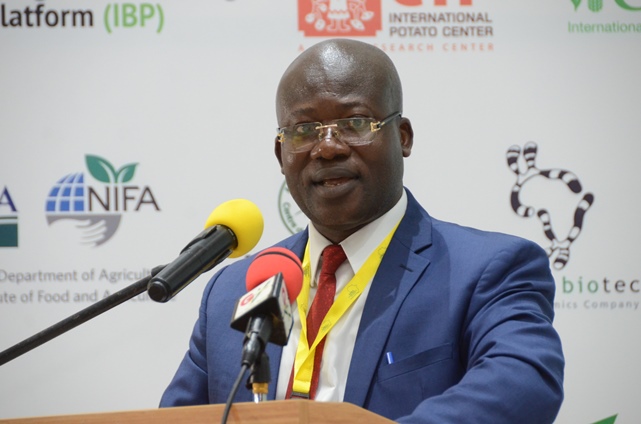
2022 Africa Food Prize winner Prof. Eric Danquah has called on African governments to increase investments in the agricultural sector.
He said there is a frustrating lack of investments by African governments in agricultural science because there is a lot of short-term thinking by visionless leaders.
“Despite typically being farmers themselves, many African politicians mentally uncouple farming and science. They somehow expect smallholders to flourish even if research and development gets no money.
"But to paraphrase a former Tanzanian president, agriculture without investment is like dancing without music,” he said in an interview.
The founding director of the West Africa Centre for Crop Improvement (WACCI) at the University of Ghana said Africa cannot afford to keep on importing so much food.
“Spending foreign exchange on crops we could be growing locally is not only perverse but also unsustainable,” he said.
“When good African science gets into their hands, our farmers can compete, improve their livelihoods, and feed their countries,” he assured.
Prof. Danquah said African crop scientists must ensure that they are using the most efficient methods such as speed-breeding and other advanced technologies to develop better seeds for farmers.
“We have to keep abreast of what is happening elsewhere and be on the lookout for new, sometimes unexpected partnerships. At the same time, we must always align our science with societal needs,” he said.
“That means, for example, breeding varieties that help improve smallholders’ resilience rather than “only” tolerating a particular pest or disease.
"That’s a subtle mindset shift, but a vital one. And it means a greater focus on multi-disciplinary teams that develop, implement and learn together,” he noted.
The University of Ghana professor said the Covid pandemic was a big reminder of the fragility of African food supply chains.
“Here in Accra, as in most of the continent’s cities, informal channels play a crucial role in ensuring access to food and income.
"To tackle major challenges to the supply chain, African countries must meet their own needs locally. We can’t depend on imports,” he said.
He said African farmers could and should be more productive than they are currently.
“They deserve better varieties, developed locally…African crop science still lacks the critical mass required to serve the continent’s agriculture appropriately,” he said.
Prof. Danquah called for more efforts to tackle brain drain on the African continent. “International experience is highly valuable.
"Just look at all the places where our faculty trained! What matters is that Africans who study overseas then come back. And for WACCI, with its international intake, there is also an intra-continental aspect,” he said.
“One of the most rewarding sides to my job is seeing the impact that our alumni make back home. Former WACCI students are now spearheading crop improvement in more than 15 African countries.
"Who would have thought that would be possible 20 years ago? There were many doubters. But my WACCI team believes in young scientists, and they continue to justify that confidence,” he added.
Prof. Danquah observed that battling brain drain also requires high-quality organizations and facilities that encourage Africans to stay and work at home.
“We have to offer people a great place to work, in all respects. That’s why “People” are one of the five priorities in the University of Ghana’s 2024-29 Strategic Plan,” he said.
“In crop science, ambitious academics want top-class labs, greenhouses, and demo plots. And they need good long-term prospects – properly endowed fellowships, for example, not just a series of temporary grants. Nobody can live on a vague “we might extend it” from governments or donors,” he added.
Latest Stories
-
Ghana ranked joint 6th in 2026 Absa Africa Financial Markets Index
25 minutes -
Demand and savings deposits decreased in August 2026, but currency outside banks increased by 4%
53 minutes -
Fiscal policy implementation poses downside risk to inflation – BoG
1 hour -
Organised Labour should seek fair adjustment, not excessive pay rise – Labour consultant
2 hours -
BoG maintains medium-term inflation target of 8 ± 2%
2 hours -
Sammi Awuku urges NPP Germany to unite ahead of 2028 elections
2 hours -
The Inconvenient Truth: We cannot pray for the cure while protecting the disease
3 hours -
MTN Ghana trains civil society organisations on artificial intelligence
4 hours -
GoldBod FX framework aims to make dollar supply predictable – Acheampong
4 hours -
How does a Ghanaian team make it to the BAL?
4 hours -
Ghana’s investment climate presents opportunities for industrial growth and job creation.
4 hours -
‘I paid thousands to a company for jobs that never came’
4 hours -
SSNIT intensifies informal sector enrolment drive with Techiman float
5 hours -
Ghana seeks long-term mining investments that benefit local communities – Armah-Kofi Buah
5 hours -
GHATOF demands compensation for 85 businesses affected by La Pleasure Beach demolition
5 hours