

Audio By Carbonatix
The West Africa Centre for Crop Improvement (WACCI) at the University of Ghana will from tomorrow Friday host an emergency consultative meeting to deliberate on food and nutrition security in the country.
The meeting from April 22-24 will develop a document that makes a compelling case for investments in the value chains of Africa’s major staple crops.
The document will encourage investments in these crops to help ensure food security and socio-economic development in Ghana, and on the continent generally. Rice, maize, soybean, cowpea, cassava, and tomato are the major crops that the deliberations will center on.
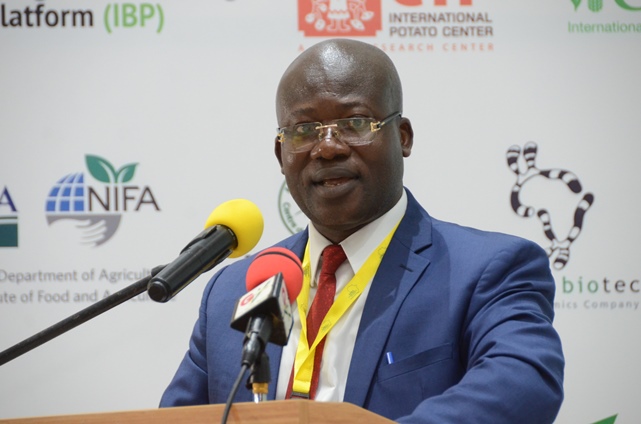
Speaking at a pre-meeting briefing, WACCI’s Founding Director, Prof. Eric Danquah observed that “Ghana needs an independent instructive document informed by evidence and foresight to chart a new path in its agricultural development for the future of food and nutrition security.”
He said that judging from global developments like the Russia – Ukraine war and the Covid-19 pandemic, the world faces imminent hunger and called for urgent action from governments and other actors in the agricultural space.
He said these global developments are also a warning that no nation should continue to rely on food imports.
The meeting will bring together key agricultural sector actors from a number of institutions including the Ghana Incentive – Based Risk – Sharing System for Agricultural Lending (GRISAL), Crop Research Institute of the Council for Scientific and Industrial Research (CSIR), Directorate of Crop Services of the Ministry for Food and Agriculture, Tree Crop Development Authority, School of Agriculture and Institute for Social, Statistical and Economic Research (ISSER) at the University of Ghana, among others.
Prof Danquah who is also the 2018 Laureate and GCHERA World Agriculture Prize winner, said the billions of dollars spent on importation of agricultural products into the country is uncalled for.
“Importing seed, feed, food, and raw materials when it comes to foods like cassava is wasteful and not strategic. Such money could be used in other important areas of the economy for sustainable development if the government prioritizes smart investments in agriculture, science, technology, and innovation,” he observed.
He said, “there is the need for sustainable intensification in the agricultural space driven by home grown genetic innovation for self sufficiency in the staple crops that feed the people of Africa.”
Prof Danquah said Ghana now has a number of modern plant breeders trained at WACCI who can drive genetic innovation to grow agribusinesses. WACCI is a notable World Bank Africa Centre of Excellence for Agricultural Innovation and Entrepreneurship at the University of Ghana that trains plant breeders at the PhD level. Prof. Danquah expressed confidence the upcoming meeting will come up with major recommendations which will inform policy change for investments in agriculture.
Latest Stories
-
Ghana ranked joint 6th in 2026 Absa Africa Financial Markets Index
25 minutes -
Demand and savings deposits decreased in August 2026, but currency outside banks increased by 4%
52 minutes -
Fiscal policy implementation poses downside risk to inflation – BoG
1 hour -
Organised Labour should seek fair adjustment, not excessive pay rise – Labour consultant
2 hours -
BoG maintains medium-term inflation target of 8 ± 2%
2 hours -
Sammi Awuku urges NPP Germany to unite ahead of 2028 elections
2 hours -
The Inconvenient Truth: We cannot pray for the cure while protecting the disease
3 hours -
MTN Ghana trains civil society organisations on artificial intelligence
4 hours -
GoldBod FX framework aims to make dollar supply predictable – Acheampong
4 hours -
How does a Ghanaian team make it to the BAL?
4 hours -
Ghana’s investment climate presents opportunities for industrial growth and job creation.
4 hours -
‘I paid thousands to a company for jobs that never came’
4 hours -
SSNIT intensifies informal sector enrolment drive with Techiman float
5 hours -
Ghana seeks long-term mining investments that benefit local communities – Armah-Kofi Buah
5 hours -
GHATOF demands compensation for 85 businesses affected by La Pleasure Beach demolition
5 hours