

Audio By Carbonatix
Results from improved air quality monitoring in Accra have revealed that Nima, Makola, Agbogbloshie, Chorkor and Madina Zongo Junction are the five most polluted hotspots in Accra.
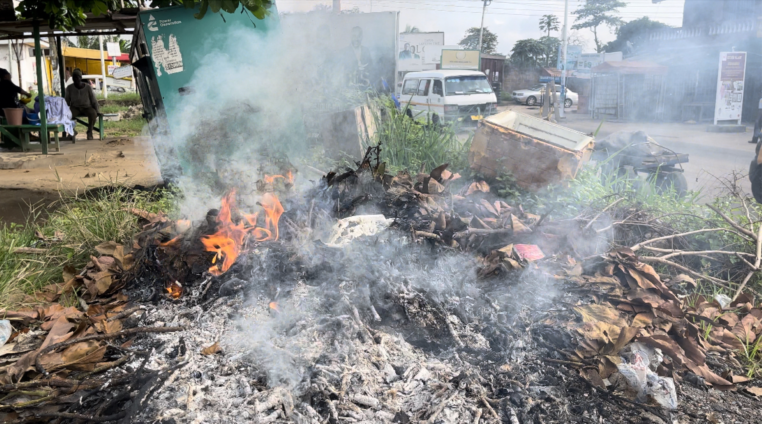
These areas have recorded the most consistently poor-quality air standards over the period, with their sources mainly being soot from open waste burning and emissions from vehicles.
Professor Kofi Amegah, the Breathe Accra Project Lead, told the Ghana News Agency that those pollutants and particulates were harmful to human health.
He said a compilation of data from over four months of monitoring showed that pollution in those areas occurred throughout the day and the readings exceeded the recommended World Health Organisation standards.

According to the Air Quality Index (AQI), the ideal or good air quality should fall between the range 0 to 50 on the index.
AQI from 51 to 100 is moderate even though there may be some health concerns for a small number of unusually sensitive individuals like children under five.
“For instance, AQI for Agbogbloshie on Wednesday 6th September 2023 was between 150 and 200, which is unhealthy for all groups of people,” Prof Amegah said.
He said the installation of over 30 sensors was augmenting the Environmental Protection Agency's monitoring stations, which had led to a larger area of the city being continuously monitored for air quality.
Even though monitoring was yet to equate the international best practice of having sensors within every five-mile radius, the improved monitoring is revealing real-time air quality, which allows for investigations to understand the sources and causes of the pollution for remedial actions.

Touching on green spaces, Prof Amegah said a recent study he conducted showed that green spaces, comprising tree cover, grass, and parks acting as the ‘lungs of the city’, had drastically dissipated in the last two decades.
“These greens purified the air, but we have removed almost all. We need to act fast by planting trees before it is too late,” he cautioned.
Mr Alex Johnson, the Head of Transport, Accra Metropolitan Assembly, said: “There is a high concentration of pollutants wherever there is high population and high volume of vehicular traffic at the same time.”
“As vehicles move slowly, fuel burning becomes inefficient resulting in high emissions of air pollutants. Also, open burning of waste in these areas is quite common, so I’m not surprised at the results of the monitored data.”
He said groups, especially market women/traders, ‘truck pushers’, head potters (kayayei), patrons, drivers, pedestrians and residents, living in those exposed environments, risked developing heart-related diseases and lung cancer in the medium to long term.
Statistics from the Ghana Health Service (GHS) for the first half of 2023 show that asthma, a condition which is mostly caused by poor air quality, was the second most non-communicable disease (NCDs) recorded.
Dr Efua Commeh, the Acting Programme Manager for Non-Communicable Diseases, GHS, explained that the data meant that more people were getting sick with chronic obstructive pulmonary diseases such as asthma.
Pollutants made children more likely to catch upper respiratory infections such as flu, which could bring on asthma symptoms, she said.
The dust and soot particles being inhaled could result in lung malfunctioning, heart diseases, cancer, and damage to nerves, brain, kidneys, liver, and other organs of the body, which could lead to premature deaths.
On health burden, data obtained by the Ghana News Agency (GNA) indicated that the National Health Insurance spent US$14,976,000 annually on the treatment of conditions related to NCDs among 500 patients hospitalised.
Mr Desmond Appiah, the Country Lead of Clean Air Fund, reiterated the need for leadership, law enforcement agencies, and the public to work together to maintain blue skies.
He said working collaboratively and making evidence-informed decisions with targeted actions would reduce and eliminate waste burning and improve modes of transportation.
A common goal of ensuring clean air for all could be a catalyst to leverage financing and investments in sectors that improved air quality measures and provided many co-benefits, he added.
Latest Stories
-
I have supported highway authority financially to fix roads in my constituency – A Plus
47 minutes -
US, Iran fail to reach peace agreement after marathon talks in Pakistan
1 hour -
ECG kicks off Phase Two of transformer upgrades at Lashibi; brief outages expected
2 hours -
Port crises loom as 11,000 drivers threaten four-day strike
3 hours -
A source of excellence across generations – Vice President Opoku-Agyemang lauds Mfantsipim
3 hours -
(Photos) Mfantsipim School launches historic 150th anniversary
4 hours -
Knights and Ladies of Marshall group backs Catholic Bishops’ stance on anti-LGBTQ+
5 hours -
Bright Simons writes: All the Filla in the Ibrahim Mahama/E&P – Gold Fields Saga
5 hours -
Monetise Idiocy In Ghana
5 hours -
The Ghanaian prophet and the mysterious death of his scottish wife Charmain Speirs
6 hours