

Audio By Carbonatix
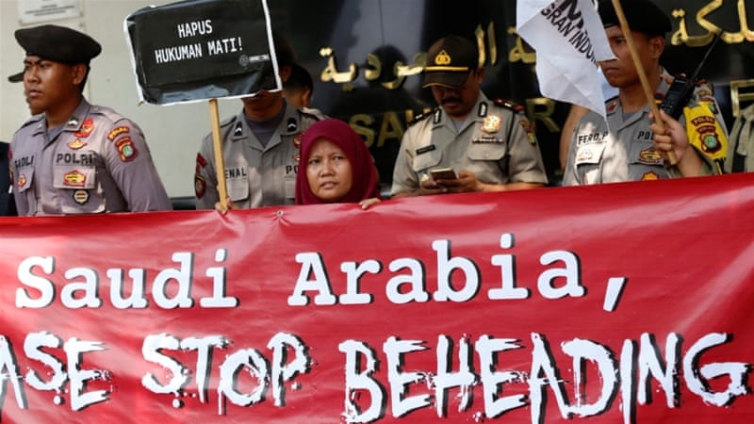
Saudi Arabia executed a record 184 people last year, according to Amnesty International, which said it was the highest number the rights organisation has ever recorded in a single year in the country.
In its 2019 global review of the death penalty published on Tuesday, Amnesty reported Saudi Arabia stepped up its use of the death penalty even as the rest of the world saw a decline in executions, including in the Asia-Pacific region.
Saudi Arabia executed 178 men and six women in 2019, just over half of whom were foreign nationals. The figure was 149 in 2018.
The majority of executions were for drug-related offences and murder.
"Saudi Arabia's growing use of the death penalty, including as a weapon against political dissidents, is an alarming development," Clare Algar, Amnesty International's Senior Director for Research, Advocacy and Policy, said.
Only 20 countries are responsible for all known executions worldwide.
Iran remained the world's second-most prolific executioner after China, where the exact number of people put to death remains a state secret. The number of executions nearly doubled in Iraq, the report added.
Global executions decreased for the fourth consecutive year to at least 657 in 2019 from at least 690 during the previous year - the lowest recorded figure of the past decade.
The top five executing countries in 2019 were: China (1000s), Iran (at least 251), Saudi Arabia (184), Iraq (at least 100) and Egypt (at least 32).
Political weapon
Amnesty International also documented the increased use of the death penalty against those from Saudi Arabia's Shia Muslim minority.
On April 23, 2019, there was a mass execution of 37 people of whom 32 were Shia men convicted on "terrorism" charges following trials that relied on false confessions extracted through torture, it said.
Individuals are brought before Saudi Arabia’s Specialized Criminal Court (SCC), which was set up in 2008 to try those accused of terror-related crimes but is increasingly used to suppress dissent, according to Amnesty.
In Iraq, the number of people executed almost doubled from at least 52 in 2018 to at least 100 in 2019, mostly due to the executions of individuals accused of being members of the Islamic State of Iraq and the Levant (ISIL or ISIS).
In South Sudan, authorities executed at least 11 people in 2019, the highest number recorded since the country's independence in 2011.
Bahrain also resumed executions after a one-year hiatus, putting three people to death during the year.
For the first time since 2010, no executions were carried out in Afghanistan.
Decline in Asia-Pacific region
The Asia-Pacific region also saw a decline for the first time since 2011, with pause in executions reported in Thailand as well as Taiwan.
In Singapore executions saw a sharp drop from 13 executions in 2018, to 4 in 2019, bringing its yearly total level in line with average figures of previous years.
"The death penalty is an abhorrent and inhuman punishment and there is no credible evidence that it deters crime more than prison terms," Algar of Amnesty said.
"A large majority of countries recognise this and it's encouraging to see that executions continue to fall worldwide."
In Malaysia, the country continues to observe the official moratorium on executions established by the previous Pakatan Harapan coalition government since July 2018.
The new government of Prime Minister Muhyiddin Yassin, which came to power in March 2020, has not yet stated whether it would go ahead with the previous government's pledge to repeal the capital punishment. The country's parliament is expected to reconvene under the new government on May 18.
Latest Stories
-
ICC London rules in favor of Ghana against Tullow over $400m tax charge
9 minutes -
We are disappointed in ICC’s ruling over our corporate income tax assessment in Ghana – Tullow Oil
19 minutes -
Cost of building inflation for August 2026 increases to 4.6% – GSS
20 minutes -
Today’s front pages: Wednesday, September 30, 2026
51 minutes -
Bawumia highlights agricultural, compulsory insurance reforms in IBAG engagement
52 minutes -
Ghana will secure Tullow tax revenues while protecting Jubilee, TEN investments – Ato Forson
1 hour -
Ghana wins $393m Tullow tax arbitration as tribunal upholds GRA assessment
1 hour -
Gender Minister assures women’s group of action on Affirmative Action, Development Bank
2 hours -
Over 2,000 teachers in Dormaa comply with strike – GNAT Secretary
2 hours -
Food Buffer Stock seeks stronger liquidity buffer despite record profit
2 hours -
LPG investments key to achieving 50% access target by 2030 – Energy Minister
2 hours -
Jinapor: New LPG terminal strengthens Ghana’s energy security
2 hours -
Agbodza directs road agencies to fast-track design approvals to prevent project delays
2 hours -
Housing Minister urges stakeholders to prioritise quality education in Banda District
2 hours -
Government redeems pledge to complete abandoned projects – Kofi Buah
2 hours