

Audio By Carbonatix
Fourteen years after oil first trickled out of the Jubilee field, Ghana has little to show for the windfall.
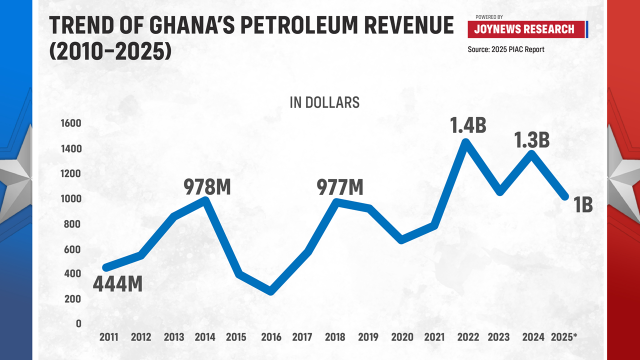
Since 2011, the state has earned about $11.58 billion from crude production, yet the transformation once promised has proved elusive.
The state’s share comes from royalties of 5% to 12.5%, surface rentals of $30 to $100 per square kilometre, a 15% minimum carried interest, a 35% corporate income tax and a mix of negotiated bonuses and other entitlements with each operator.
These inflows peaked in 2022, when the government collected $1.43 billion, but production has faltered since.
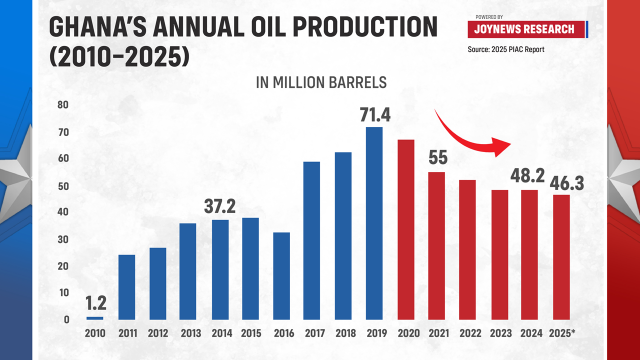
Output has fallen steadily since 2019, weakening state revenues year after year.
In the first half of 2025, receipts dropped to $370 million. That's less than half of the $840 million earned a year earlier. A sharply appreciating cedi eroded the dollar value of these inflows even further.
In all, Ghana has pumped around 675 million barrels of crude since 2010.
The question today is not whether the country has benefited from petroleum, but how far the money has carried it.
Through the Africa Extractives Media Fellowship (AEMF), led by Newswire Africa and the Australian High Commission, Isaac Dwamena, coordinator of the Public Interest and Accountability Committee (PIAC), the independent body that monitors the use of Ghana’s petroleum revenues, outlined how the state has handled the cash so far.
Under the Petroleum Revenue Management Act, all petroleum income flows first into a central account, the Petroleum Holding Fund (PHF), before being shared among key recipients.
The Ghana National Petroleum Corporation has received about $3.15 billion to finance operations and exploration.
Another $2.6 billion has been paid into the Ghana Stabilisation Fund to cushion fiscal shocks, while the Ghana Heritage Fund, reserved for future generations, has received $1.1 billion and now holds roughly $1.3 billion.
The largest visible impact has come through the Annual Budget Funding Amount (ABFA), which has absorbed about $4.5 billion since 2011 and supports the government’s yearly budget, making it the channel through which most citizens feel the benefits of oil revenue.
These ABFA resources have financed headline projects including Kotoka Airport’s Terminal 3, the Kojokrom–Tarkwa railway, the Axim coastal protection works, the Tamne irrigation scheme, Free Senior High School and the Atuabo gas processing plant.
The investments are visible enough, yet many Ghanaians still wonder whether the wider promise of oil wealth has translated into everyday improvements.
Mr Dwamena argues that spending has lacked a clear guiding framework.
Ghana still has no long-term national development plan approved by Parliament to steer the use of petroleum revenues.
The absence of such a plan, he says, has produced a patchwork of projects launched at once, stretching resources thin and creating bottlenecks, delays and cost overruns.
A new shift is also taking shape in how petroleum funds are allocated.
Under the 2025 budget, the government has directed 95% of the ABFA into its Big Push programme to accelerate major road construction nationwide. The remaining 5% goes to the District Assemblies Common Fund.
It is a sharp pivot from previous years, concentrating almost the entire ABFA on a single priority rather than spreading it across several sectors.
Fourteen years after first oil, the gains remain uneven.
Ghana’s experience contrasts with that of Norway, which channels oil income into a large sovereign wealth fund, invests almost entirely abroad and limits withdrawals to preserve capital for the long term.
Ghana’s own rules for managing petroleum wealth were drafted more than a decade ago. They now require fresh scrutiny.
Public consultations, expert input and legislative review could help adapt the framework to today’s economic pressures and the coming energy transition.
Citizens have seen how the laws they helped craft have worked in practice; they must now consider whether the current system delivers what they intended.
For now, Ghana’s oil money has built airports, schools and pipelines. What it has not yet delivered is the economic transformation its discovery once promised.
Latest Stories
-
Association of Small-Scale Industries empowers trade executives in Bono East with a mentorship programme
4 minutes -
AMA evacuates refuse along Graphic Road, warns against indiscriminate dumping
10 minutes -
STC interdicts driver over Pokuase overtaking incident
14 minutes -
Ekumfi: How $6m EXIM participation built a $53m industrial asset — now poised for a 24-Hour Economy breakthrough
15 minutes -
4 arrested, 142 parcels of suspected Indian hemp seized as officers reject GH¢50k bribe
15 minutes -
No MMDCE can say they don’t see galamsey – Local Government Ministry
16 minutes -
Ghana, Germany explore stronger partnership in technical and vocational education
23 minutes -
AMA urges motorists and road users to comply with traffic regulations
23 minutes -
Sam George urges One Million Coders participants to complete all three levels
24 minutes -
Communications Minister announces 2,800-site telecom expansion during Volta visit
26 minutes -
Impunity fuelling sexual abuse in Ghana – Angela Dwamena-Aboagye
27 minutes -
NUGS condemns alleged sexual abuse by Obuasi SHTS headmaster, calls for prosecution
30 minutes -
President Mahama urges investors to employ trained local residents as 1,238-acre industrial park takes off
34 minutes -
Media doing its job, but politicians fuelling insults on social media – NMAG president
36 minutes -
Child protection must be the state’s responsibility, not NGOs’ burden – ARK Foundation Boss
42 minutes