

Audio By Carbonatix
Dr Emmanuel Akwetey, Executive Director of the Institute for Democratic Governance (IDEG), has urged the New Patriotic Party (NPP) and the National Democratic Congress (NDC) to build consensus on the election of Metropolitan, Municipal and District Chief Executives (MMDCEs) before undertaking major local government reforms.
He said the longstanding disagreement between the two major political traditions over whether MMDCEs should be elected on political party lines or through non-partisan contests remained a major obstacle to durable decentralisation and responsive local governance.
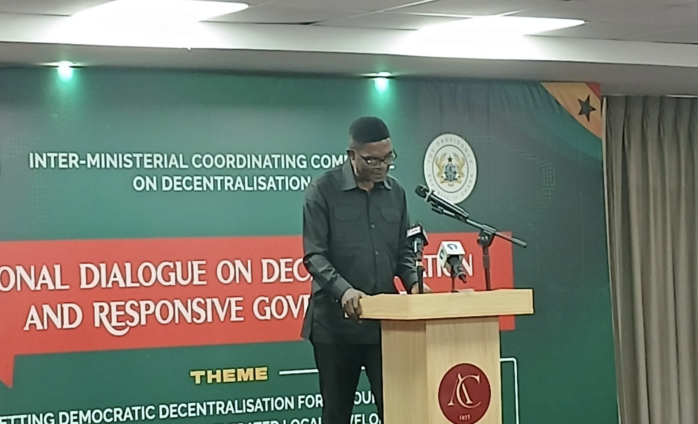
Dr Akwetey made the call at the Inter-Ministerial Coordinating Committee on Decentralisation’s (IMCC) National Dialogue on Decentralisation and Responsive Governance in Accra on Tuesday.
The two-day dialogue, on the theme: “Resetting Democratic Decentralisation for Accountable Public Service Delivery and Accelerated Local Development,” brought together regional ministers, MMDCEs, traditional leaders, local government experts, development partners, civil society organisations and other stakeholders to deliberate on the future of decentralisation and responsive local governance.
Dr Akwetey said Ghana had spent decades debating local government reforms without achieving sufficient political consensus, citing the failed 2019 referendum as evidence of the deep divisions surrounding the issue.
He said the Constitution Review Committee (CRC), in its recommendations to the President, had proposed replacing the presidential appointment of District Chief Executives with elections while maintaining the non-partisan character of local government elections.
The CRC also proposed qualifications for DCE candidates and a phased implementation of the reforms.
Government has subsequently indicated support for the direct election of MMDCEs by citizens on a non-partisan basis, although the proposed changes require constitutional amendments.
Dr Akwetey said the critical issue was not simply whether MMDCEs should be elected, but whether the major political parties could agree on a system capable of strengthening local accountability and development.
“The two major political traditions remain one of the greatest obstacles to durable local government reform. There is no consensus between the NDC and NPP on whether we should open local government to political parties or keep it non-partisan,” he said.
“We have to find out how we can build that consensus to move local government reform forward.”
He suggested that political parties could be allowed to participate while creating space for credible independent candidates, if that emerged as the consensus model.
Dr Akwetey also called for greater national responsibility for financing decentralisation and democratic institutions, noting that external development support was coming under increasing pressure globally.
He said any new electoral arrangement should address the marginalisation of women, young people, persons with disability and traditional authorities, stressing that changing the method of selecting MMDCEs alone would not guarantee inclusive local governance.
He further called for stronger fiscal decentralisation, saying political decentralisation without adequate financial resources would have limited impact.
Greater resources at the local level, he noted, must be accompanied by stronger auditing, financial disclosure, community monitoring and professional public administration.
Although Ghana had made progress in strengthening fiscal transfers and public financial management at the local level, Dr Akwetey said local authorities still exercised less authority and control over resources than required for effective decentralisation.
He also called for the professionalisation of political parties through greater support for policy research, technical expertise and institutional development rather than campaign financing.
A strong, merit-based and politically neutral public service was equally necessary to build an effective local government system, warning that frequent changes in public-sector appointments following changes in government could undermine institutional continuity and weaken public administration, Dr Akwetey said.
He urged stakeholders to strengthen legal protections for professional public servants and reduce political interference in the bureaucracy.
Stakeholders must approach the reform process through broad cross-party and public consultation to ensure that whichever model was adopted enjoyed legitimacy and continuity beyond changes in government, he added.
Latest Stories
-
Anwelle Foundation launched in Jirapa to tackle poverty, youth unemployment
19 minutes -
Joy Sports Editor Fentuo Tahiru Fentuo to moderate inaugural Music Meets Football Summit in Zambia
23 minutes -
Court premises too volatile for Baffour Awuah’s attempted arrest by EOCO – Inusah Fuseini
31 minutes -
Drug bust: Under no circumstances will NACOC leadership be compromised – Twum-Barimah
32 minutes -
VIDEO: EOCO’s attempted arrest of Baffour Awuah was flawed beyond saving – Law Lecturer
32 minutes -
Genuine Ghanaian exporters may face heightened foreign inspections over drug busts – Lawyer
32 minutes -
Stakeholders demand action against foreign-led illegal mining in Ahafo Region
2 hours -
Ghana handed tricky draw at 2026 Amputee World Cup
2 hours -
2024 Nyankpala election violence: Youth group petitions authorities over slow probe
2 hours -
Ghana, UNICEF strengthen partnership to advance child protection
3 hours -
Day Two of 3rd Republic Bank-JoyNews Habitat Fair ends with great homeownership offers and financing solutions
3 hours -
Guinness Ghana DJ Awards 2026 Pub Fest celebrates Ghana’s DJ culture as Accra turns up the energy
3 hours -
10th woman found dead in South Africa’s string of killings
3 hours -
French Embassy trains Ghana Police CTU in counter-terrorism operations
4 hours -
UPSA uncovers mass results manipulation involving 178 students, over 500 results compromised
4 hours