

Audio By Carbonatix
World leaders meeting in Paris on Thursday could give poorer countries access to hundreds of billions of dollars to tackle climate change.
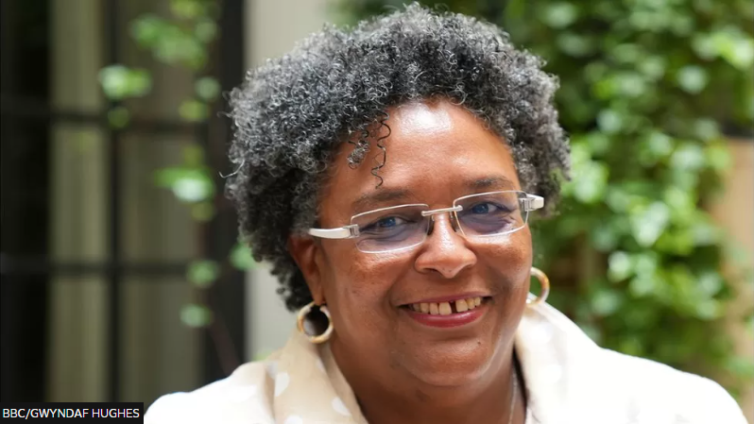
Mia Mottley, Barbados' first female PM, is leading the global fight for this money and tells BBC News that her tiny country urgently needs help.
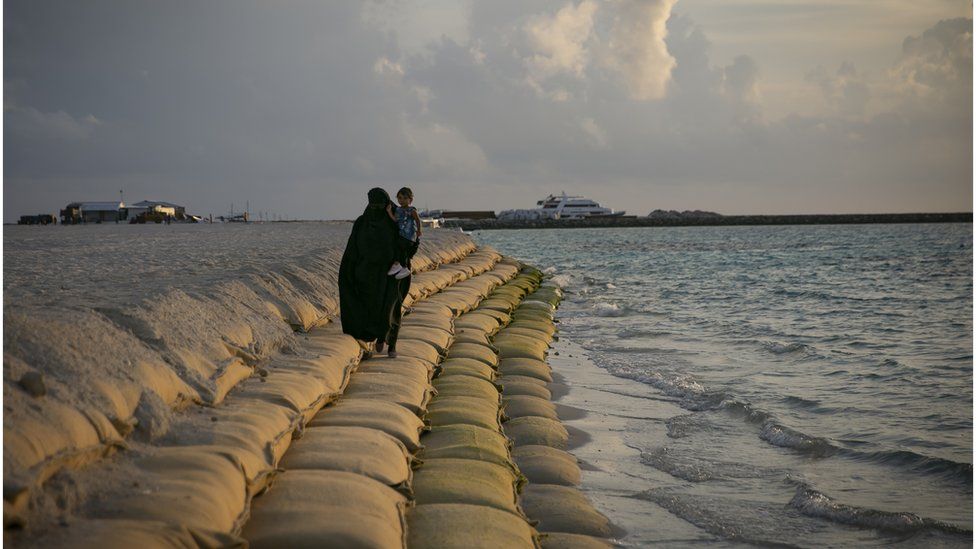
Poorer nations want more money because they did little to cause climate change but face its worst effects.
They also struggle to afford expensive projects like renewable energy.
Climate finance, including funding for flood defences or solar plants, has long been one of the biggest sticking points in climate negotiations.
But Ms Mottley has built a global coalition to support her demand that the international financial system be fundamentally reformed.
"We are all in this together", Ms Mottley told BBC News in Paris. "If we don't realise that, we will not act with the urgency that's necessary to save the planet and save lives."
The Barbadian prime minister is joint host of the Paris conference with President Emmanuel Macron of France.
Dozens of world leaders are attending the Summit for a New Global Financing Pact, including the German Chancellor, the president of Brazil and the new president of the World Bank as well as the prime minister of China and the US Treasury Secretary.
The UK is sending its minister for development, Andrew Mitchell.
Ms Mottley is determined the meeting deliver results.
She describes the threat of climate change as "a death sentence" on the world. "If it is a death sentence, then we need to move with urgency," she explains.
Insiders at the summit are expecting an announcement that a target for $100bn worth of a kind of international currency called Special Drawing Rights (SDRs) has been met.
These assets will be transferred to low-income countries to be used for climate programmes.
But Ms Mottley has an even bigger prize in her sights, a plan dubbed the "Bridgetown Agenda" after the Barbadian capital.
It wants to generate more finance for the countries that need it most through a wholesale modernisation of the international monetary system.
The current institutions - including the World Bank and the International Monetary Fund (IMF) - were set up by the victorious nations towards the end of the Second World War at a conference in a ski resort called Bretton Woods in New Hampshire, US
The so-called "Bretton Woods system" will celebrate its 80th anniversary next year.
Ms Mottley says she wants to make it fit for the challenges of the modern world by moving the focus away from richer nations and towards delivering outcomes that benefit the entire world, like helping developing countries tackle climate change.
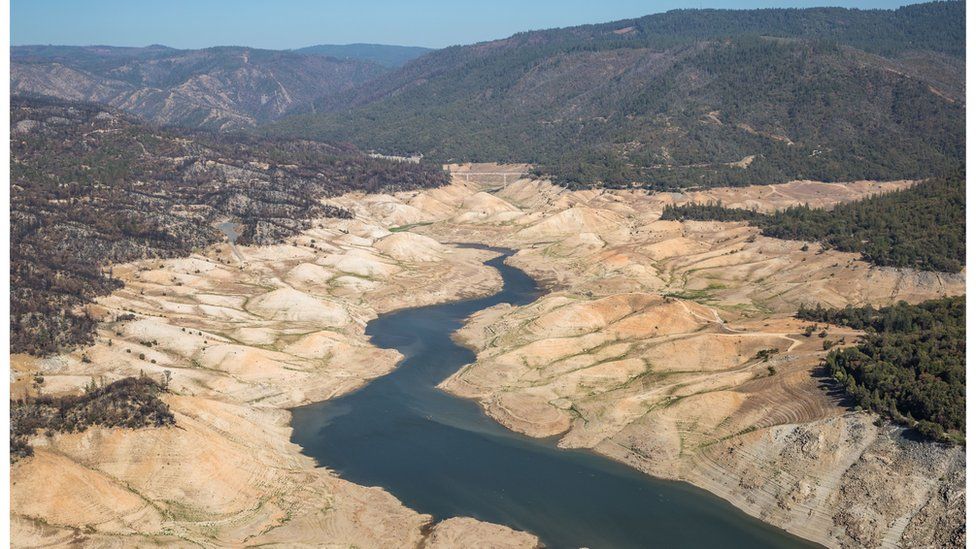
"The reason why these institutions exist is that they were created to help the world in the reconstruction effort after World War Two. We are in a moment that is equal to World War Two with respect to climate," she said.
This week the International Energy Agency warned annual investments in clean energy in developing nations will need to triple from $770bn in 2022 to as much as $2.8tn by the early 2030s if the world is to avoid the worst impacts of climate change.
One proposal is that institutions like the World Bank offer cheaper loans for climate action projects.
It is much more expensive to build flood defences in Barbados or Angola than it is in the Netherlands or the UK, Ms Mottley points out.
The same goes for erecting wind turbines or installing solar farms.
That is because low-income countries are charged high interest rates - often two or even three times the rates developed nations face.
Yet the risks of individual projects don't vary anywhere near as much as that.
Another suggestion is that institutions like the World Bank should agree to guarantee loans for climate action in developing nations. That would encourage the private sector to lend at lower interest rates.
Experts say these initiatives could generate hundreds of billions of dollars' worth of loans for climate projects in low-income countries.
Another proposal involves the creation of an auction in which developing nations would bid for cheap finance for climate projects.
This "Climate Mitigation Trust Fund" would be funded by tens of billions of dollars' worth of SDRs and overseen by the IMF and the UN.
The winners would be the projects that reduce global warming fastest.
It is not expected that a final decision will be made on these proposals, but Ms Mottley is confident that progress will be made.
We tell our children we shouldn't put off to tomorrow what we need to do today, Ms Mottley says.
"I find myself actually repeating a lot of things that we would say to children, in order to inform global behaviour today," she continues. "That tells us a lot."
Latest Stories
-
‘At the age of 12, I was teaching people and collecting money from them’ – Forty Under 40 Awards
32 minutes -
I broke my virginity at the age of 26 after university – Richard Abbey Jnr.
2 hours -
Sacked for fees, saved by faith: The untold story of Forty Under 40 Awards founder Richard Abbey Jnr
2 hours -
GCB Bank surges GH¢0.45, ETI gains GH¢0.06 as GSE ends week higher
3 hours -
Two teens jailed 55 years for robbery
3 hours -
UDS demands apology for MPhil student wrongly branded as Tamale robber
4 hours -
“We don’t sell fish!” – Tema Shipyard CEO hits back over dead fish discovery
4 hours -
Sam George defends anti-LGBTQ+ Bill as ‘national priority’ amid debate over gov’t focus
5 hours -
Artemis II astronauts safely back on Earth after trip around moon
5 hours -
Sam George unveils massive 1,150-cell site rollout to end network woes
5 hours -
This Saturday on Prime Insight: Fuel levy suspension, LGBTQ+ legislation, and Damang Mine controversy
6 hours -
Struggling Real suffer title blow with Girona draw
6 hours -
Mahama nominates Pamela Graham as Auditor-General
7 hours -
The five big sticking points in US-Iran talks
8 hours -
Melania Trump’s speech propels Epstein crisis back to forefront
8 hours