

Audio By Carbonatix
Remnants from a Chinese rocket are expected to fall back to Earth in an uncontrolled re-entry this weekend.
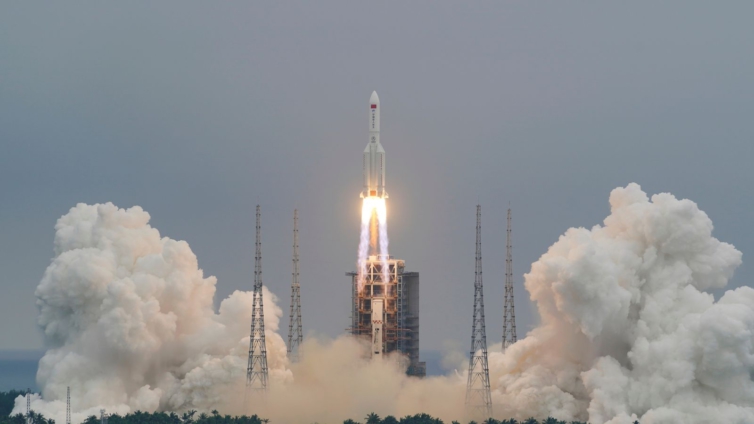
The rocket, called Long March 5B, was launched from Wenchang Space Launch Centre on 29 April to carry Tianhe - the first module of China's future space station - into orbit.
The spacecraft contains what will become living quarters for three crew on the space station and was the first of 11 missions needed to complete the station.

The body of the rocket is circling Earth and is about to enter the lower atmosphere.
Its exact point of descent "cannot be pinpointed until within hours of its re-entry", which is projected to occur on Saturday.
The US said on Thursday it was tracking the path of the object from the Vandenberg Air Force Base in California but that there were no plans to shoot it down.
"We're hopeful that it will land in a place where it won't harm anyone," US Defence Secretary Lloyd Austin said.
"Hopefully, in the ocean or someplace like that."
Mr Austin also indirectly criticised China, he said: "There should be a requirement to operate in a safe and thoughtful mode and make sure that we take those kinds of things into consideration as we plan and conduct operations."
Harvard-based astrophysicist Jonathan McDowell said potentially dangerous debris will likely escape incineration after streaking through the atmosphere at hypersonic speed but in all likelihood would fall into the sea.
Mr McDowell did add that there was a chance that pieces could fall over land, like in May 2020, when pieces from another Chinese rocket came down over the Ivory Coast, damaging several buildings but leaving no one injured.
Mr McDowell also said most countries design spacecraft in such a way as to avoid large, uncontrolled re-entries.
"It makes the Chinese rocket designers look lazy that they didn't address this," he said, calling the failure to do so "negligent."
Based on its current orbit, the debris trail is likely to fall somewhere as far north as New York, Madrid or Beijing and as far south as southern Chile and New Zealand, Mr McDowell said.
Chinese state media have played down fears that the rocket could cause damage as a situation "not worth panicking about" and suggested it will fall somewhere in international waters.
The rocket launch is part of China's increasingly ambitious space programme, with Beijing planning at least 10 similar launches to carry equipment into orbit.
The space station will be complete by 2022, with China also planning to build a moon base in cooperation with Russia.
China is a late entrant in space exploration, only sending its first astronaut into space in 2003.
Latest Stories
-
OmniBSIC Bank delivers 104% profit growth, assets and deposits double in 2025
3 minutes -
Ghana month donation drive ends on high note as NPA donates GH₵1m to GMTF
4 minutes -
Prudential Africa CEO working visit to Ghana sets pace for business excellence and agency expansion
4 minutes -
Salman residents call for halt to illegal mining activities
6 minutes -
Goaso Municipal Hospital decries NHIS arrears, staff and equipment shortages
15 minutes -
Two dead, one critically injured in domestic fire at Kodjonya
20 minutes -
No start date yet for Ghana–Dangote fuel deal — Gov’t
26 minutes -
GWL attributes Kokomlemle water crises to rationing, localised faults after JoyNews report
30 minutes -
Open letter to Ibrahim Mahama
49 minutes -
More UK troops to be sent to Middle East, defence secretary announces
57 minutes -
GMet warns of incoming rainstorm, flood risk across parts of Ghana
1 hour -
Mahama, NDC have abandoned anti-LGBTQ Bill after weaponising it to win power – Ntim Fordjour
1 hour -
Police arrest suspect over murder at Soronko Farms
2 hours -
The attack on Ghanaian traders in Burkina Faso and the blame game: Why Hybrid Security Governance holds the key (I)
2 hours -
TaxForGalamey: Stop taxing galamsey immediately or face sanctions – Gov’t cautions MMDCEs
2 hours