

Audio By Carbonatix
Xiao Chen turned up at the US Consulate in Shanghai on Thursday morning, hours after Washington announced that it would "aggressively" revoke the visas of Chinese students.
The 22-year-old had a visa appointment: she was headed to Michigan in the autumn to study communications.
After a "pleasant" conversation, she was told her application had been rejected. She was not given a reason.
"I feel like a drifting duckweed tossed in wind and storm," she said, using a common Chinese expression used to describe feeling both uncertain and helpless.
She had been hopeful because she already had the acceptance letter. And she thought she had narrowly escaped the bombshells in recent days.
First, Donald Trump's administration moved to end Harvard University's ability to enrol international students, a move that has since been blocked in court. And then it said it had stopped visa appointments for all foreign students.
But now, Chen is ready for plan B. "If I can't get the visa eventually, I'll probably take a gap year. Then I'll wait to see if things will get better next year."
A valid visa may still not be enough, she adds, because students with visas could be "stopped at the airport and deported".
"It's bad for every Chinese student. The only difference is how bad."
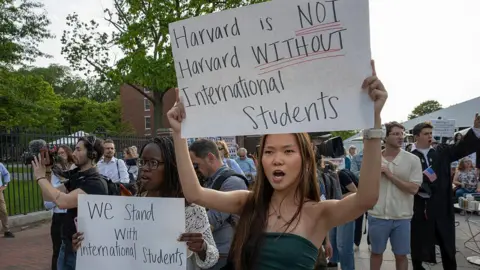
It has been a bleak week for international students in the US - and perhaps even harder for the 280,000 or so Chinese students who would have noticed that their country has been singled out.
Homeland Security Secretary Kristi Noem accused Harvard of "coordinating with the Chinese Communist Party".
Secretary of State Marco Rubio said that the move against Chinese students in the US would include "those with connections to the Chinese Communist Party or studying in critical fields".
That could hit a wide swathe of them, given membership of the Communist Party is common among officials, entrepreneurs, business people and even artists and celebrities in China.
Beijing has called it a "politically motivated and discriminatory action", and its foreign ministry has lodged a formal protest.
There was a time when China sent the highest number of foreign students to American campuses. But those numbers slipped as the relationship between the two countries soured.
A more powerful and increasingly assertive Beijing is now clashing with Washington for supremacy in just about everything, from trade to tech.
Trump's first term had already spelled trouble for Chinese students. He signed an order in 2020 barring Chinese students and researchers with ties to Beijing's military from obtaining US visas.
That order remained in place during President Joe Biden's term. Washington never clarified what constitutes "ties" to the military, so many students had their visas revoked or were turned away at US borders, sometimes without a proper explanation.
One of them, who did not wish to be named, said his visa was cancelled by Customs and Border Protection (CBP) when he landed in Boston in August 2023.
He had been accepted into a post-doctoral program at Harvard University. He was going to study regenerative medicine with a focus on breast cancer and had done his master's degree from a military-affiliated research institution in China.
He said he was not a member of the Communist Party and his research had nothing to do with the military.
"They asked me what the relationship was between my research and China's defence affairs," he told the BBC then. "I said, how could breast cancer have anything to do with national defence? If you know, please tell me."
He believes he never stood a chance because the officials had already made up their minds. He recalled one of them asking: "Did Xi Jinping buy your suitcase for you?"
What was surprising, or even shocking then, slowly turned normal as more and more Chinese students struggled to secure visas or admissions to study science and technology in US universities.
Mr Cao, a psychology major whose research involves neuroscience, has spent the past school year applying for PhD programs in the US.
He had graduated from top-tier universities - credentials that could send him to an Ivy League school. But of the more than 10 universities he applied to, only one extended an offer.
Trump's cuts to biomedical research didn't help, but the mistrust surrounding Chinese researchers was also a factor. Allegations and rumours of espionage, especially in sensitive subjects, have loomed over Chinese nationals at US universities in recent years, even derailing some careers.
"One of the professors even told me, 'We rarely give offers to Chinese students these days, so I cannot give you an interview," Mr Cao told the BBC in February.
"I feel like I am just a grain of sand under the wheel of time. There is nothing I can do."
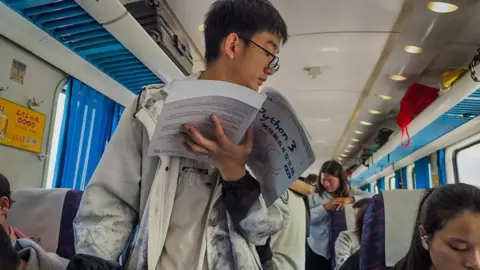
For those who did graduate from US colleges, returning home to China has not been easy either.
They used to be lauded as a bridge to the rest of the world. Now, they find that their once-coveted degrees don't draw the same reaction.
Chen Jian, who did not want to use his real name, said he quickly realised that his undergraduate degree from a US college had become an obstacle.
When he first came back in 2020, he interned at a state-owned bank and asked a supervisor if there was a chance to stay on.
The supervisor didn't say it outright, but Chen got the message: "Employees should have local degrees. People like me (with overseas degrees) won't even get a response."
He later realised that "there really weren't any colleagues with overseas undergraduate background in the department".
He returned to the US and earned his master's degree at Johns Hopkins University, and now works at the Chinese tech giant Baidu.
However, despite holding a degree from a prestigious American university, Mr Chen does not feel he has an edge due to the stiff competition from Chinese graduates.
What also has not helped is the suspicion around foreign graduates. Beijing has ramped up warnings of foreign spies, telling civilians to be on the lookout for suspicious figures.
In April, prominent Chinese businesswoman Dong Mingzhu told shareholders in a closed-door meeting that her company, home appliance maker Gree Electric, will "never" recruit Chinese people educated overseas "because among them are spies".
"I don't know who is and who isn't," Ms Dong said, in comments that were leaked and went viral online.
Days later, the CIA released promotional videos encouraging Chinese officials dissatisfied with the government to become spies and provide classified information. "Your destiny is in your own hands," the video said.
The suspicion of foreigners as the US and China pull further away from each other is a surprising turn for many Chinese people who remember growing up in a very different country.
Zhang Ni, who also did not want to use her real name, says she was "very shocked" by Ms Dong's remarks.
The 24-year-old is a recent journalism graduate from Columbia University in New York. She says she "doesn't care about working at Gree", but what surprised her was the shift in attitudes.
That so many Chinese companies "don't like anything that might be associated with the international" is a huge contrast from what Ms Zhang grew up with - a childhood "filled with [conversations centred on] the Olympics and World Expo".
"Whenever we saw foreigners, my mom would push me to go talk to them to practice my English," she says.
That willingness to exchange ideas and learn from the outside world appears to be waning in China, according to many.
And America, once a place that drew so many young Chinese people, is no longer that welcoming.
Looking back, Ms Zhang can't help but recall a joke her friend made at a farewell dinner before she left for the US.
Then, a flippant comment, it now sums up the fear in both Washington and Beijing: "Don't become a spy."
Latest Stories
-
GoldBod commits GH¢35m to reclaim galamsey-damaged Tano Nimri Forest Reserve
5 minutes -
Afenyo-Markin reflects on loneliness of public service, says survival is largely spiritual
12 minutes -
Achimota Court designated to handle petroleum diversion cases – NPA CEO
20 minutes -
Bekwai court jails mine worker 14 years for defiling 8-year-old girl
25 minutes -
CHASS conference calls for collective action to tackle indiscipline in schools
29 minutes -
Oil edges down as investors weigh possible US sanctions on ‘shadow fleet’
42 minutes -
Netflix names former Disney executive Peter Rice as new content chief as Bajaria departs
52 minutes -
India’s ‘cockroach’ protesters set to return despite police crackdown
60 minutes -
Porn showing choking or incest to be banned from early November, government says
1 hour -
Russell Brand accuser says he turned ‘monster-like’ before alleged rape
1 hour -
US police identify remains of man found in barrel in shrinking reservoir
1 hour -
My uncle told me I will never make it in music – Lojay
2 hours -
Martinez apologises for outburst and fined by Man Utd
2 hours -
Infantino apologises to FIFA Council – but told he is still not fit to lead
2 hours -
Southgate does not see return to Premier League management
2 hours