

Audio By Carbonatix
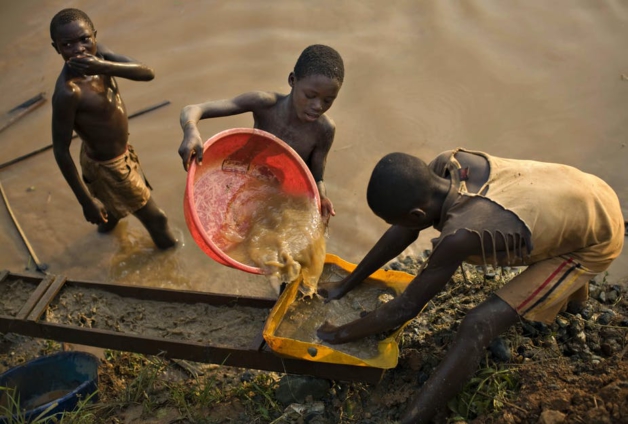
As the world marks the World Day Against Child Labour, the Ghana Statistical Service (GSS) has unveiled concerning statistics showing that close to 900,000 children aged 5 to 17 years are engaged in paid employment across the country.
In a statement issued to commemorate the day, the GSS highlighted that male children dominate the child labour force, comprising 56% of the working children. Disturbingly, nearly half a million (458,443) of these children are not attending school, including 68,500 who have never attended school and 389,943 who attended school in the past.
“The 2023 Annual Household Income and Expenditure Survey indicates that over 1.1 million children 5 to 17 years were involved in different forms of work in the fourth quarter of 2023, which represents one in every 10 (10.3%) children in this age range. Among these children, about 893,000 are involved in employment work, which is mostly paid work,” portions of the statement reads.
The report underscores a stark urban-rural divide, with 72% of working children residing in rural areas, compared to 28% in urban areas.
It added that "regionally, Ashanti leads with the highest percentage of working children at 13.6%, followed by Bono East (12.1%) and Northern Region (11.8%). Conversely, Ahafo (0.8%), Greater Accra (1.6%), and Western North (1.8%) have the lowest percentages of working children."
Breaking down the types of work, the GSS found that 35.4% of children are engaged in family help, 31.2% in farm work, 11.7% as unpaid trainees, and 7.3% in own-use production. Additionally, 6.2% of children are involved in non-farm work, 5.3% in wage work, and 2.9% in domestic, non-productive agriculture, voluntary work, or apprentice work.
Elementary occupations dominate the landscape for working children, accounting for 60.4%, followed by craft and trade-related work (19.8%) and skilled agricultural, forestry, and fish-related work (17.7%). Service and sales workers make up 1.7%, while plant and machine operators and assemblers represent 0.2%, and managers constitute 0.1%.
The services sector employs the majority (91.7%) of working children, with agriculture and industry accounting for 4.8% and 3.6%, respectively.
Latest Stories
-
Professor Agyeman-Duah labels CJ Torkonoo’s removal a key low point in Mahama’s administration
1 minute -
CDM calls on President Mahama to act over ‘alarming’ GoldBod trading losses
9 minutes -
CDM rejects claims that BoG losses were due to Gold Purchase Programme
12 minutes -
Ghanaians experiencing tangible relief under Mahama administration – Professor Baffour Agyeman-Duah
14 minutes -
Livestream: 2025 Year in Review on The Pulse
42 minutes -
Ho Central Mosque closed for 2 weeks amid leadership dispute
57 minutes -
31st December: Remembering the Spirit of Probity, Accountability, and the Renewed Call for Justice
58 minutes -
Mali and Burkina Faso impose travel ban on US citizens in tit-for-tat move
1 hour -
CDM accuses GoldBod CEO of contradictions over Gold-for-Reserves losses
1 hour -
Cyborg fined GH¢24k for discharging firearm during Asake meet-up
1 hour -
Guinea junta chief wins presidential election by landslide
1 hour -
Machu Picchu train crash leaves one dead and dozens injured
2 hours -
Heavy police presence in Sydney for New Year’s celebrations after Bondi attack
2 hours -
Ghana not experiencing ‘dumsor’ despite occasional outages – Analyst
2 hours -
ESLA stabilised energy sector but legacy debt remains major challenge – Analyst
2 hours